Learn about evaporators, essential devices used in industrial processes and HVAC systems to efficiently remove moisture by exploiting the physics of boiling points and pressure.
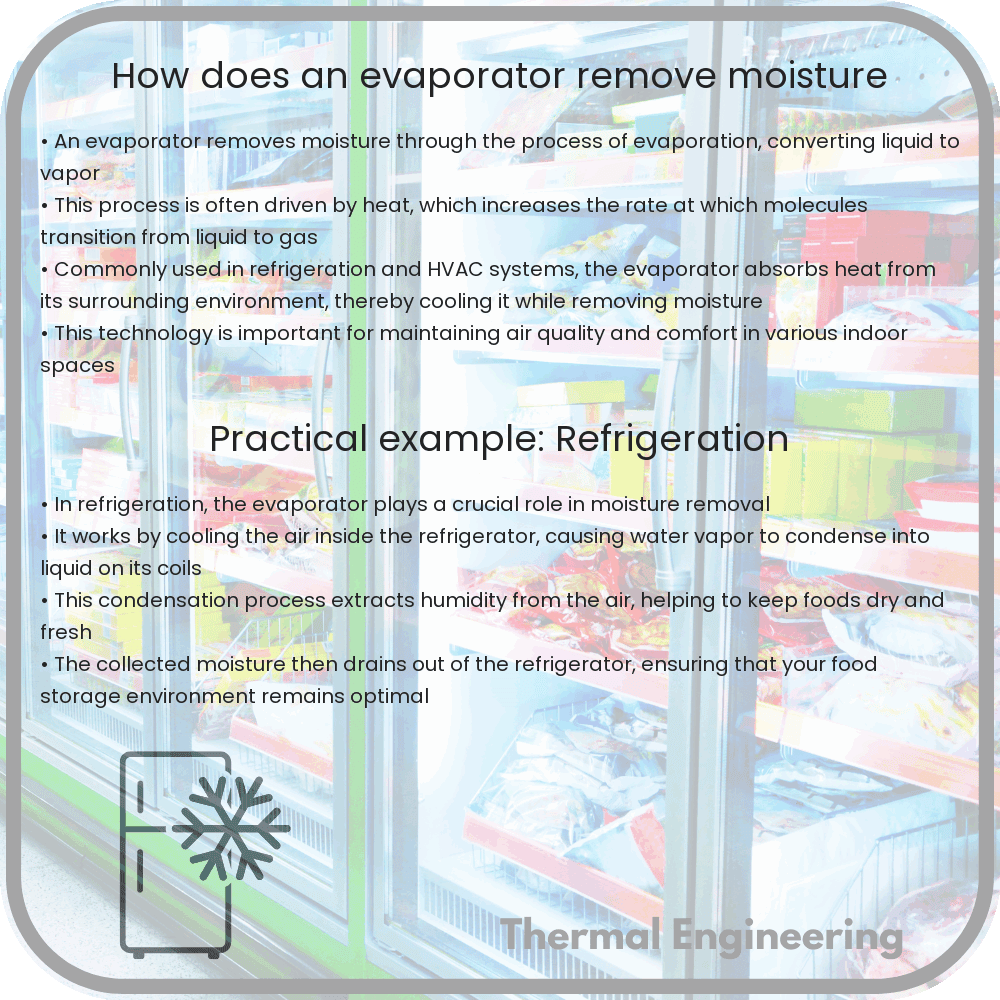
Understanding How an Evaporator Removes Moisture
An evaporator is an essential component in various industrial processes and HVAC (Heating, Ventilation, and Air Conditioning) applications, primarily used to extract moisture from a fluid mixture or air. This device operates on fundamental principles of thermodynamics and mass transfer, providing efficient results in moisture removal, which is crucial for many system operations such as refrigeration, air conditioning, and food processing.
Basic Principle
The primary function of an evaporator is to exploit the physical properties of the liquid’s boiling point and the surrounding air’s partial pressure to remove moisture. By changing the pressure or temperature within the system, the evaporator can convert the liquid component of a solution or air into its gaseous form, leaving behind less volatile components, primarily solids or denser liquids.
Types of Evaporators
- Dry Expansion Evaporator: Used in refrigeration, where the refrigerant absorbs heat upon vaporization.
- Flooded Evaporator: Immerses cooling coils in the liquid to be chilled, enhancing heat transfer efficiency.
- Falling Film Evaporator: Distributes the liquid to be evaporated over a vertical, heated tube bundle with gravity pulling the film down while it evaporates.
- Forced Circulation Evaporator: Employs a pump to circulate the liquid continuously, generally used for viscous liquids or those with suspended solids.
Evaporation Process
In the typical operation of an evaporator, the process begins with the feeding of the solution or moist air into the evaporator. If the application involves the removal of moisture from air, as in HVAC systems, the air passes over a set of coils containing a refrigerant at low pressure. This causes the refrigerant to absorb heat from the air, reducing its temperature below the dew point, thereby condensing water vapor into liquid droplets that are collected and removed.
For liquid mixtures, the process involves heating the mixture until the volatile solvents or water begin to vaporize. This can be induced by direct heating or reducing the pressure within the evaporator (using a vacuum), which lowers the boiling temperature of the liquid.
Mathematical Understanding
The efficiency and design of an evaporator can be understood more accurately through mathematical analysis, primarily using the heat transfer and mass transfer principles. The fundamental equation governing the evaporation process in terms of heat transfer is represented as:
Q = mlv * Hfg
- Q represents the heat input required for the evaporation process.
- mlv is the mass flow rate of the liquid vaporized.
- Hfg is the latent heat of vaporization of the fluid.
This equation helps predict the amount of energy required to vaporize a specific mass of liquid and can be critical for designing energy-efficient evaporators.
Applications
Evaporators play a critical role in numerous fields:
- In air conditioning systems, they extract humidity from the air, providing comfort and preventing mold growth.
- In food processing, such as in the production of concentrated fruit juices, evaporators remove excess water.
- In chemical processing, they are used to concentrate solutions, reducing the solvent volume and increasing product purity.
- In waste water treatment, evaporators can remove water from waste streams, reducing the volume of waste and recovering water for reuse.
In conclusion, evaporators are versatile units that leverage fundamental engineering principles to remove moisture. By understanding and applying these principles, engineers can design systems that are both effective and efficient, across various industries.