Learn about oil refineries and their crucial role in transforming crude oil into gasoline, diesel, and other petroleum products.
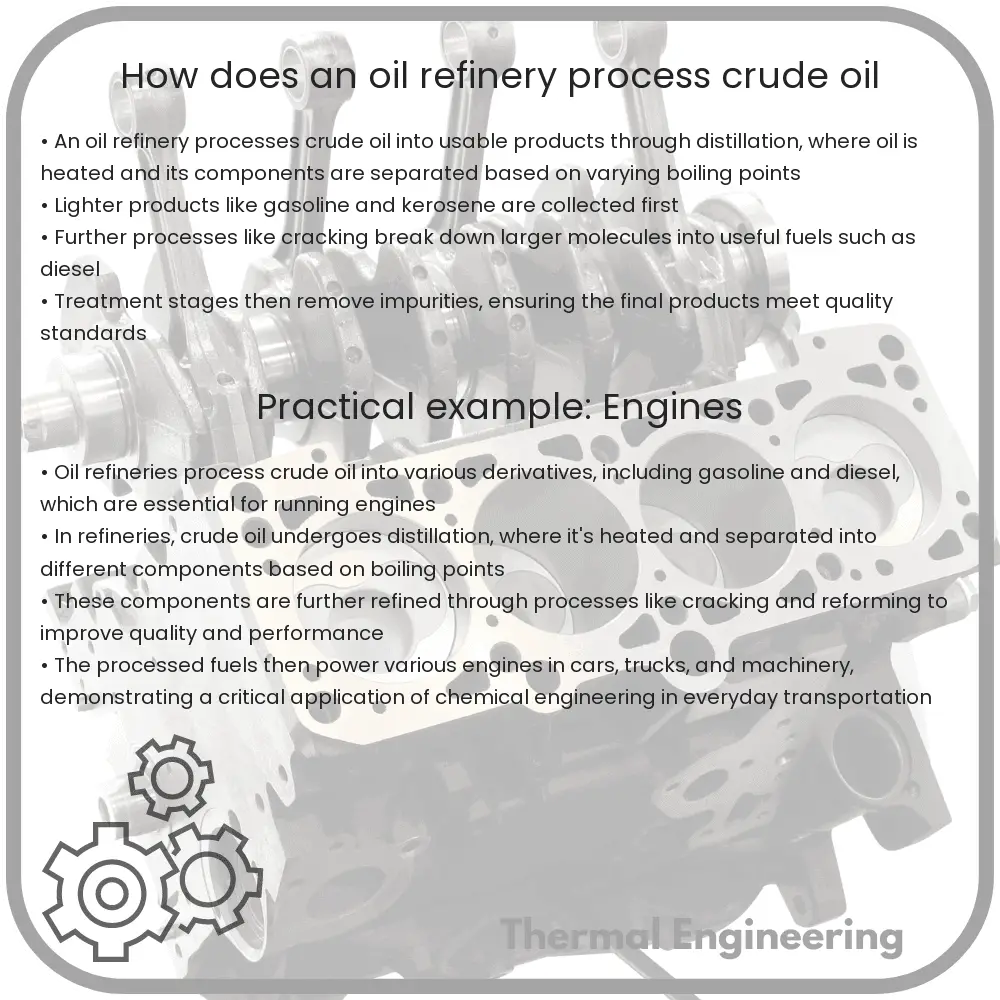
Understanding the Process of an Oil Refinery
Oil refineries are complex engineering facilities that are crucial to the production of gasoline, diesel fuel, and other petroleum products from crude oil. Crude oil itself is a mixture of hydrocarbons, and the goal of an oil refinery is to separate this mixture into its useful components and remove unwanted impurities.
Key Processes in an Oil Refinery
Refining crude oil involves several key processes:
- Distillation: This is the first and most fundamental process in an oil refinery. Crude oil is heated in a large furnace to temperatures where different hydrocarbon compounds boil off and can be separated based on their boiling points. The resulting vapors ascend a distillation column, where they cool and condense back into liquids at different levels, effectively separating the crude oil into various ‘fractions’ or types of fuel.
- Conversion Processes: These processes alter the chemical structures of the fractions. Techniques such as ‘cracking’ break larger molecules into smaller ones, while ‘reforming’ rearranges molecular structures. Cracking can be thermal (using heat) or catalytic (using a catalyst).
- Treatment: This involves removing impurities such as sulfur, nitrogen, and metals that can affect the quality of the final products. Processes include hydrotreating, which uses hydrogen to clean up the refinery products.
- Blending: The final step in the refinery process involves blending different refined products to achieve specific properties and standards required for commercial fuels and other products.
Distillation Process
At the heart of an oil refinery is the distillation unit, often called the crude unit. It operates on the principle of fractional distillation. A typical column might consist of several trays or plates, each collecting different hydrocarbon fractions as they condense at different temperatures:
- Light distillates such as LPG (liquefied petroleum gas), gasoline, and naphtha condense at the top where the temperature is the lowest.
- Medium distillates including kerosene and diesel collect in the middle sections of the column.
- Heavy distillates and residues such as fuel oil and bitumen settle at the bottom of the column due to their high boiling points.
Conversion and Treatment
Conversion processes are critical for producing more valuable and in-demand products like gasoline. Catalytic cracking, for example, uses a catalyst to aid in breaking long-chain hydrocarbons into shorter, more valuable chains. Catalytic reforming, on the other hand, uses a catalyst to rearrange or combine molecules to improve the quality of the fuel.
Treatment processes are critical to meet environmental regulations and fuel standards, ensuring that products are safe for consumption and use. Hydrotreating is a prominent treatment process where hydrogen gas is bubbled through the petroleum product to remove contaminants like sulfur, converting them into hydrogen sulfide which can then be removed.
Blending and Storage
The final products of the refinery processes often require precise blending to meet specific standards. For instance, different additives might be blended into gasoline to inhibit corrosion, improve combustion, and reduce emissions. Once blended, the final products are stored in large tanks and eventually transported to consumers.
Oil refining is a dynamic and essential field in engineering. It combines complex chemical engineering processes with real-world economics and environmental considerations, showcasing the vital role of engineers in transforming natural resources into valuable commodities.