Explore how heat impacts the physical properties of nanomaterials, including thermal expansion, melting points, and conductivity.
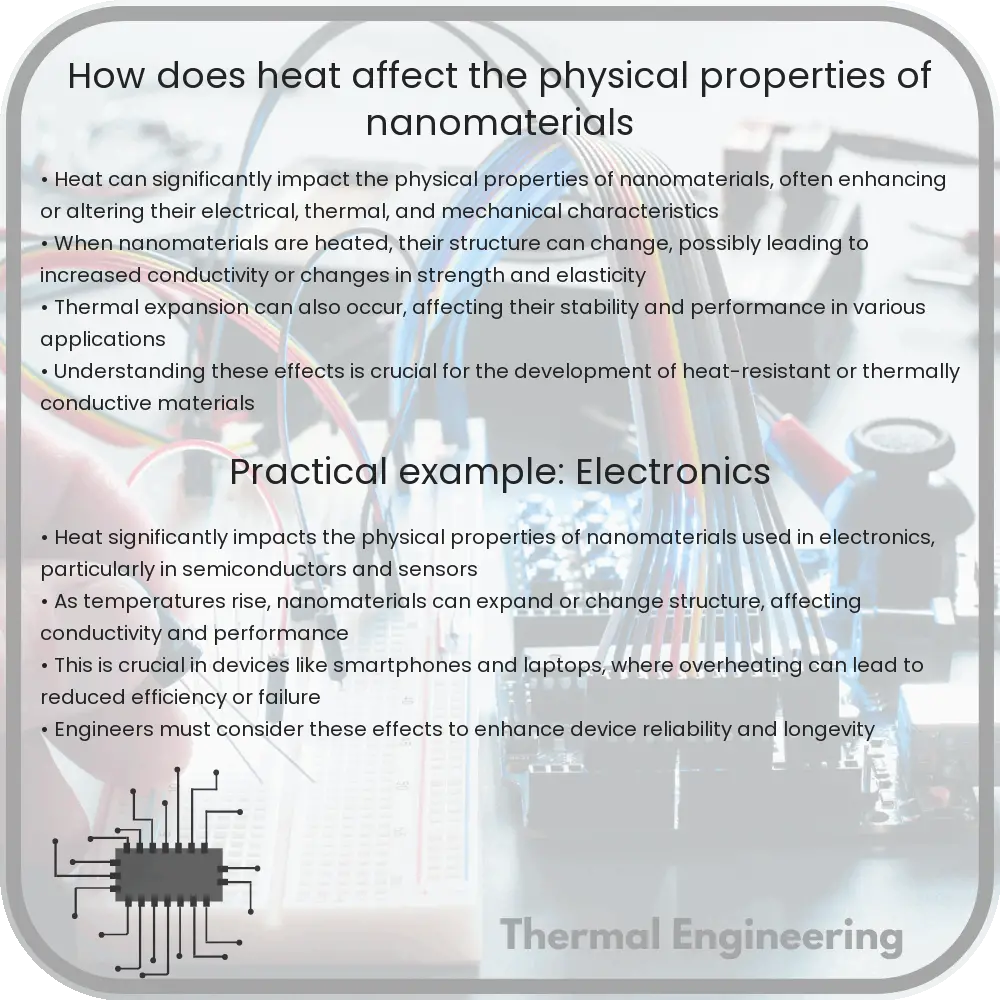
How Does Heat Affect the Physical Properties of Nanomaterials?
The behavior of materials at the nanoscale can significantly differ from that of their bulk counterparts, primarily because of their size and the increased importance of surface atoms relative to those in the interior. As heat is introduced, nanomaterials exhibit unique changes in their physical properties, ranging from structural stability to electrical conductivity. Here, we explore some of the principal effects of heat on these properties.
Thermal Expansion
Thermal expansion refers to the tendency of a material to change in volume in response to a change in temperature. When materials are heated, their particles move more and usually maintain a greater average separation. Nanomaterials, especially those with confined dimensions like nanoparticles or nanowires, can exhibit significantly different thermal expansion behaviors compared to bulk materials due to surface stress and the constrained structure. For instance, the coefficient of thermal expansion may be lower in nanomaterials because the surface atoms impose a constraint that is less significant in larger bulk materials.
Melting Point Depression
Heat affects the melting point of nanomaterials significantly. Typically, nanoparticles have a lower melting point than their bulk counterparts. This phenomenon, known as melting point depression, occurs because the atoms at the surface of nanomaterials, which are more numerous relative to the total number of atoms than in bulk materials, have lower coordination numbers and thus weaker overall interatomic forces. This reduction in the melting point is crucial for processes like nanoparticle sintering and is given by the Gibbs-Thomson equation:
Tm(d) = Tm,bulk – (2 * γ * ΔHf) / (R * d)
- Tm(d) is the melting temperature of the nanoparticle.
- Tm,bulk is the bulk melting temperature.
- γ is the surface energy.
- ΔHf is the heat of fusion per unit volume.
- R is the gas constant.
- d is the diameter of the nanoparticle.
Thermal Conductivity
Nanomaterials often exhibit altered thermal conductivity when subjected to high temperatures. For example, the thermal conductivity of nanoscale materials can either increase or decrease, depending on the structure and composition of the material. Factors such as increased surface scattering of phonons and the presence of defects or grain boundaries can significantly influence how effectively heat is transported through the material. This property is particularly interesting for engineering applications such as in thermal management systems or heat sinks in electronic devices.
Electrical and Magnetic Properties
Heat can also alter the electrical and magnetic properties of nanomaterials. For instance, the increase in temperature generally increases the resistance in metallic nanowires due to enhanced phonon scattering. Similarly, heat can influence the magnetic properties of nanomaterials, such as reducing the saturation magnetization or altering the magnetic anisotropy, which are critical factors in applications like magnetic storage devices or sensors.
Conclusion
Understanding how heat affects the physical properties of nanomaterials is crucial for their practical applications in technology and industry. These variations can be utilized to tailor materials for specific applications or to improve the efficiency of existing technologies. As research continues to reveal more about these phenomena, the potential for innovative applications of nanomaterials expands, promising new solutions to longstanding challenges in material science and engineering.