Learn about thermal energy harvesting, a technology that converts waste heat into electrical power, enhancing energy efficiency and reducing environmental impact.
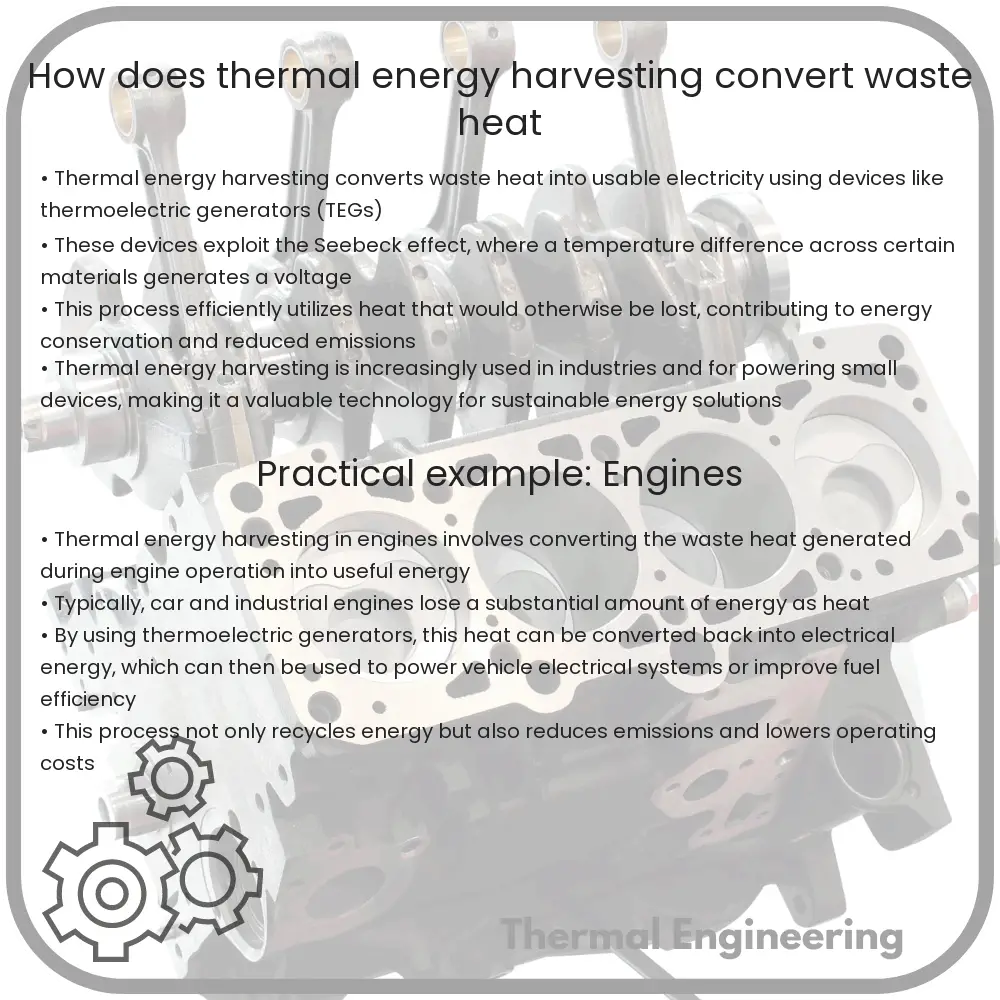
Understanding Thermal Energy Harvesting
Thermal energy harvesting is a transformative technology that provides a route to convert waste heat generated in various processes into useful electrical power. This approach not only contributes to improving energy efficiency but also helps in reducing the overall environmental impact of energy usage.
How Does Thermal Energy Harvesting Work?
At its core, thermal energy harvesting operates on the principle of capturing and converting the surplus heat that would otherwise dissipate unused into the environment. This conversion process typically exploits the “thermoelectric effect,” which constitutes several phenomena including the Seebeck effect, Peltier effect, and Thomson effect. However, for the purpose of energy harvesting, the Seebeck effect is most pertinent.
The Seebeck effect occurs when a temperature difference is established between two dissimilar electrical conductors or semiconductors. This temperature difference generates a voltage difference between these two materials, which can then be used to drive an electrical current through an external circuit. The process can be summarized by the equation:
V = S * ΔT
- V refers to the voltage generated.
- S is the Seebeck coefficient, which varies depending on the materials used.
- ΔT is the temperature difference between the hot and cold ends of the thermoelectric materials.
Key Components of a Thermoelectric Generator
A typical thermoelectric generator (TEG), which is a device designed for thermal energy harvesting, includes several key components:
- Thermoelectric Materials: These are typically made from bismuth telluride (Bi2Te3) or other semiconductor materials that exhibit strong thermoelectric properties.
- Heat Source: Provides the necessary temperature gradient required for the Seebeck effect to occur. This could be any waste heat source from industrial processes, automotive exhausts, or natural heat sources.
- Heat Sink: Maintains the colder side of the thermoelectric materials, essential for maintaining the temperature gradient.
- Electrical Load: The device or resistor where the generated electrical power is utilized or further processed.
Applications of Thermal Energy Harvesting
Thermal energy harvesting finds applications across a wide range of industries. Some notable examples include:
- Automotive: Harvesting exhaust heat to generate additional power for vehicle systems.
- Industrial: Recovering heat from furnaces, boilers, and other industrial machinery to improve overall energy efficiency.
- Consumer Electronics: Using body heat to power wearable devices, reducing dependency on batteries.
- Aerospace: Managing and reusing heat within spacecraft systems to enhance energy efficiency in extreme environments.
Challenges and Future Prospects
While thermal energy harvesting presents a promising avenue for managing waste heat and improving energy sustainability, there are challenges. These primarily revolve around the efficiency of thermoelectric materials and the cost-effectiveness of deploying such systems at a large scale. Ongoing research focuses on developing materials with higher Seebeck coefficients, better thermal conductivity, and overall greater efficiency at converting heat to electricity.
In conclusion, thermal energy harvesting stands as a critical component in the drive towards more sustainable energy practices. With advancements in materials science and thermoelectric technology, its role is set to expand significantly in the coming years, offering a greener alternative by converting waste heat into a valuable energy resource.