Learn how thermal expansion affects engine components and the engineering solutions used to mitigate its impact for reliable performance.
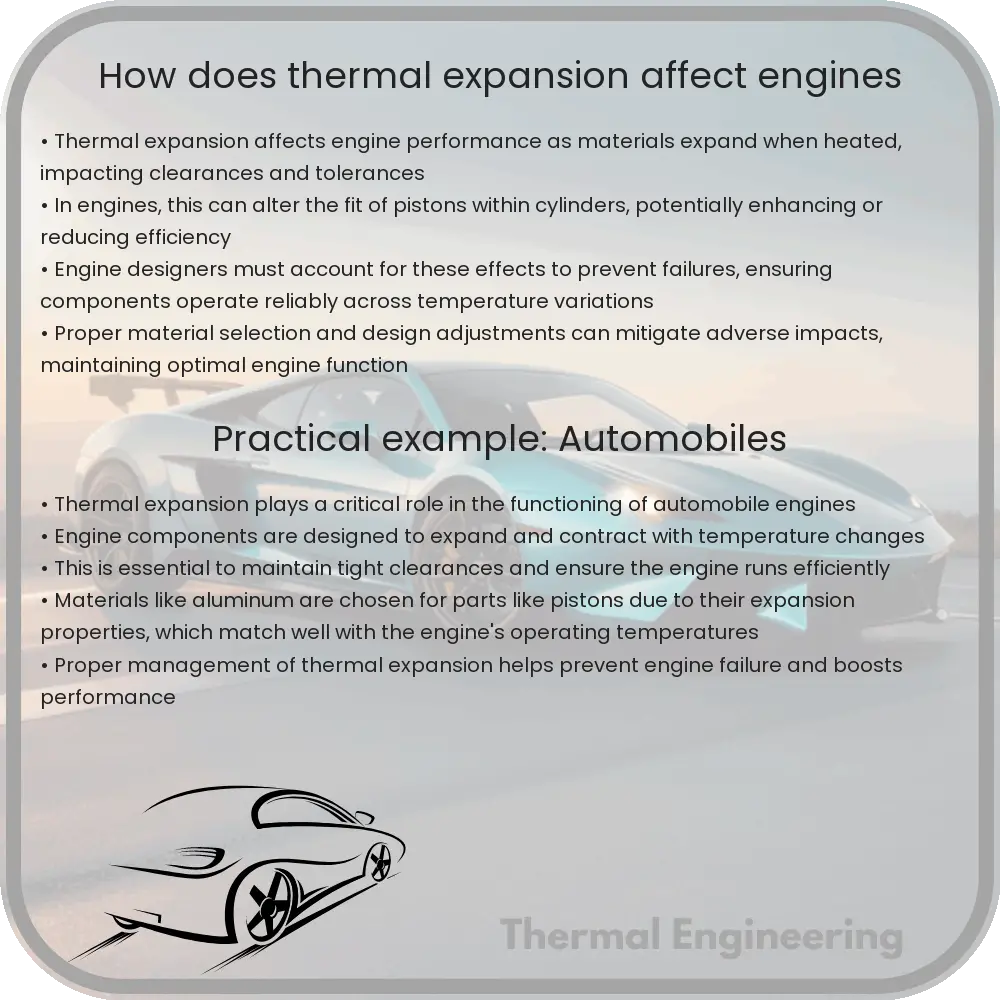
Understanding Thermal Expansion in Engines
Thermal expansion is the tendency of matter to change in shape, area, and volume in response to a change in temperature. This physical principle has significant implications for various mechanical systems, including engines. Engines, whether they are in cars, airplanes, or industrial machines, generate a lot of heat through combustion and friction processes. As such, understanding how thermal expansion affects engines is crucial for their design, operation, and maintenance.
Basics of Thermal Expansion in Solids
In solid materials, thermal expansion occurs because heat increases the vibrations of the atoms in the material. As temperature rises, the atoms vibrate more vigorously and move slightly further apart. The degree to which a material expands is characterized by its coefficient of thermal expansion, which varies depending on the material’s composition. This coefficient gives the change in length per degree change in temperature.
The general formula for linear thermal expansion is:
ΔL = α * L0 * ΔT
- ΔL is the change in length.
- α is the linear coefficient of thermal expansion.
- L0 is the original length of the material.
- ΔT is the change in temperature.
Effects of Thermal Expansion in Engine Components
Several components of an engine are affected by thermal expansion:
- Pistons: Pistons must fit snugly within the cylinder bore, but if they expand too much due to heat, they can seize within the cylinder. To prevent this, pistons are often made from materials with a lower coefficient of thermal expansion than the cylinder, or are engineered to have clearances that account for the expansion when at operating temperatures.
- Cylinder Heads: The cylinder head houses critical components such as the valves and spark plugs. Uneven thermal expansion in the cylinder head can lead to warping, which in turn can cause head gasket failures and lead to engine malfunctions or breakdowns.
- Exhaust System: The rapid heating and cooling of the exhaust system can lead to thermal stress. Materials and design structures that can tolerate high temperature changes are crucial for the durability and functionality of these components.
- Engine Block: The block, being a large mass, heats up and expands more slowly than other smaller parts. Different expansion rates can strain connections with other components, potentially leading to cracks or misalignments.
Engineering Solutions to Thermal Expansion Challenges
Engineers employ various strategies to mitigate the negative effects of thermal expansion in engines:
- Material Selection: Choosing materials with appropriate thermal expansion coefficients is fundamental. For example, using alloys like aluminum-silicon in pistons which expand less than the iron cylinder liner.
- Thermal Barriers: Coatings and other barrier materials can be used to reduce the rate of heat transfer into certain engine parts, thereby controlling the expansion rates.
- Design Techniques: Incorporating expansion joints, slots, or flexible mounts in the design allows components room to expand without causing damage or loss of function.
- Active Cooling Systems: Efficient cooling systems are essential to keep the engine at a manageable temperature, minimizing extreme fluctuations that cause detrimental expansion.
Understanding and managing thermal expansion is critical for the reliable function and longevity of engines. By considering thermal expansion in the design phase, engineers can create resilient and efficient engines capable of handling the stresses of operation across a wide range of temperatures.