Learn about thermal paste, a critical substance used to enhance heat dissipation between computer components and coolers, ensuring optimal performance and longevity.
Understanding the Role of Thermal Paste in Heat Dissipation
Thermal paste, also known as thermal compound or thermal grease, plays a crucial role in the maintenance and efficiency of computer systems and other electronic devices. This article explores the reasons behind the use of thermal paste in improving heat dissipation, its composition, and how it effectively manages heat transfer from a device’s components to its cooling mechanisms.
What is Thermal Paste?
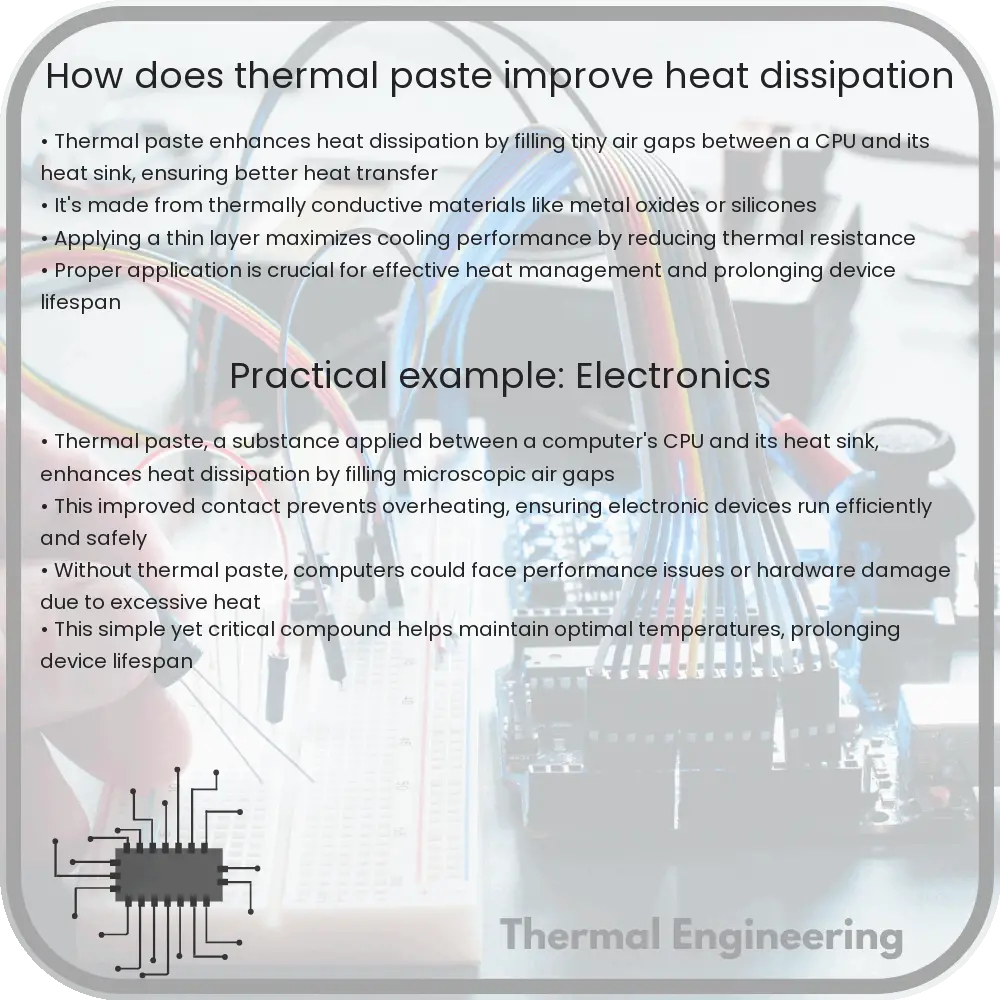
Thermal paste is a thermally conductive chemical compound, which is used as an interface between heat sources and heat sinks. Its primary function is to fill microscopic imperfections on the surfaces of the heat source (such as a CPU or GPU) and the heat sink. By doing this, the thermal paste eliminates air gaps or spaces from the interface area, as air is a poor conductor of heat and can greatly impede thermal efficiency.
Composition of Thermal Paste
The composition of thermal paste typically includes a mixture of compounds that possess high thermal conductivity. Common materials used in these mixtures include:
- Metal oxides such as zinc oxide or aluminum oxide
- Silicones
- Graphite or carbon particles
- Metal particles like silver or copper
Each of these materials is chosen for its ability to conduct heat effectively, ensuring faster and more efficient heat transfer from the heat source to the heat sink.
How Does Thermal Paste Improve Heat Dissipation?
The mechanism of heat transfer in the presence of thermal paste can be understood through basic principles of heat conduction. The thermal conductivity of the materials involved plays a key role. The formula for heat transfer by conduction is given by:
Q = (k * A * ΔT) / d
where:
- Q is the amount of heat transferred,
- k is the thermal conductivity of the material,
- A is the area through which heat is being transferred,
- ΔT is the temperature difference across the material,
- d is the thickness of the material.
In this equation, the higher the thermal conductivity (k), the greater the heat transfer. Thermal paste replaces the less conductive air (which has a thermal conductivity of about 0.024 W/mK) with a substance that has a much higher thermal conductivity (generally about 1-10 W/mK depending on the composition), thus significantly enhancing heat dissipation.
Application and Effectiveness
Applying thermal paste is a critical step in building or maintaining computers and other devices where heat generation could affect performance. The paste should be applied in a thin, even layer on the surface of the component before attaching the heat sink. This ensures optimal heat transfer and helps prevent overheating, which can lead to hardware malfunctions or failures.
The effectiveness of thermal paste in improving heat dissipation has been substantiated through various studies and practical applications in electronic device manufacturing and maintenance. By enhancing the thermal interface between heat-generating components and coolers, thermal paste not only prolongs the lifespan of the hardware but also boosts its performance.
In conclusion, the use of thermal paste is a simple yet essential step in managing the operational temperature of heat-intensive devices. Its ability to efficiently transfer heat away from critical components makes it an invaluable tool for those looking to enhance their system’s performance and reliability.