Learn about thermal shock resistance, a vital material property for enduring rapid temperature changes in aerospace, cookware, and electronics.
Understanding Thermal Shock Resistance in Materials
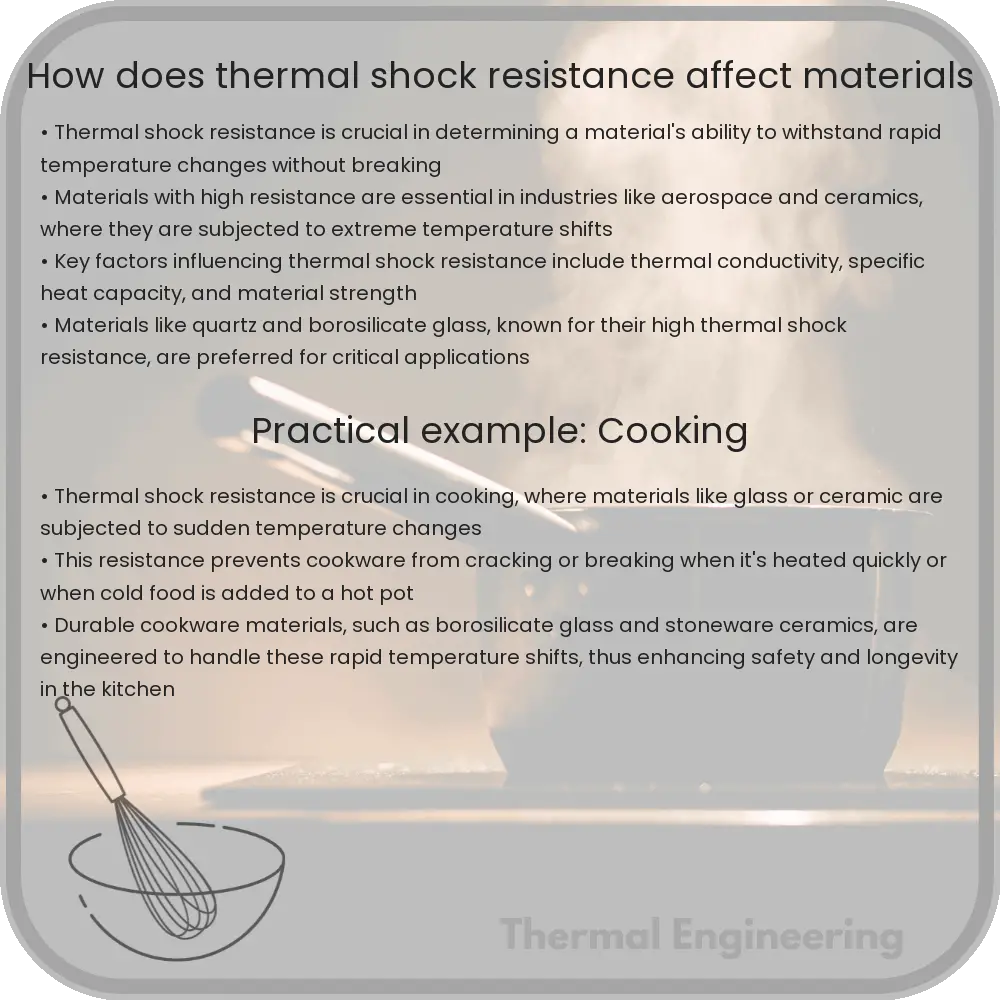
Thermal shock resistance is a critical property of materials that determines their ability to withstand rapid changes in temperature without deteriorating or breaking. This property is particularly important in applications that involve sudden heating or cooling, such as in aerospace components, cookware, and ceramic materials used in electronics and energy systems.
What is Thermal Shock?
Thermal shock refers to the stress experienced by a material when it undergoes a sudden change in temperature. The rapid temperature variation can lead to thermal expansion or contraction, which, in turn, creates stress within the material. If the material cannot withstand this stress, it may crack, fracture, or fail in other ways.
Factors Influencing Thermal Shock Resistance
- Thermal Expansion Coefficient: Materials with low thermal expansion coefficients are less likely to experience internal stresses due to less expansion or contraction with temperature changes.
- Thermal Conductivity: High thermal conductivity helps in quickly dissipating the heat across the material, thus minimizing temperature gradients that can lead to stress.
- Elastic Modulus: Materials with a higher elastic modulus tend to be more brittle, and thus, more susceptible to thermal shock. Conversely, materials with a lower elastic modulus can absorb more stress.
- Strength and Toughness: High strength and toughness allow a material to resist fractures under stress, contributing positively to thermal shock resistance.
Measurement of Thermal Shock Resistance
Thermal shock resistance is often quantified using a parameter known as the thermal shock parameter (R), which is calculated based on the material’s properties. It can be given by the formula:
R = (K * σt) / (E * α2 * ΔT)
Where:
- K = Thermal conductivity
- σt = Tensile strength
- E = Modulus of elasticity (Young’s modulus)
- α = Coefficient of thermal expansion
- ΔT = Temperature change
Practical Applications and Examples
In practical applications, the design of components considers thermal shock resistance to ensure longevity and reliability. For example:
- In aerospace, materials such as advanced ceramics and composites are chosen for engine components because of their high thermal shock resistance.
- In cooking, utensils made from materials like borosilicate glass are popular because they resist cracking under rapid temperature changes.
- Electronic devices often use materials with high thermal shock resistance to prevent damage due to rapid heating and cooling cycles.
Conclusion
Understanding and enhancing thermal shock resistance is crucial for developing materials that can withstand extreme and sudden temperature changes. This property plays a significant role in a wide range of engineering applications, influencing the design and material choice in industries as diverse as cookware, aerospace, and electronics. By selecting materials with optimum thermal shock resistance, engineers can enhance the performance, safety, and durability of the components and systems they design.