Learn about thermal spraying, an industrial process used to apply protective coatings to surfaces, enhancing resistance to wear, corrosion, and heat.
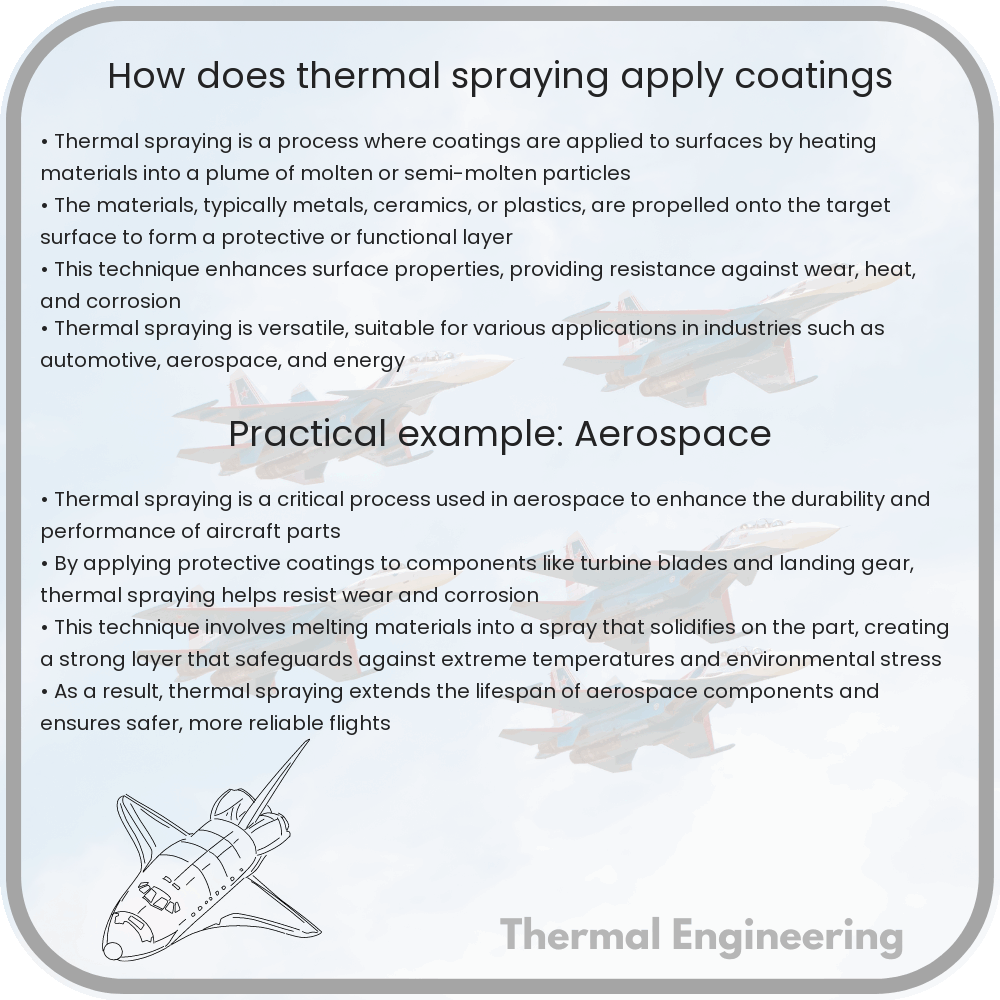
Understanding Thermal Spraying: A Method for Applying Coatings
Thermal spraying is an industrial coating process used to enhance a surface’s properties or dimensions, providing benefits like increased resistance to wear, corrosion, and heat. This process involves the deposition of finely divided metallic or non-metallic materials onto a substrate, creating a robust layer that adheres to the underlying material.
The Basics of Thermal Spraying
In thermal spraying, material in the form of powder, wire, or rod is heated to a molten or semi-molten state and then propelled towards the substrate using a gas stream. The particles, upon striking the surface, flatten and form a layer. This process can be conducted in various environments, including air, controlled atmospheres, or vacuum.
Types of Thermal Spraying Techniques
- Flame Spraying: In this method, the feedstock is melted by an oxy-fuel gas flame. The molten material is then atomized by compressed air and projected onto the surface.
- Arc Spraying: This technique uses an electric arc to melt metallic wires. Compressed air is used to atomize and propel the molten material toward the substrate.
- Plasma Spraying: In plasma spraying, a plasma jet, generated by an electric arc, is used to melt the material, which is then accelerated towards the substrate to form the coating.
- HVOF (High-Velocity Oxygen Fuel): Combining a liquid fuel and oxygen, this method creates a high-velocity flame. The material, usually in powder form, is injected into this flame, melts, and is propelled at high speeds onto the substrate.
Applications and Materials
Thermal spraying can apply a wide variety of materials, such as metals, alloys, ceramics, and plastics. It is widely used in various industries including aerospace, automotive, healthcare, and manufacturing. Common applications include coating jet engine components for heat resistance, applying wear-resistant coatings on mechanical parts, or providing corrosion resistance to offshore structures.
Advantages of Thermal Spraying
- Versatility: Capable of applying a multitude of coatings to a diverse array of substrates.
- Efficiency: Coatings can be applied relatively quickly compared to other processes like electroplating or physical vapor deposition.
- Economic: Generally, it’s more cost-effective for large-scale production and for coatings which require frequent reapplication.
- Quality: Produces thick coatings that are strong, porous-free, and have good adhesion to the substrate.
Conclusion
Thermal spraying is a critical technology in surface engineering, allowing for the enhancement of material properties to meet specific needs. Its versatility and efficiency make it a preferred choice in many industrial applications, fostering innovations across various sectors by extending the life and improving the performance of critical components.