Explore latent heat storage systems, a technology harnessing phase change materials (PCMs) to efficiently absorb, store, and release thermal energy, beneficial for energy management and sustainability.
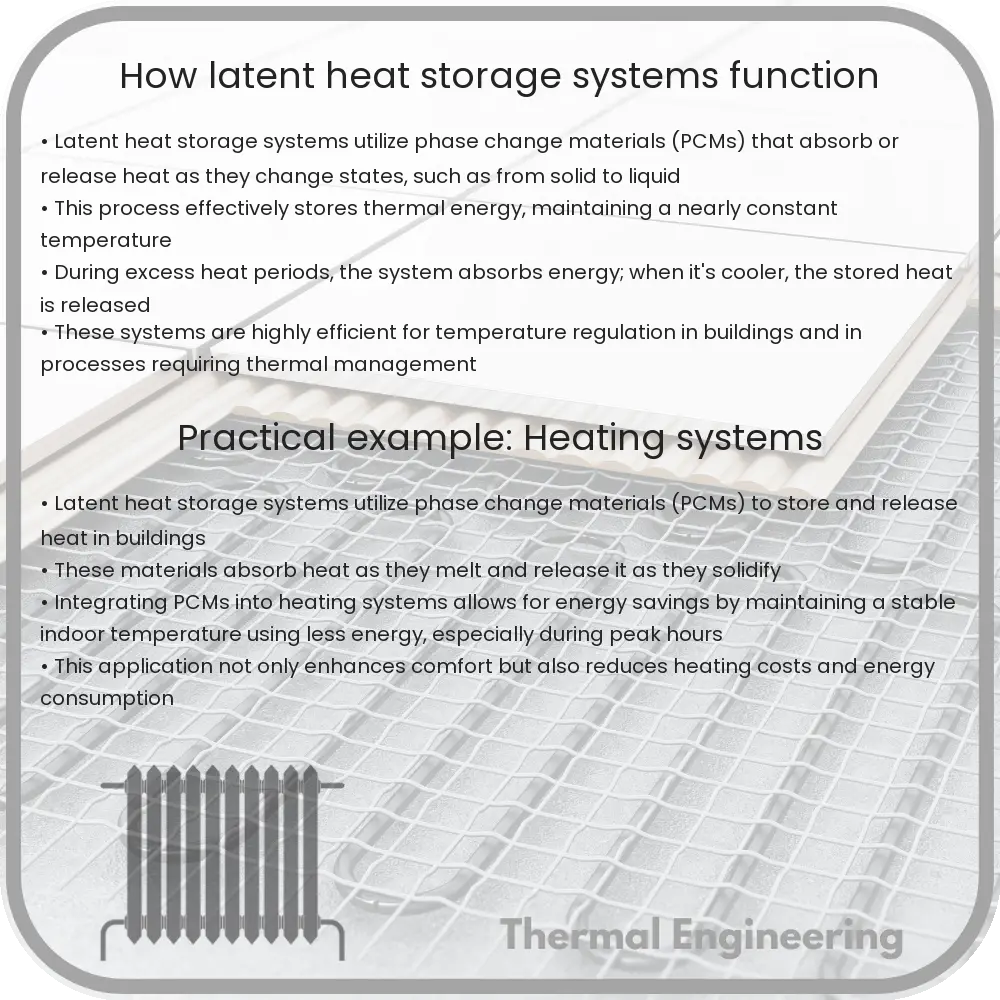
Understanding Latent Heat Storage Systems
Latent heat storage systems are an innovative approach to energy storage using materials that absorb or release heat during phase changes, typically between solid and liquid phases. This technology plays a crucial role in improving energy efficiency and managing heat for later use in various applications, from buildings to industrial processes.
Basic Principles
The core concept of latent heat storage is rooted in the physics of phase change materials (PCMs). When a PCM changes its state, for example from solid to liquid, it absorbs energy in the form of heat; conversely, it releases energy when it returns to its original state. This heat is referred to as ‘latent’ because it does not cause a temperature change in the material, instead facilitating the phase change.
Key Components
- Phase Change Material (PCM): The choice of PCM is vital and depends on its melting point, which should be within the operational temperature range of the application. Common PCMs include paraffin wax and salt hydrates.
- Containment Unit: The PCM is enclosed in this unit to manage the thermal exchange efficiently and maintain the structural integrity of the system.
- Heat Exchange System: Essential for transferring heat to and from the PCM, this system can be integrated with existing heating and cooling systems.
Functioning of a Latent Heat Storage System
The operation of a latent heat storage system can be described in the following steps:
- Energy Absorption: When the surrounding temperature exceeds the melting point of the PCM, the material absorbs heat and transitions from a solid to a liquid, storing thermal energy in the process.
- Energy Storage: Once the PCM reaches its liquid state, the energy is stored until it is needed. The containment unit ensures that the PCM stays isolated and does not lose heat to the external environment.
- Energy Release: When the temperature around the PCM drops, the PCM begins to solidify, releasing the stored heat. This heat can then be used to warm spaces, generate hot water, or drive industrial processes.
The efficiency of a latent heat storage system is largely dependent on the thermal conductivity of the PCM, the surface area of the heat exchanger, and the insulation properties of the containment unit. Enhancements in these areas can significantly improve the overall performance of the storage system.
Applications and Advantages
Latent heat storage systems find applications in numerous fields, including renewable energy systems, building heating and cooling, and industrial heat recovery. These systems offer the following benefits:
- High Energy Density: PCMs can store and release a large amount of heat per unit volume, making latent heat storage systems very efficient.
- Stability: Most PCMs are chemically stable and can withstand numerous phase change cycles without significant degradation.
- Controlled Temperature Operations: Since the system operates around the phase change temperature of the PCM, it can maintain near-constant temperature conditions, which is advantageous for thermal management.
Challenges and Future Prospects
While latent heat storage offers compelling benefits, several challenges remain, such as improving the thermal conductivity of PCMs and minimizing the volume changes during phase transitions. Research is ongoing to develop advanced PCMs and innovative containment methods that address these challenges. The future of latent heat storage in contributing to energy sustainability looks promising as it provides a critical solution for managing and utilizing thermal energy more efficiently.
In conclusion, latent heat storage systems stand out as a pivotal technology in energy management strategies, offering a blend of high efficiency, reliability, and the potential to leverage renewable energy sources more effectively.