Explore the mechanics and applications of hydrodynamic fluid film lubrication in mechanical engineering to reduce wear and friction.
Understanding Hydrodynamic Fluid Film Lubrication
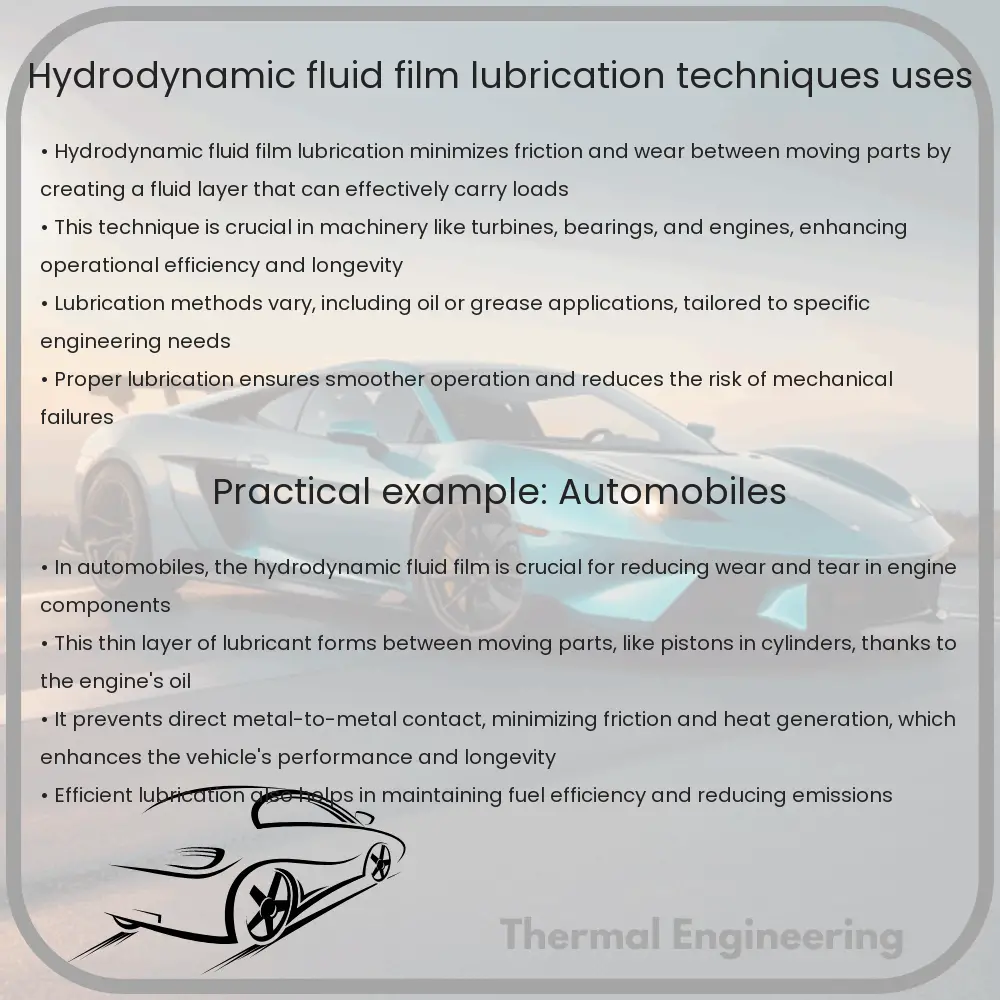
Hydrodynamic fluid film lubrication is a critical technique used in mechanical engineering to minimize wear and friction between sliding surfaces. This type of lubrication primarily relies on the movement of the surfaces to drag the lubricant into the space between them, subsequently creating a separating film. The film formation is vital as it prevents surface contact and reduces the risk of damage and increased friction.
How Hydrodynamic Fluid Film Lubrication Works
In hydrodynamic lubrication, the surfaces moving relative to each other are separated by a thin layer of fluid. This layer forms as the relative motion begins and becomes thick enough to support the normal loads of operation. It is characterized by the fluid’s viscous forces being much larger than the forces due to the fluid’s inertia. As the speed or viscosity increases, the thickness of the lubricating film also increases, thereby enhancing the lubrication effectiveness. The basic principle can be described by the Reynolds equation:
PdV = -d(h3/12μ)(dp/dx)
where P is the pressure in the fluid, V is the velocity, h is the film thickness, μ is the viscosity of the lubricant, and x is the coordinate in the direction of motion.
Types of Lubrication Systems Using Hydrodynamic Fluid Films
Various designs and configurations exist for implementing hydrodynamic fluid film lubrication, depending on the application and machinery design:
- Journal Bearing: This common type of bearing is used in rotating shafts, and the fluid creates a film as the shaft spins within its housing.
- Thrust Bearing: Used for axial load support, these bearings form a fluid film that supports loads parallel to the shaft.
- Kingsbury Bearing: A specialized type of thrust bearing with pivoted shoes that adapt to variations in load and movement, helping maintain a stable fluid film.
- Lobe Bearings: Often used in gear pumps, lobe bearings support the rotating gears while maintaining a fluid film that separates the gear teeth from the casing.
Applications and Benefits
Hydrodynamic fluid film lubrication is crucial in many industrial applications. Some of the most common applications include:
- Automotive Engines: The moving parts such as pistons, crankshafts, and camshafts are supported by hydrodynamic lubrication.
- Power Generators: Hydrodynamic bearings support turbine shafts in hydroelectric, wind, and other power plants.
- Heavy Machinery: Essential for the smooth operation of equipment in mining, manufacturing, and construction.
The benefits of using hydrodynamic fluid film lubrication include:
- Reduction in Wear and Tear: By preventing direct contact between moving parts, the lubrication minimizes wear and extends the life of machinery.
- Decrease in Energy Consumption: Efficient lubrication reduces friction, leading to lower energy use and operational costs.
- Improved Machine Performance: With reduced friction, machines operate more smoothly and efficiently, enhancing overall performance.
- Heat Reduction: Lubrication helps in dissipating heat generated by moving parts, thus preventing overheating and potential damage.
In conclusion, hydrodynamic fluid film lubrication plays an indispensable role in a wide range of engineering applications, offering significant benefits in terms of reliability, efficiency, and longevity of equipment. Understanding and implementing effective lubrication systems are essential for optimizing the operation and durability of mechanical systems.