Learn about hydrogen peroxide’s roles as an effective oxidizer in numerous applications and its dynamic thermal decomposition process.
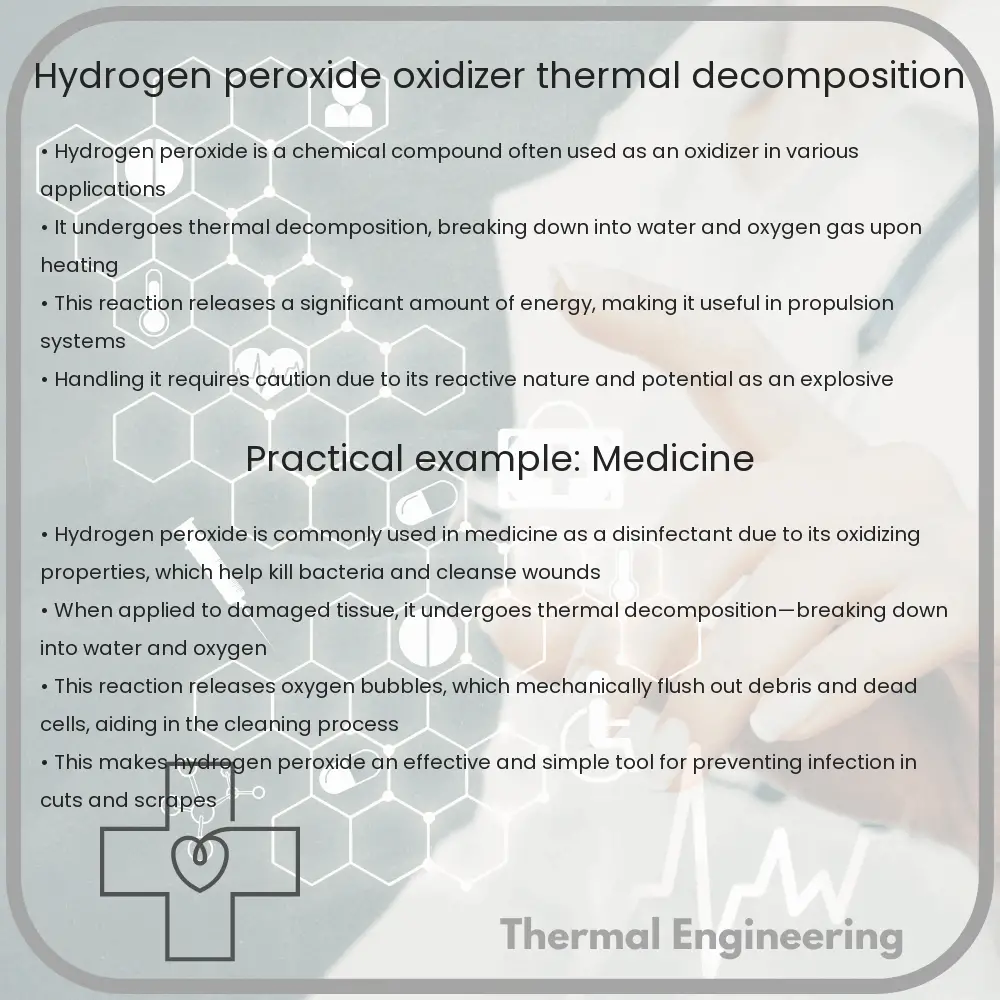
Understanding Hydrogen Peroxide as an Oxidizer and its Thermal Decomposition
Hydrogen peroxide (H2O2) is a clear, colorless liquid commonly used in various concentrations for different applications. In this article, we delve into its role as an oxidizer in chemical reactions and explore the dynamic process of its thermal decomposition.
Hydrogen Peroxide as an Oxidizer
As an oxidizing agent, hydrogen peroxide is capable of accepting electrons from other substances during a chemical reaction. This property makes it extremely useful in both industrial processes and everyday products. The oxidizing ability of hydrogen peroxide makes it effective for applications such as disinfection, bleaching, and even propelling rockets. For instance, in environmental engineering, it is used for pollution control by breaking down contaminants in wastewater.
- Disinfection: It kills microorganisms by destroying their cell walls through oxidation.
- Bleaching: Hydrogen peroxide is used in paper and textile industries to bleach materials, removing colors without damaging the fibers.
- Rocket Propulsion: In rocketry, H2O2 can be decomposed rapidly to produce oxygen and steam, which are expelled to generate thrust.
Thermal Decomposition of Hydrogen Peroxide
Thermal decomposition is a chemical reaction where a substance breaks down into simpler substances when heated. For hydrogen peroxide, this decomposition can be represented by the equation:
2H2O2 → 2H2O + O2
This reaction suggests that when hydrogen peroxide is heated, it decomposes into water (H2O) and oxygen (O2). The reaction is exothermic, releasing heat and potentially causing violent boiling of the solution.
- Catalysts: The rate of decomposition can be significantly increased by the presence of a catalyst such as manganese dioxide (MnO2) or iron(III) chloride (FeCl3).
- Uses of Decomposed Products: The oxygen released can be used in medical settings for providing supplemental oxygen or in chemical synthesis. The produced heat and steam can drive turbines or engines in specific applications.
- Safety Measures: Due to its exothermic nature, handling concentrated hydrogen peroxide requires careful temperature control and protective equipment to prevent hazardous situations.
In conclusion, hydrogen peroxide serves as a versatile substance in various scientific and industrial fields due to its properties as an oxidizer and its capability to decompose under heat. Its efficient conversion into water and oxygen, along with the heat generated during decomposition, makes it valuable for numerous applications ranging from environmental management to energy production.