Explore the properties, production, and applications of Chlorine Dioxide, a potent oxidizing agent used in water treatment and paper bleaching.
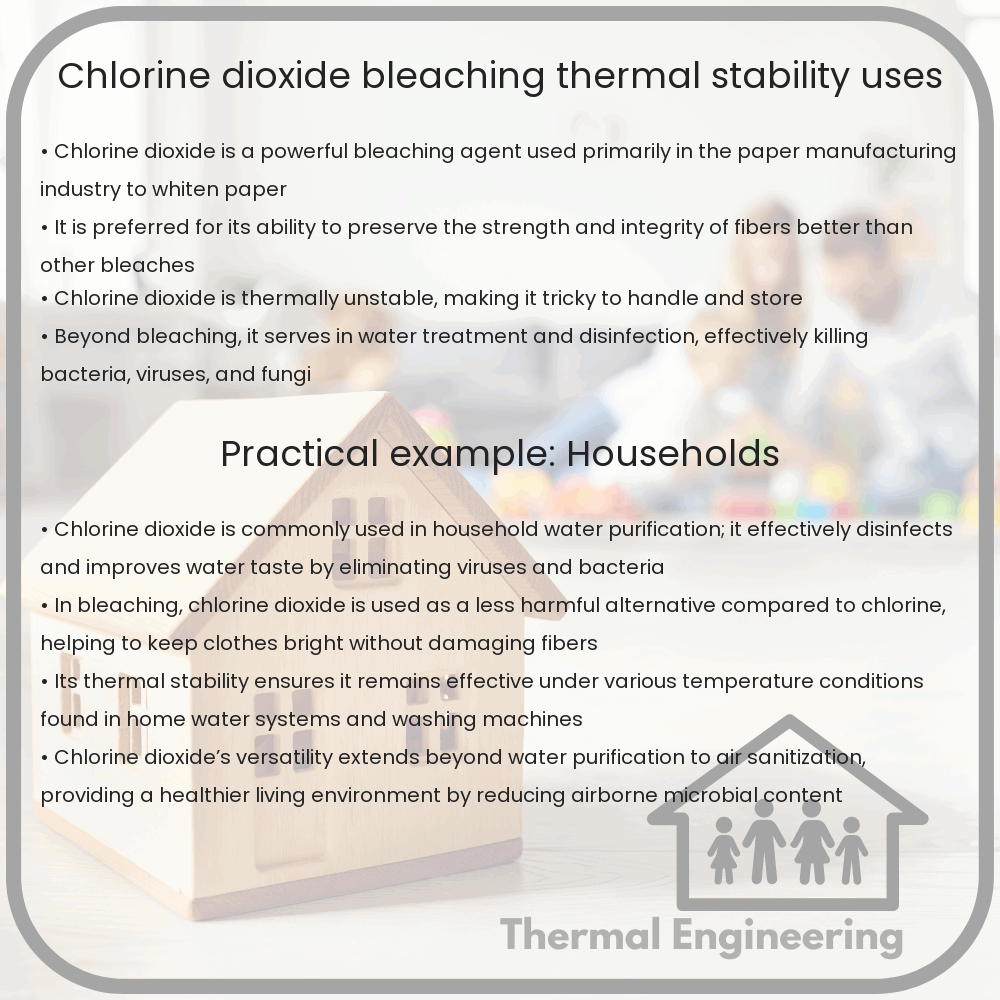
Introduction to Chlorine Dioxide
Chlorine dioxide (ClO2) is a yellowish-green gas known for its potent oxidizing properties. It is a unique and versatile chemical compound that differs significantly from elementary chlorine, both in its chemical structure and in its behavior. It has a variety of applications in industries ranging from water treatment to paper production.
Chemical Properties and Production
Chlorine dioxide is a small, volatile and highly reactive molecule. It exists as a free radical in most conditions. Despite its name, it does not actually contain chlorine but rather, it consists of one chlorine atom bonded to two oxygen atoms. This composition enables chlorine dioxide to act as an effective oxidizer.
It is most commonly produced through the reduction of sodium chlorate by hydrochloric acid or through the oxidation of sodium chlorite with chlorine gas. The typical reaction for generating chlorine dioxide industrially is as follows:
2 NaClO3 + 4 HCl → 2 ClO2 + 2 NaCl + 2 H2O
Bleaching Applications
One of the primary uses of chlorine dioxide is as a bleaching agent in the paper and pulp industry. Unlike chlorine, chlorine dioxide does not chlorinate organic compounds, which leads to the formation of fewer chlorinated organic compounds and, consequently, reduces the environmental impact. This makes it an environmentally preferable bleaching agent for maintaining the brightness of paper products.
- It selectively oxidizes lignin without degrading the cellulose fiber.
- The result is a high-quality, bright paper product with improved strength and durability.
Thermal Stability
Chlorine dioxide is known for its thermal instability. It decomposes rapidly when exposed to heat, light, or when it comes into contact with certain materials. Its decomposition can release oxygen, thereby posing both fire and explosion risks under certain conditions.
The decomposition reaction of chlorine dioxide can be represented as follows:
2 ClO2 → 2 ClO2 + O2
This sensitivity requires careful handling and storage solutions, usually involving dilute aqueous solutions kept in cold, dark environments.
Other Uses of Chlorine Dioxide
Aside from its application in the paper industry, chlorine dioxide is also widely used for water treatment. Its ability to effectively kill bacteria, viruses, and protozoa, including hardy cysts that can evade other disinfectants, makes it valuable for both drinking and wastewater treatment.
- It is used in the disinfection of municipal water supplies, where it helps in the control of waterborne pathogens without forming harmful byproducts like trihalomethanes (THMs).
- Additionally, it is used in food processing for sanitizing equipment, water systems, and even for washing fruits and vegetables.
- In medical facilities, chlorine dioxide gas is used for the decontamination of rooms and equipment.
Chlorine dioxide’s broad spectrum efficacy and relatively low risk of harmful byproducts make it a preferred choice in many applications requiring sanitization and disinfection.
Conclusion
Chlorine dioxide remains a critical chemical in various industrial applications due to its powerful oxidative properties and its environmentally friendly profile when compared to traditional chlorine treatments. Despite its challenges, particularly in terms of handling and safety due to its thermal instability, ongoing research and technological advancements continue to expand its applications, making it an indispensable tool in industries requiring efficient oxidation and disinfection solutions.