Ionic liquids are revolutionary green solvents with tunable properties, used in electrochemical applications and as eco-friendly alternatives in various industries.
Ionic Liquids: Revolutionary Green Solvents and Their Electrochemical Applications
Ionic liquids, often termed “designer solvents,” are organic salts that are liquid at temperatures below 100°C. They consist solely of ions, making them unique from traditional molecular liquids like water or alcohol. What sets ionic liquids apart in the field of green chemistry and engineering is their negligible vapor pressure, which minimizes environmental pollution through evaporation. This characteristic, along with their impressive chemical and thermal stability, makes them excellent candidates for sustainable and environmentally-friendly applications.
Characteristics and Benefits of Ionic Liquids
These salts boast several key characteristics that make them appealing for various applications in science and industry:
- Low Volatility: Ionic liquids have low to no vapor pressure, which significantly reduces the risk of air contamination and health hazards associated with traditional organic solvents.
- Thermal Stability: They can operate under a wide temperature range without decomposing, which is advantageous in processes requiring high temperatures.
- Tunable Properties: The physical and chemical properties of ionic liquids can be customized by altering the combination of anions and cations, allowing scientists to “design” the liquid specific to the application’s needs.
- Good Solvating Abilities: Ionic liquids can dissolve a wide variety of compounds, including challenging polar and non-polar substances.
Green Solvent Applications
As green solvents, ionic liquids are used to replace volatile organic compounds (VOCs) in many applications:
- Chemical Synthesis: Their inert nature and ability to dissolve numerous materials make them ideal for use in chemical reactions and syntheses that are sensitive to contamination.
- Biomass Processing: Ionic liquids are effective in processing biomass into biofuels and other chemicals, offering a more environmentally-friendly method than traditional solvents.
- Waste Recycling: They can extract valuable metals from waste streams, promoting recycling and reducing landfill waste.
Electrochemical Applications
In the realm of electrochemistry, ionic liquids are utilized for their excellent ionic conductivity and wide electrochemical windows. Some of the key applications include:
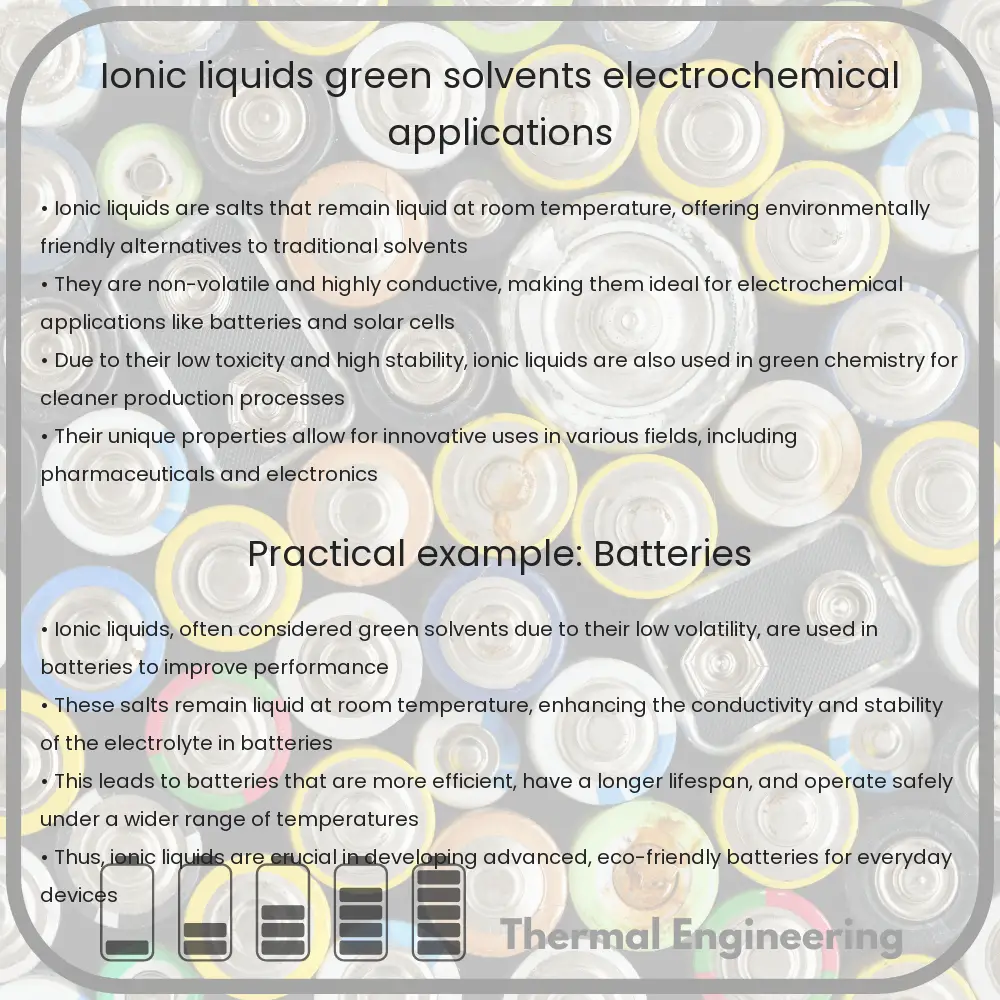
- Batteries: Ionic liquids are used as electrolytes in battery technologies, particularly lithium-ion batteries, to enhance performance and safety. Their non-flammable nature and ability to operate over a broad temperature range improve battery stability and longevity.
- Supercapacitors: They serve as electrolytes in supercapacitors, devices that store energy through electrostatic charges rather than chemical reactions, offering faster charging and discharging than conventional batteries.
- Sensors: Ionic liquids are employed in sensor technologies to increase sensitivity and stability in the detection of various substances.
- Electroplating: Their application in electroplating includes providing a non-toxic alternative to conventional solvents, leading to safer and cleaner production methods.
Future Perspective
The versatility and environmental benefits of ionic liquids position them as front-runners in the quest for sustainable technology solutions across various fields. Continuing advances in chemistry and materials science will likely expand their applications and enhance their effectiveness, solidifying their role in the industries of the future. As research and development in ionic liquids continue, we can anticipate more innovative and eco-friendly solutions, making significant contributions to green chemistry, electrochemistry, and beyond.