Learn about Laser Flash Analysis (LFA), a technique for measuring material thermal properties essential in science and engineering.
Understanding Laser Flash Analysis (LFA)
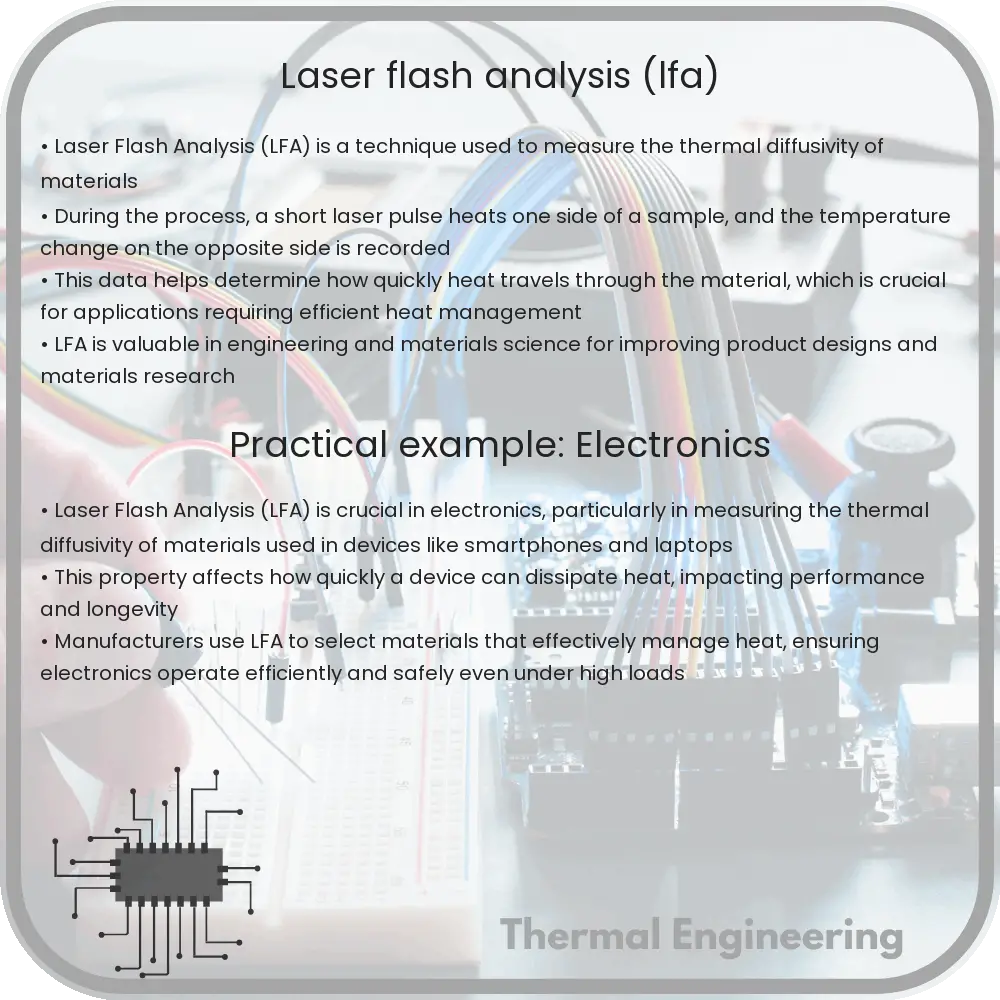
Laser Flash Analysis (LFA) is a sophisticated technique used primarily to measure the thermal diffusivity, and, with additional data, the specific heat capacity and thermal conductivity of materials. LFA plays a crucial role in the fields of material science, engineering, and thermal analysis, providing essential data for research and development, quality control, and safety testing.
How Laser Flash Analysis Works
LFA involves subjecting a small, disk-shaped sample of material to a short pulse of laser energy on one surface. The resulting temperature rise on the opposite surface of the material is then monitored using an infrared detector. The time it takes for the heat to travel through the material, known as the ‘time lag’, is precisely measured.
The fundamental relation used in LFA to determine thermal diffusivity (\(\alpha\)) is given by the formula:
\[ \alpha = \frac{{d^2}}{{\pi^2 \cdot t_{1/2}}} \]
Where:
- \(d\) is the thickness of the sample,
- \(t_{1/2}\) represents the time taken for the rear face temperature to reach half of its maximum value after the laser pulse.
Applications of Laser Flash Analysis
The ability of LFA to characterize thermal properties quickly and with small sample sizes makes it invaluable in several areas:
- Material Development: Engineers and material scientists use LFA to evaluate and compare the thermal characteristics of new materials, including metals, polymers, and ceramics.
- Electronic Industry: As electronics continue to shrink in size, managing heat becomes increasingly critical. LFA helps in designing materials that efficiently dissipate heat in electronic components.
- Aerospace and Automotive Industries: High-performance materials used in aerospace and automotive sectors are often subjected to extreme temperatures. LFA assists in understanding the thermal properties that are critical for ensuring durability and safety.
Advantages of Using Laser Flash Analysis
LFA comes with several benefits that make it a preferred method in thermal analysis:
- Non-destructive: Being a non-contact and non-destructive testing method, LFA maintains the integrity of the sample throughout the analysis.
- High Speed: Each measurement typically takes only a few seconds, allowing for rapid analysis and high throughput in testing.
- Precision and Accuracy: LFA offers high precision and accuracy in measuring thermal properties, even at very high temperatures.
- Versatility: It can be applied to a wide range of materials and temperatures, making it extremely versatile.
Limitations and Considerations
While LFA is a powerful tool, there are certain considerations and limitations that must be understood:
- Sample Preparation: Accurate results depend heavily on the quality of sample preparation, including thickness, surface finish, and parallelism.
- Thermal Contact Resistance: Poor contact between the sample and the temperature sensor can affect the accuracy of the data and needs to be minimized.
- Limited to Planar Samples: LFA typically requires samples to be flat and of uniform thickness, which may not always be practical for all material types or applications.
Conclusion
Laser Flash Analysis is a critical tool in the field of thermal analysis, offering depth and precision in understanding the thermal characteristics of various materials. By enabling engineers and scientists to accurately measure thermal properties, LFA contributes significantly to material innovation and safety in numerous applications. As technology evolves, the importance of reliable and efficient thermal management is set to grow, further elevating the role of Laser Flash Analysis in modern engineering and materials science.