Liquid uranium is a state of uranium used in molten salt reactors for more efficient and safer nuclear energy generation.
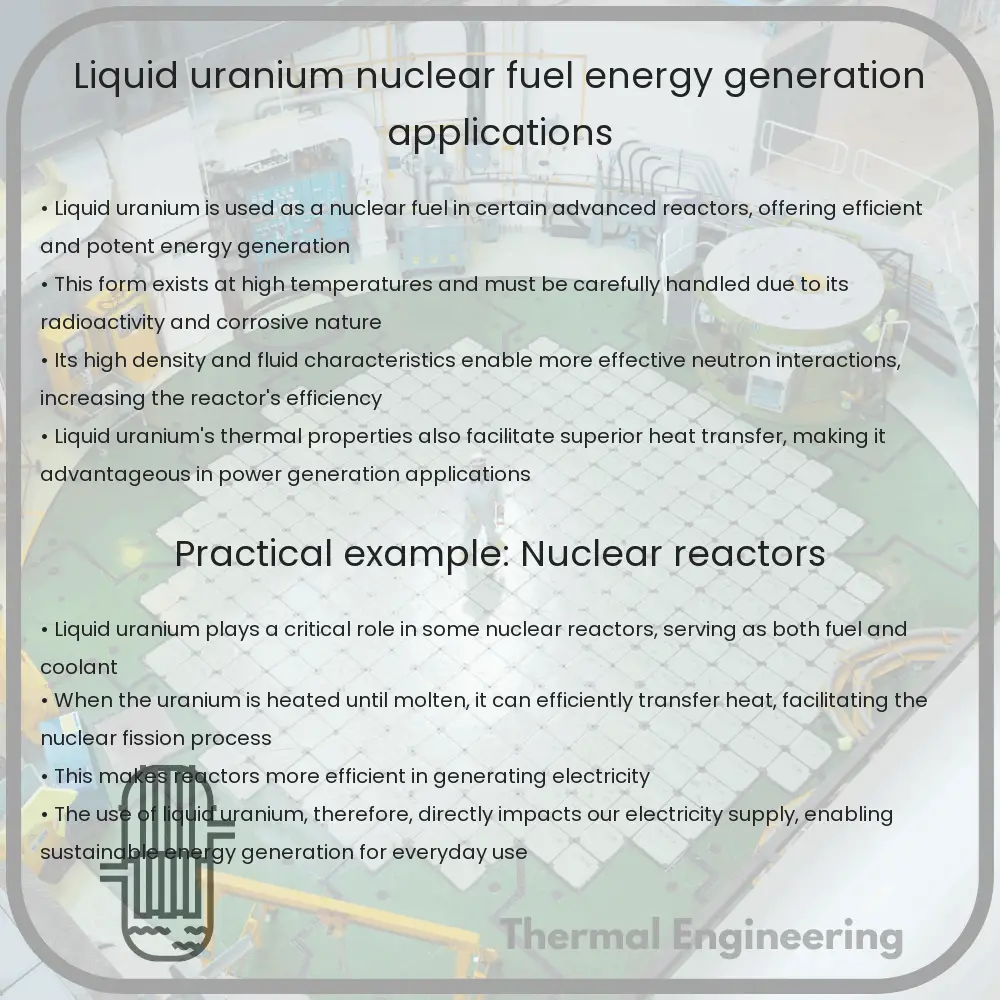
Liquid Uranium: Pioneering Nuclear Fuel for Energy Generation
Liquid uranium represents a cutting-edge approach in the field of nuclear energy, especially within the framework of molten salt reactors (MSRs). This innovative methodology leverages the unique properties of uranium when it is in a liquid state, primarily to enhance efficiency and safety in nuclear power generation. Understanding the core aspects of liquid uranium and its application in energy generation can provide insights into the future of nuclear technology.
What is Liquid Uranium?
Liquid uranium refers to uranium that has been heated to a point where it transitions from a solid to a liquid. This typically occurs at very high temperatures — over 1,132 degrees Celsius (the melting point of uranium). In the context of nuclear fuel, liquid uranium is often used in a molten salt mixture, where it acts both as a fuel and a coolant, significantly differing from conventional solid nuclear fuels.
Characteristics and Benefits
- High Thermal Conductivity: Liquid uranium effectively transfers heat, which is crucial for the efficient operation of a reactor.
- Lower Melting Point: When mixed with other elements, such as fluorine to form uranium tetrafluoride (UF4), the melting point is reduced, which is advantageous for managing reactor temperatures.
- Efficient Heat Transfer: The use of liquid uranium can allow for more uniform heat distribution and reduces the risk of hot spots, which can compromise reactor safety.
Application in Molten Salt Reactors (MSRs)
Molten Salt Reactors (MSRs) are a type of nuclear reactor where fuel is dissolved in a molten fluoride or chloride salt, which functions as both the nuclear fuel (carrying the fissile material, like uranium) and coolant. In these reactors, uranium is often used in the form of a salt, such as UF4 or uranium trichloride (UCl3). The core processes of an MSR involve circulating the molten salt through a loop, where it absorbs heat from nuclear fission and transfers this heat to a secondary salt circuit or directly to a steam generator for electricity production.
- The molten salt mixture is heated by nuclear reactions.
- Heat is transferred from the molten salt to a heat exchanger.
- This thermal energy is then used to produce steam, which drives turbines to generate electricity.
Advantages of Liquid Uranium in MSRs
The utilization of liquid uranium in MSRs offers several distinct advantages:
- Enhanced Safety: MSRs can operate at atmospheric pressure and their molten salts have high boiling points, which significantly reduces the risk of explosions or leaks.
- Efficient Use of Fuel: The solubility of uranium in molten salts permits better fuel utilization and potentially easier reprocessing and recycling of spent fuels.
- Reduction in Nuclear Waste: MSRs can potentially reduce the volume of long-lived radioactive waste, as well as the ability to burn existing waste materials.
- Versatility in Fuel: MSRs can be designed to run on different types of fuel, including thorium or plutonium, providing flexibility depending on resource availability.
Conclusion
The exploration and development of liquid uranium in nuclear reactors, particularly in MSRs, represents a promising advance in nuclear technology. By improving efficiency, safety, and waste management, the implementation of liquid uranium could play a crucial role in shaping the future of sustainable and safe nuclear energy deployment worldwide.
Therefore, continuing research and technological development in this sector are vital for harnessing the full potential of nuclear energy with minimal environmental impact, marking a significant step forward in the pursuit of clean energy solutions.