Explore the role of nanostructured materials in improving thermal conductivity for various advanced applications.
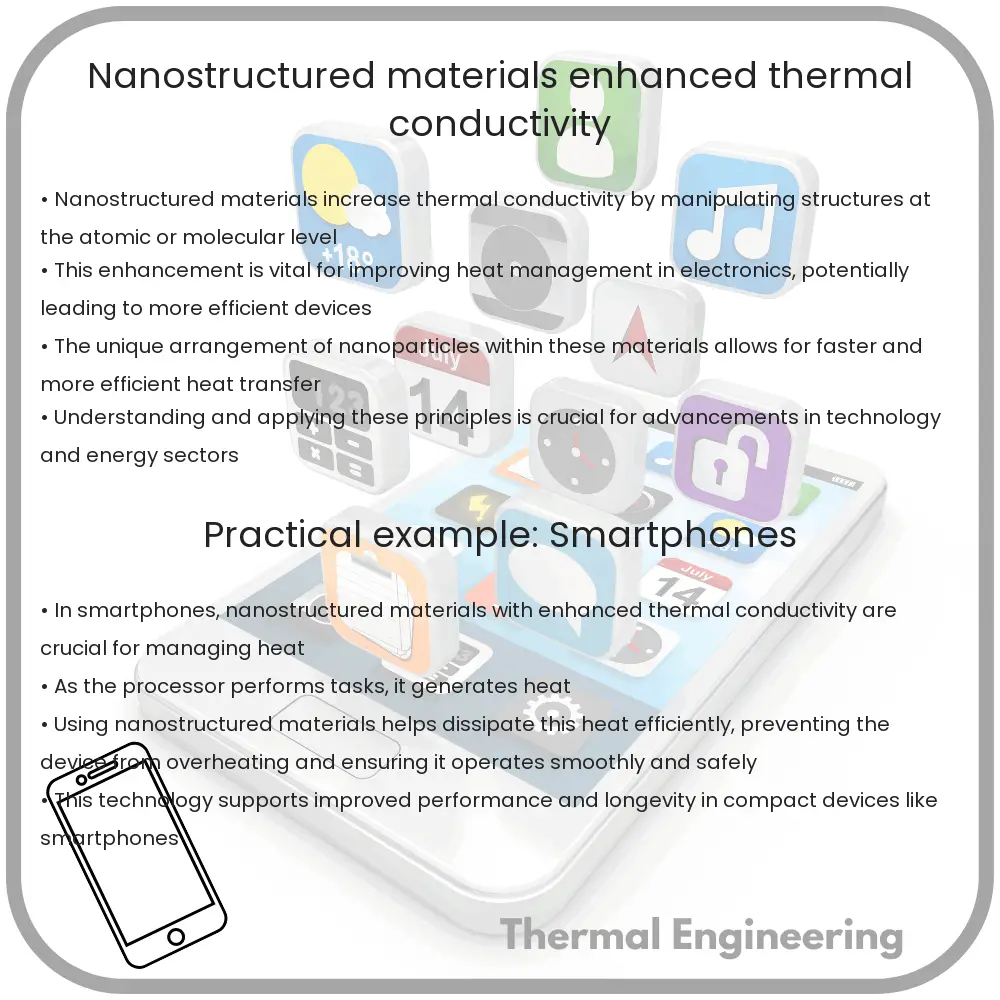
Nanostructured Materials and Their Role in Enhanced Thermal Conductivity
Nanostructured materials represent a fascinating area of research and technology due to their unique properties, which differ significantly from their bulk counterparts. One of their standout attributes is their ability to conduct heat. This enhanced thermal conductivity makes them ideal for a variety of applications, from electronics cooling to thermal energy storage devices. In this article, we’ll delve into what nanostructured materials are, why their thermal conductivity is superior, and some practical examples of their use.
Understanding Nanostructured Materials
Nanostructured materials are materials whose structural elements — particles, fibers, or grains — are in the nanometer scale, typically less than 100 nanometers. These can include nanotubes, nanowires, nanoplates, and nanoporous materials. At this scale, the physical, chemical, and biological properties of materials can be quite different from those seen in larger forms.
How Nanostructured Materials Enhance Thermal Conductivity
The thermal conductivity of a material determines how well it can conduct heat. In nanostructured materials, this property can be significantly enhanced through the manipulation of size, shape, and structural composition, which influence phonon transport mechanisms. Phonons are quasiparticles representing the quantum mechanical description of vibrations within a rigid crystal lattice. Here are a few ways nanostructuring can enhance thermal conductivity:
- Reduced Phonon Scattering: At the nanoscale, the boundaries and interfaces of materials can be engineered to reduce phonon scattering, which normally impedes thermal flow in bulk materials.
- Interface Engineering: By optimizing the interfaces between different nanoscale components (e.g., in a composite material), thermal resistance can be minimized, enhancing overall thermal conductivity.
- Material Purity: Nanostructuring techniques often involve high levels of material purity and reduced defects, which further facilitate efficient thermal transport.
Applications of Enhanced Thermal Conductivity
The improved thermal conductivity of nanostructured materials finds applications in several critical sectors:
- Electronics: Efficient heat dissipation is crucial in electronic devices to improve performance and extend lifespan. Nanostructured materials are used in thermal interface materials (TIMs) that sit between heat sources (e.g., a CPU) and heat sinks to enhance heat transfer.
- Energy Storage: In systems like phase change materials (PCMs) used for thermal energy storage, nanostructured materials help achieve faster thermal response and better thermal stability.
- Aerospace: The high thermal conductivity and low density of certain nanostructured materials (like carbon nanotubes) are ideal for aerospace applications where weight is critical, and thermal management is vital.
Challenges and Future Prospects
Despite their promising potential, nanostructured materials face challenges, particularly in manufacturing scale-up and integration into existing systems. Consistency in production quality, cost-effectiveness, and robustness of the final product are critical issues that need addressing. However, ongoing research continues to push the boundaries, promising even greater efficiencies and novel applications. As technology advances, the role of nanostructured materials in enhancing thermal conductivity is expected to grow, influencing more innovations in various fields.
In conclusion, nanostructured materials with enhanced thermal conductivity offer a gateway to solving many of the heat management challenges faced in modern technological applications. Their unique properties and the ongoing advancements in nanoengineering hold great potential for the future across multiple industries.