Learn about nitrogen dioxide’s thermal properties and methods for its pollution control to improve air quality and environmental health.
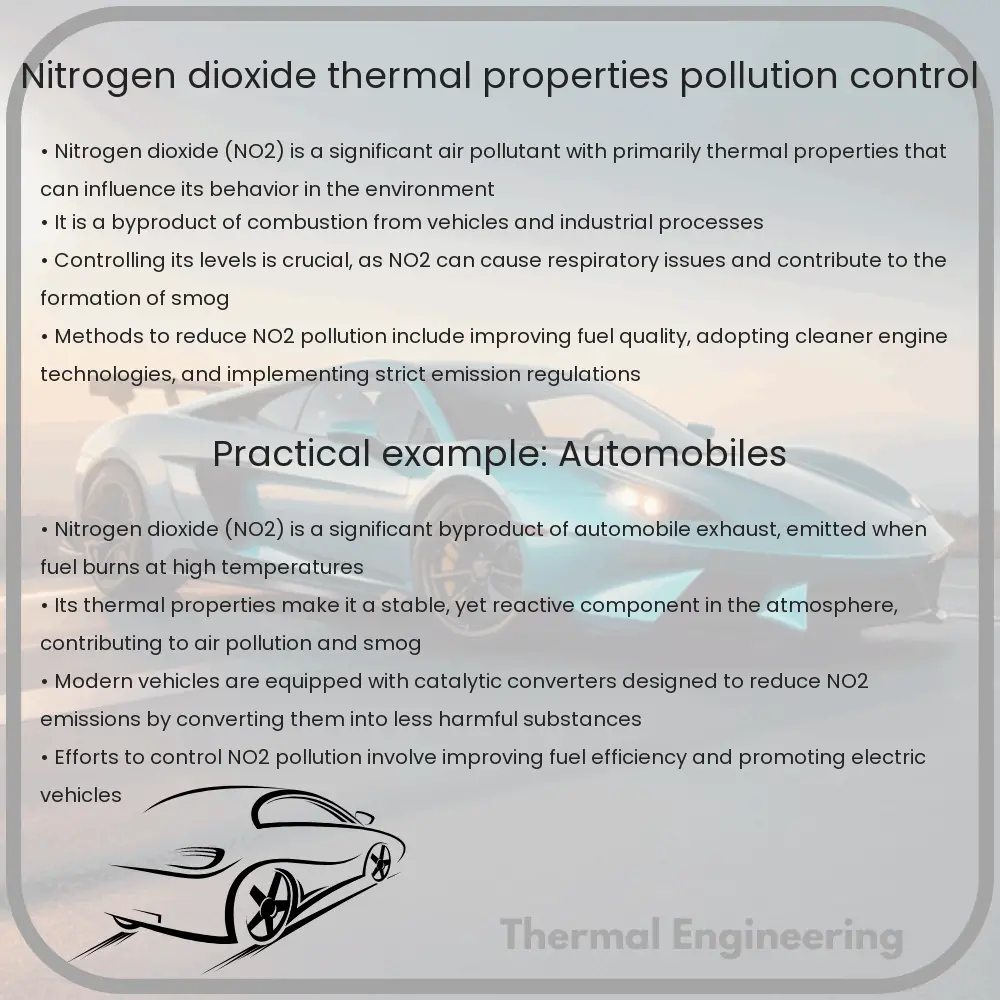
Understanding Nitrogen Dioxide: Its Thermal Properties and Pollution Control
Nitrogen dioxide (NO2) is a significant atmospheric pollutant that plays a crucial role in the chemistry of the atmosphere. Commonly associated with road traffic and fossil fuel combustion, NO2 is a reddish-brown gas with a characteristic sharp, biting odor. This article focuses on the thermal properties of nitrogen dioxide and explores various methods employed to control its pollution.
Thermal Properties of Nitrogen Dioxide
Nitrogen dioxide is a part of the nitrogen oxides (NOx) family, compounds consisting of nitrogen and oxygen in varying ratios. The thermal properties of NO2 are critical for understanding its behavior in different environmental conditions and engineering applications. Some key thermal properties include:
- Boiling point: NO2 has a boiling point of 21.2°C, which means it exists as a gas at room temperature and can liquefy at higher pressures or lower temperatures.
- Melting point: The melting point of NO2 is -11.2°C, indicating its state change from a solid to a liquid under standard atmospheric conditions.
- Specific heat capacity: NO2 has a specific heat capacity of about 0.854 J/gK, which is vital for calculating the energy required to change its temperature.
- Thermal conductivity: The thermal conductivity of NO2 is relatively low, reflecting its ability to conduct thermal energy.
Pollution Control for Nitrogen Dioxide
The control of nitrogen dioxide emissions is crucial for improving air quality and minimizing impacts on human health and the environment. Various regulatory and technological methods have been developed and implemented to manage NO2 concentrations. Here are some of the most effective approaches:
- Catalytic converters: Widely used in vehicles, catalytic converters help reduce NOx emissions. They convert NO2 and other NOx gases to nitrogen (N2) and oxygen (O2) through catalytic reactions.
- Scrubbing: Wet scrubbing techniques involve absorbing NO2 into a liquid solution, typically water or alkaline substances, which successfully remove it from exhaust gases.
- Selective catalytic reduction (SCR): SCR is a process used to reduce levels of NOx gases emitted from diesel engines and power plants. It involves the injection of a urea-based reagent that reacts with NOx to produce nitrogen and water.
- Emission standards: Governments worldwide impose emission standards that limit the amount of NO2 and other pollutants that can be legally released into the atmosphere. These regulations necessitate technologies like SCR and catalytic converters.
- Alternative fuels: Using fuels that produce less NOx during combustion, such as natural gas or renewables, effectively reduces NO2 emissions from power plants and vehicles.
While the challenge of controlling nitrogen dioxide pollution is significant, ongoing technological advancements and stringent environmental policies are making substantial progress in managing and reducing NO2 emissions globally. Understanding both the properties of NO2 and the technologies available to control its emissions is essential for further advancements in environmental protection and air quality improvement.
Conclusion
Nitrogen dioxide’s thermal properties and the effective control strategies are critical areas of study in environmental science and engineering. By continuing to enhance pollution control technologies and implementing rigorous environmental policies, the global community can aspire to achieve cleaner air and a healthier environment.