Explore how non-equilibrium thermodynamics influences materials science, focusing on systems outside of thermodynamic balance and their applications in developing advanced materials.
Understanding Non-Equilibrium Thermodynamics in Materials Science
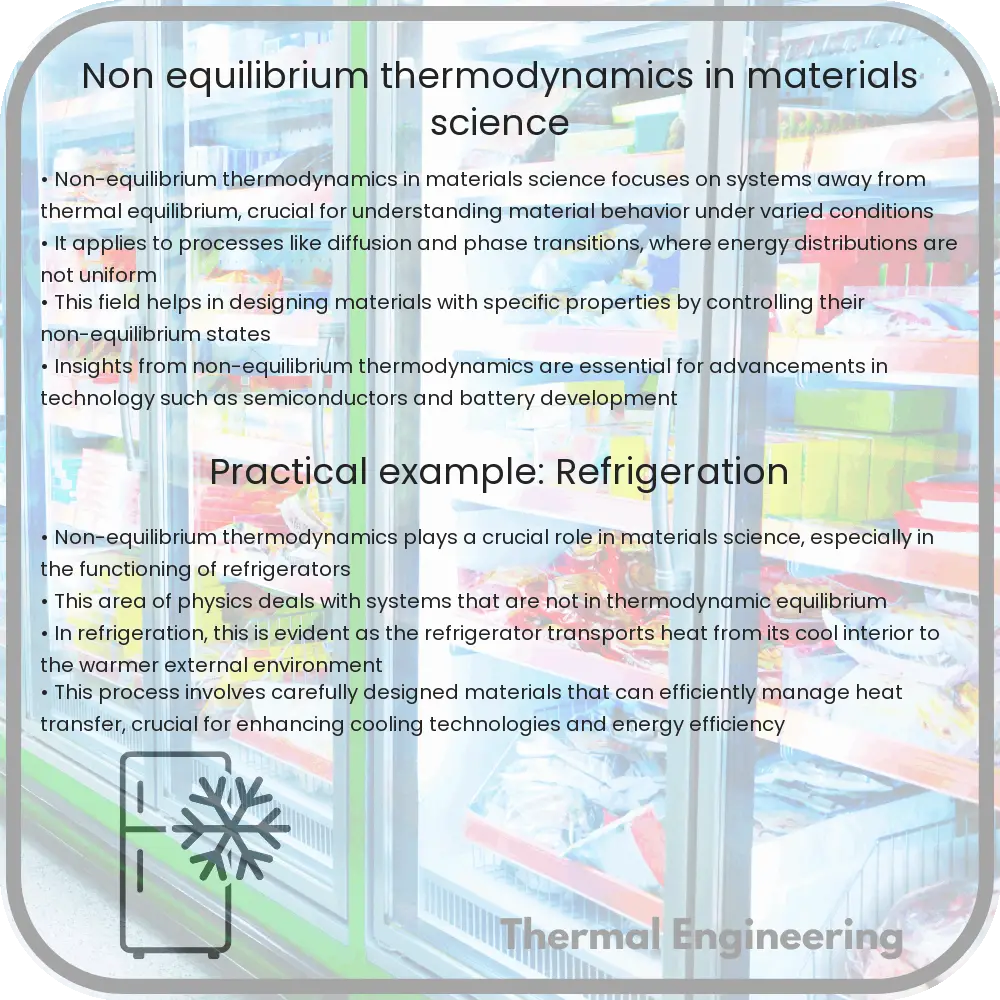
Non-equilibrium thermodynamics is a branch of physics that deals with systems that are not in thermodynamic equilibrium. Most natural processes occur far from equilibrium, and understanding these systems is crucial in materials science. This discipline plays a key role in developing new materials and improving existing ones, by controlling the processes that depend on thermal history such as phase transformations, diffusion, and reaction kinetics.
Basics of Non-Equilibrium Thermodynamics
In classical thermodynamics, the focus is on systems in equilibrium where macroscopic properties like temperature and pressure are uniform and do not change over time. Non-equilibrium thermodynamics, however, deals with conditions where these variables may vary within the system, leading to flows of energy and matter.
This approach involves extending the laws of thermodynamics to situations where irreversible processes occur, such as in the presence of temperature gradients, chemical reactions, or other external forces. The second law of thermodynamics, which in equilibrium states that entropy never decreases, is reformulated to account for the continuous production and flow of entropy in non-equilibrium systems.
Key Concepts in Non-Equilibrium Thermodynamics
- Entropy Production: In non-equilibrium conditions, entropy production is crucial. It quantifies the irreversibility of a process and is always a non-negative quantity.
- Fluxes and Forces: Non-equilibrium thermodynamics often involves various fluxes (like heat flux or particle flux) and thermodynamic forces (gradients of temperature, chemical potential, etc.) that drive these fluxes.
- Onsager’s Reciprocal Relations: These are fundamental relations that provide a framework to relate fluxes and forces in linear non-equilibrium systems. They imply that the matrix of coefficients linking these quantities is symmetric.
Applications in Materials Science
Understanding non-equilibrium thermodynamics is essential in materials science, especially in areas such as:
- Diffusion: Describing how atoms and molecules move in materials, which affects the properties of alloys and ceramic materials.
- Phase Transformations: Non-equilibrium conditions influence the kinetics of phase changes in materials, critical for processing techniques like quenching in metallurgy.
- Thermal Treatments: Procedures like annealing, tempering, and hardening are governed by principles of non-equilibrium thermodynamics, affecting the microstructure and mechanical properties of materials.
Challenges and Future Directions
The study of non-equilibrium systems in materials science presents numerous challenges, primarily due to the complexity of these systems and the mathematical models involved. Researchers continue to develop more accurate and computationally efficient methods to better understand and predict the behavior of materials under non-equilibrium conditions.
Moreover, advances in experimental techniques, such as ultra-fast spectroscopy and high-resolution electron microscopy, allow scientists to observe the microscopic processes in real-time, providing deeper insights and validations for theoretical models.
As we improve our understanding and computational capabilities, non-equilibrium thermodynamics will enable more precise control over material properties, leading to innovative applications and more efficient materials processing technologies.
Conclusion
Non-equilibrium thermodynamics in materials science offers extensive opportunities for innovation and improvement in material properties and processing techniques. By bridging the gaps between theoretical understanding and practical application, this field continues to be a fundamental part of advancements in materials science and engineering.