Learn how thermal analysis is used in forensic engineering to investigate material failures and understand thermal histories in engineering accidents.
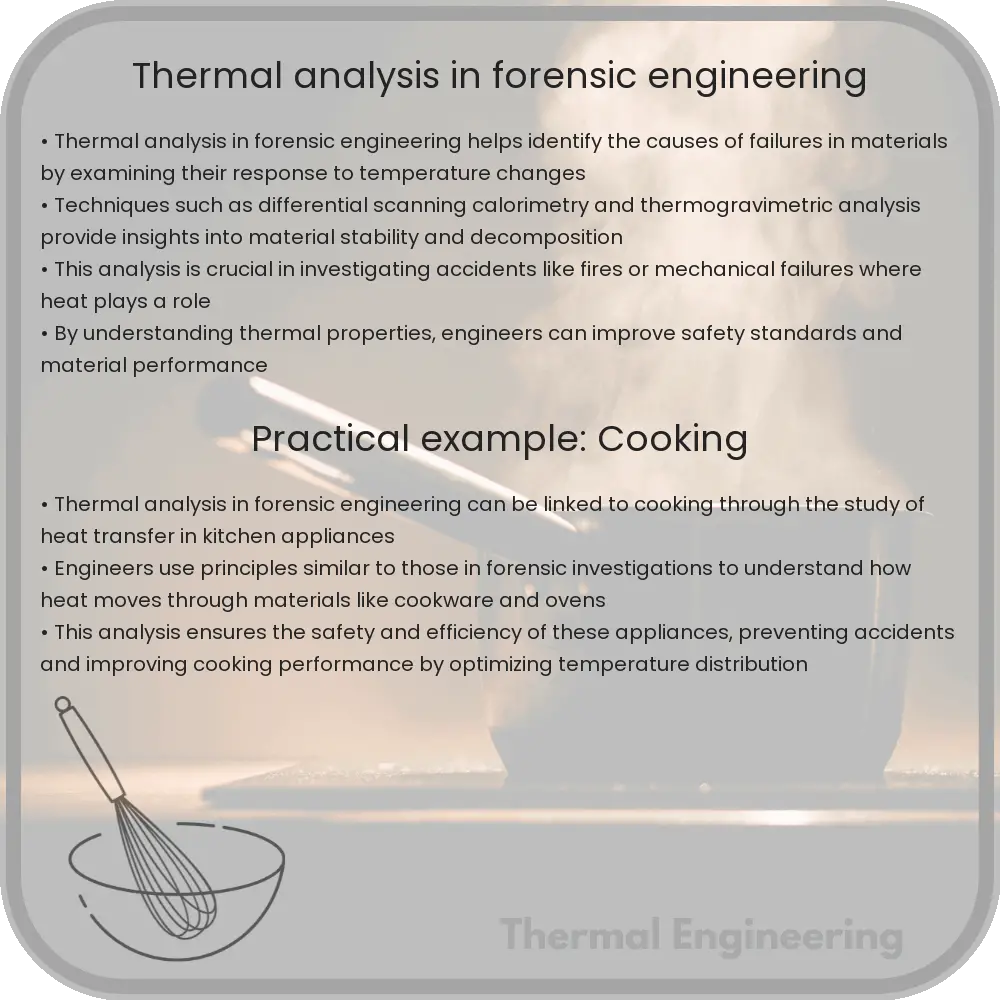
Understanding Thermal Analysis in Forensic Engineering
Forensic engineering is the field that involves the investigation of materials, products, structures or components that fail or do not operate as intended, often causing personal injury or damage to property. One of the critical techniques used in forensic engineering to determine the causes of failures is thermal analysis. This tool can provide invaluable data about the thermal properties of materials that undergo changes due to temperature variations which could be due to a number of factors including misuse, accidents, or design flaws.
What is Thermal Analysis?
Thermal analysis refers to a branch of materials science where the properties of materials are studied as they change with temperature. Specifically, in forensic engineering, thermal analysis helps investigators understand the thermal history of a component, which can indicate whether the material was subjected to abnormal conditions such as excessive heat or cold, exposure to fire, or electrical malfunctions.
Types of Thermal Analysis Techniques
- Differential Scanning Calorimetry (DSC): DSC measures how much heat a sample absorbs or releases as it is heated or cooled. This information helps identify specific transitions such as melting, crystallization, or phase changes which can indicate if a material has been exposed to conditions outside its design specifications.
- Thermogravimetric Analysis (TGA): TGA measures the amount of weight change a material undergoes as it is heated or cooled. This technique can detect decomposition, oxidation, and other reactions that indicate thermal degradation.
- Dynamic Mechanical Analysis (DMA): DMA measures changes in material properties as a function of temperature, time, and frequency. It is particularly useful for evaluating polymers and can help determine if a failure resulted from material fatigue under cyclic thermal stress.
Application of Thermal Analysis in Forensic Investigations
Thermal analysis can be crucial in determining why a material failed. For instance, if a polymer component in a machine failed leading to an accident, DMA could determine whether the failure was due to inadequate heat resistance of the polymer which might not have been aligned with its specified operational temperature range. Similarly, in the case of a structural fire, DSC can reveal whether the materials used were not compatible with the fire safety requirements, thus contributing to the spread of the fire.
Case Studies
- In an investigation of an electronic device fire, TGA was used to determine that the polymer casing had undergone significant thermal degradation at temperatures lower than the specified threshold for the material. This indicated a potential flaw in the material selection or manufacturing process.
- A building collapse investigation utilized thermal analysis to reveal that the metallic structure had not been treated for thermal expansion and contraction, which weakened the integrity of the building’s framework over time as it was exposed to seasonal temperature variations.
Thermal analysis provides forensic engineers with a deeper insight into the materials involved in failures, allowing them to piece together the sequence of events leading up to an incident. This crucial analysis supports not only the determination of causality in legal cases but also helps in formulating guidelines for safer material practices and preventive measures in engineering design.