Explore the essential role of thermal analysis in enhancing the performance and safety of lithium-sulfur batteries.
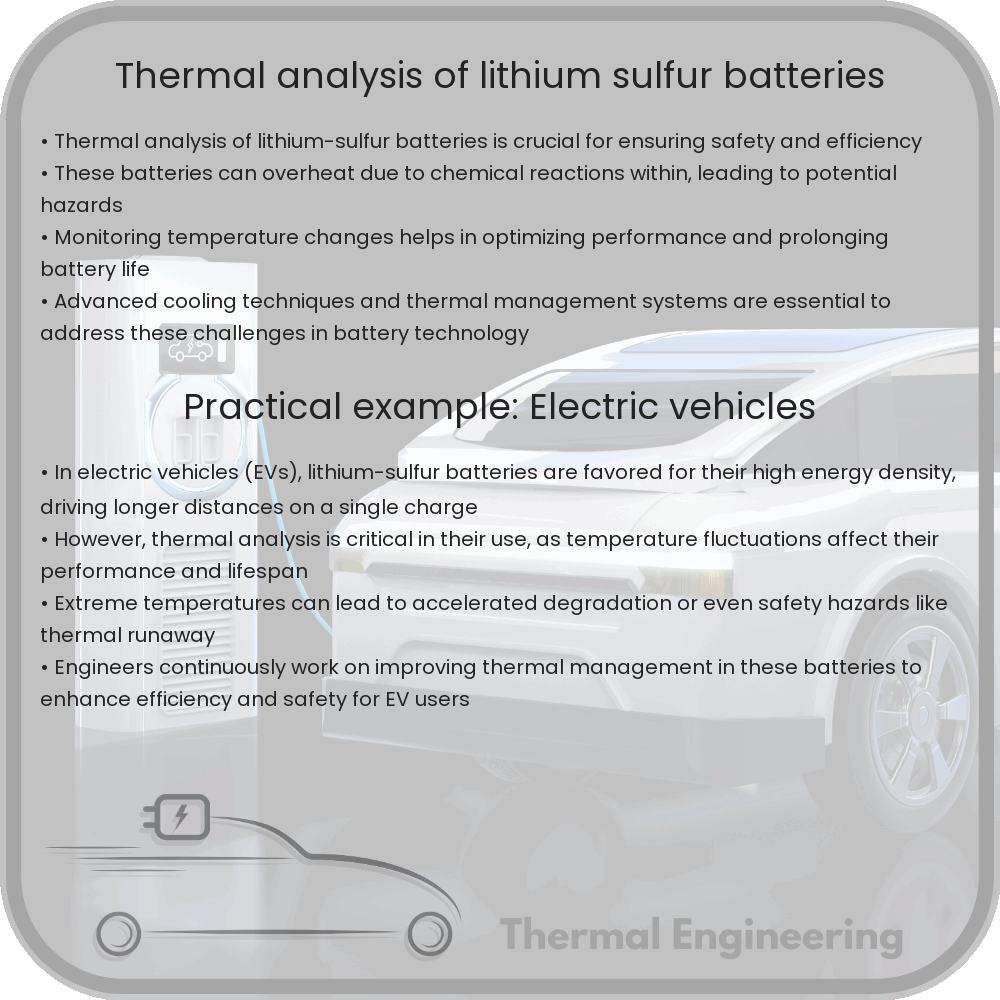
Understanding Thermal Analysis of Lithium-Sulfur Batteries
The field of battery technology is crucial for the development of energy storage solutions, particularly in applications such as electric vehicles and portable electronic devices. Among various battery types, lithium-sulfur (Li-S) batteries are gaining attention due to their high energy density and cost-effectiveness. However, their commercial application is hindered by several challenges, including thermal stability issues. Thermal analysis plays a key role in addressing these challenges by helping to understand and improve the thermal behavior of Li-S batteries.
Why Thermal Analysis is Important for Li-S Batteries
Thermal analysis involves studying the response of materials and systems to changes in temperature. In the case of Li-S batteries, thermal analysis is critical because these batteries can experience significant heat generation during charge and discharge cycles. Excessive heat can lead to accelerated degradation of the battery components, reduced efficiency, and even safety hazards such as thermal runaway.
Effective thermal management and analysis can lead to:
- Improved battery performance and lifespan by mitigating overheating and ensuring operation within a safe temperature range.
- Enhanced safety through the prevention of thermal runaway, which is a critical concern for all battery technologies.
- Better understanding of material behavior under thermal stress, which is essential for the development of more robust battery systems.
Key Methods in Thermal Analysis of Li-S Batteries
The main methods used in the thermal analysis of Li-S batteries include Differential Scanning Calorimetry (DSC), Thermogravimetric Analysis (TGA), and Accelerating Rate Calorimetry (ARC). Each technique offers insights into different aspects of thermal behavior:
- Differential Scanning Calorimetry (DSC): DSC measures the heat flow into or out of a battery as a function of temperature and time. It is used to identify specific heat-related events such as melting or crystallization temperatures, as well as heat capacities of the battery materials.
- Thermogravimetric Analysis (TGA): TGA measures the amount of weight change that a battery material undergoes as it is heated or cooled. This method is useful for studying thermal stability and decomposition characteristics of the battery components.
- Accelerating Rate Calorimetry (ARC): ARC is used to assess the rate of heat release under adiabatic conditions. It is particularly valuable for studying the risk of thermal runaway in battery systems.
Challenges and Solutions in Thermal Management
One of the primary challenges in the thermal management of Li-S batteries is the control of heat generation and dissipation during high-rate discharge and charge cycles. The following strategies are commonly utilized to address this issue:
- Design of battery packs with effective thermal interfaces and heat dissipation paths.
- Incorporation of phase change materials that absorb and release heat to moderate temperature fluctuations.
- Optimization of battery geometry and cell arrangement to enhance thermal uniformity across the battery pack.
Advancements in thermal management technologies not only enhance the safety and performance of Li-S batteries but also contribute to their broader adoption in various applications.
Future Perspectives
With ongoing research and development, the thermal analysis and management of Li-S batteries continue to evolve. Future work is likely to focus on integrating real-time thermal monitoring systems into battery management systems (BMS), developing novel materials with improved thermal properties, and enhancing predictive models for better safety and efficiency. As these technologies mature, the role of thermal analysis in optimizing and validating battery designs becomes increasingly critical, paving the way for more reliable and powerful lithium-sulfur battery systems.