Learn about Thermal Barrier Coatings (TBCs), designed to enhance heat resistance and boost engine efficiency in high-temperature systems.
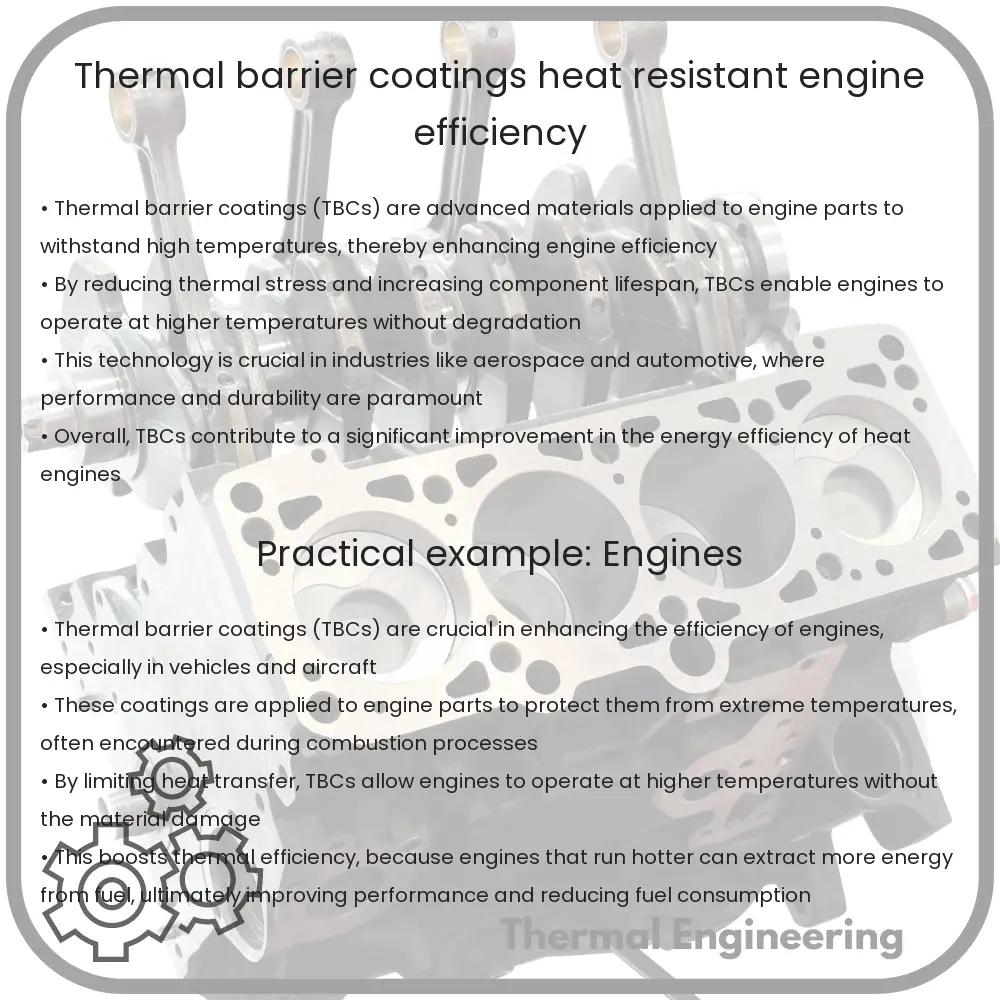
Understanding Thermal Barrier Coatings: Enhancing Heat Resistance and Engine Efficiency
Thermal Barrier Coatings (TBCs) play a pivotal role in the field of engineering, especially in enhancing the efficiency and performance of high-temperature systems such as gas turbines, aero-engines, and automotive engines. These advanced coating systems are specifically designed to protect components from excessive heat by providing a thermally resistant layer. This not only extends the lifespan of the components but also improves the overall efficiency of the engine by allowing for higher operating temperatures.
Composition and Functionality of Thermal Barrier Coatings
TBCs are generally composed of materials that have low thermal conductivity, high stability at elevated temperatures, and good thermal shock resistance. The most commonly used material for TBCs is yttria-stabilized zirconia (YSZ). YSZ is effective because it maintains its stability and insulating properties at very high temperatures, up to 1200°C or more.
The structure of a typical TBC system includes a bond coat and a ceramic top coat. The bond coat, often made of metallic alloys, serves to improve the adhesion of the ceramic layer to the substrate and to protect the underlying metal from oxidation and corrosion. The ceramic layer, which is the actual thermal barrier, drastically reduces the heat transfer to the metal component.
Impact on Engine Efficiency
By insulating the metal components of an engine from extreme heat, TBCs allow the engine to operate at higher temperatures. This is crucial because the efficiency of a thermal engine is related to the temperature difference between the hot and cold parts of the system. According to the thermodynamic principle known as the Carnot efficiency, the efficiency (\(\eta\)) of a thermal engine is given by:
\[\eta = 1 – \frac{T_c}{T_h}\]
where \(T_c\) is the temperature of the cold reservoir and \(T_h\) is the temperature of the hot reservoir. By using TBCs to increase \(T_h\), the efficiency of the engine can be significantly improved without the risk of heat-induced damage.
Applications of Thermal Barrier Coatings
- Gaseous Turbines: In turbines, TBCs reduce the temperature of the metallic parts, enhancing the durability and efficiency of the engine.
- Aero-Engines: Similar to gaseous turbines, TBCs in aero-engines enable higher operating temperatures, which improves fuel efficiency and performance.
- Automotive: TBCs are used in piston tops, cylinder heads, and exhaust systems in the automotive industry to improve engine efficiency and durability while reducing emissions.
Challenges and Future Perspectives
Despite their numerous benefits, the application of TBCs faces certain challenges. The principal issue is the durability of the coatings under extreme operating conditions. Over time, the thermal cycles can cause cracks and delamination of the ceramic layer, leading to failure of the barrier. Advances in materials science are focused on improving the toughness and adherence of these coatings to extend their life and reliability further.
Furthermore, research continues to explore alternative materials such as new ceramics and composites that can withstand higher temperatures and offer better performance. These developments promise to push the boundaries of existing engine designs toward higher efficiency and lower environmental impact.
In conclusion, Thermal Barrier Coatings represent a critical technology in high-temperature engineering applications. By allowing engines to operate at higher temperatures without compromising the structural integrity of metal components, TBCs significantly enhance the efficiency and longevity of engines. With ongoing research and technological advancements, the scope and efficacy of these coatings are only expected to improve, paving the way for more sustainable and efficient thermal systems.