Learn about thermal conductivity analyzers, critical tools for measuring a material’s heat conduction properties in various industries.
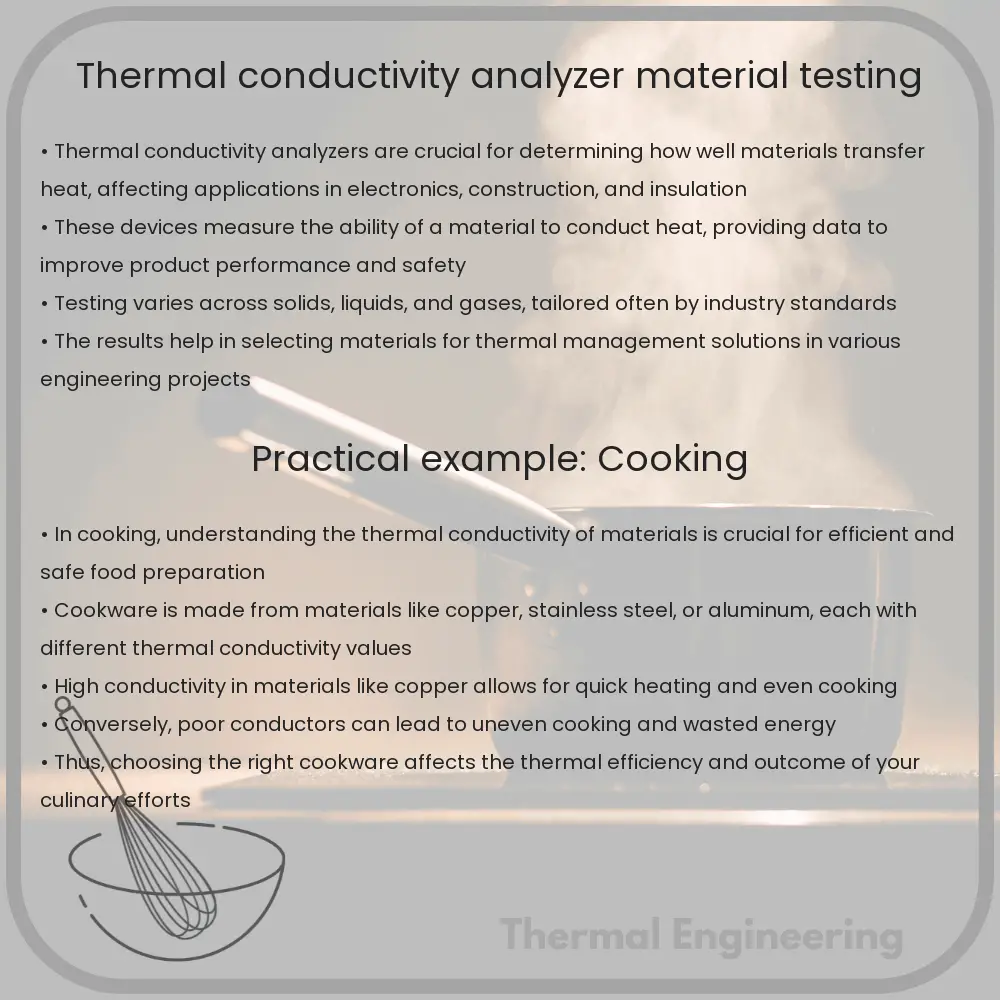
Understanding Thermal Conductivity Analyzers in Material Testing
Thermal conductivity is a critical physical property in materials science, determining how well a material can conduct heat. This characteristic is essential for a wide range of applications, from thermal insulation in the building sector to heat dissipation in electronic components. A thermal conductivity analyzer is an instrument used to measure the rate at which heat passes through a material, providing vital data for engineering and scientific research.
The Basics of Thermal Conductivity
Thermal conductivity, often denoted as ‘k’, quantifies the ability of a material to conduct thermal energy. It is defined by Fourier’s law of heat conduction, which can be expressed as:
q = -k * A * (dT/dx)
where:
- q is the heat flux (the amount of heat transferred per unit area per unit time),
- k is the thermal conductivity of the material,
- A is the cross-sectional area through which heat is flowing,
- dT/dx is the temperature gradient in the direction of the flow.
The negative sign indicates that heat flows from higher to lower temperatures. The SI unit for thermal conductivity is watts per meter-kelvin (W/m*K).
How a Thermal Conductivity Analyzer Works
Thermal conductivity analyzers can be based on several different methodologies, including steady-state techniques, transient techniques, and others. Among the most commonly used techniques are:
- Steady-State Method: This technique involves applying a constant heat source to one side of a sample and measuring the temperature difference after a steady state (no change in temperature with time) is reached. This method is suitable for materials with low and medium thermal conductivity.
- Transient Hot-Wire Method: In this approach, a thin wire is embedded in the material, and an electrical current is passed through it. The increase in temperature of the wire over time is monitored, and thermal conductivity is calculated based on this data. This method is quick and suitable for fluids and gases.
- Laser Flash Analysis: A laser pulse heats the surface of a small specimen, and an infrared detector or thermocouple measures the temperature on the opposite surface. The time it takes for the heat to travel through the specimen is used to calculate thermal conductivity.
Applications of Thermal Conductivity Testing
Thermal conductivity testing is crucial in several sectors:
- Construction and Building Materials: Determining the thermal insulation properties of materials such as foam, fiberglass, and brick.
- Electronics: Analyzing how well heat is dissipated in electronic components to prevent overheating and failure.
- Automotive: Testing materials used in engines and exhaust systems to ensure they can handle high temperatures efficiently.
- Energy: Evaluating materials for use in solar panels and other energy-conversion devices.
The data obtained from a thermal conductivity analyzer helps engineers and scientists choose the right materials for specific applications, enhancing performance and safety. Understanding thermal properties is fundamental in the development of new materials and for improving existing ones.
Conclusion
A thermal conductivity analyzer is a vital tool in materials science, crucial for assessing a material’s ability to conduct heat. This testing not only contributes to better material design and application in various industries but also leads to advancements in technology and improved energy efficiency. By analyzing thermal properties, engineers can ensure that materials will perform safely and effectively in their intended applications.