Learn about the ability of ceramics to withstand rapid temperature changes, a key factor in their use in demanding applications.
Understanding Thermal Shock Resistance in Ceramics
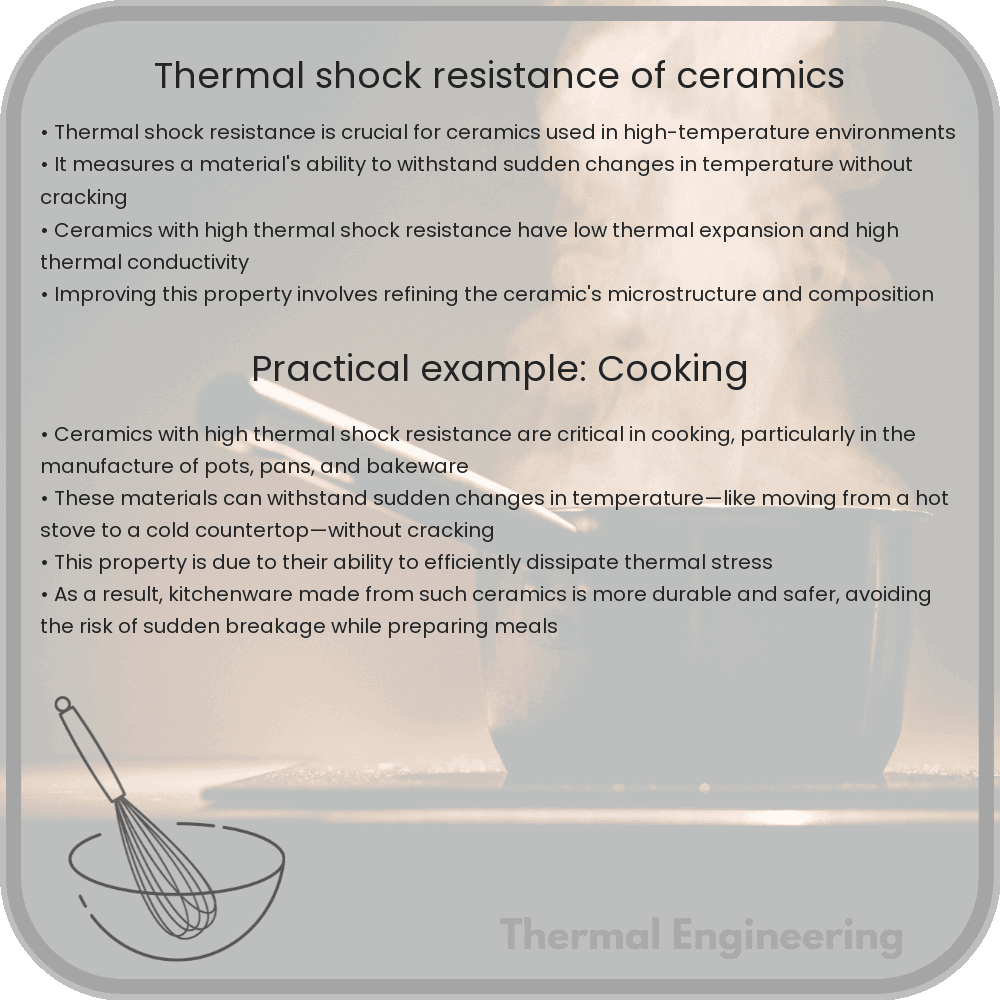
Thermal shock resistance is a critical property of ceramics, pivotal in various applications from spacecraft coatings to kitchenware. It is the ability of a material to withstand rapid temperature changes without damage. This characteristic is especially important for ceramics because, unlike metals, they tend to have low toughness and high brittleness, making them more susceptible to cracking under thermal stress.
What Causes Thermal Shock in Ceramics?
Thermal shock in ceramics occurs when a rapid temperature change induces differential thermal expansion within a material. Different parts of the ceramic expand or contract at different rates due to variations in temperature across its body. This uneven expansion creates stress within the material, potentially leading to cracks and, ultimately, failure.
Factors Influencing Thermal Shock Resistance
- Thermal Expansion Coefficient: Materials with lower coefficients of thermal expansion are less prone to stress under temperature changes.
- Elastic Modulus: A lower modulus of elasticity often indicates that the material can absorb more strain before failing.
- Thermal Conductivity: High thermal conductivity helps in rapidly distributing the thermal stresses over a larger area, reducing localized stresses.
- Strength and Toughness: Higher mechanical strength and toughness generally enhance the resistance to thermal shock.
Quantifying Thermal Shock Resistance
Thermal shock resistance can be quantified using various methods, one of which is the calculation of a thermal shock parameter, \( R \), defined as:
\[
R = \frac{\sigma \sqrt{a}}{E \alpha \Delta T}
\]
Where:
- \(\sigma\) is the strength of the material (in tension)
- \(a\) is the thermal diffusivity
- \(E\) is the Young’s modulus
- \(\alpha\) is the coefficient of thermal expansion
- \(\Delta T\) is the temperature change
This parameter helps in comparing the thermal shock resistance of different materials under similar conditions.
Applications of Ceramics with High Thermal Shock Resistance
Ceramics that exhibit high thermal shock resistance are essential in many high-stress environments:
- Aerospace: Components like space shuttle tiles and turbine blades require materials that can withstand extreme and rapid temperature fluctuations.
- Cookware: Ceramic cookware can go from refrigerator to oven without cracking, owing to good thermal shock properties.
- Electronics: Certain ceramic substrates are used in electronics for their ability to handle rapid thermal cycling during power cycling.
Improving Thermal Shock Resistance
Enhancing the thermal shock resistance of ceramics is often a key research area. Techniques include:
- Material Modification: Adding zirconia to alumina can improve both toughness and thermal shock resistance.
- Material Processing: Controlled cooling and heating rates during the manufacturing process can reduce residual stresses.
- Composite Materials: Developing composite ceramics with materials having different thermal properties to manage and distribute thermal stresses effectively.
In summary, thermal shock resistance is a vital property for ceramics in various engineering applications. Understanding and enhancing this characteristic allows the development of better, more resilient materials compatible with extreme working environments.