Learn about thermal storage systems, their types, capacity, and benefits in energy efficiency and sustainability.
Understanding Thermal Storage Systems: Capacity and Benefits
Thermal storage systems are an innovative engineering solution that store thermal energy for later use, either for heating or cooling applications. These systems are critical components in improving the efficiency of energy usage and supporting sustainable practices in various industries. In this article, we’ll explore the capacity of thermal storage systems and their myriad benefits.
Types of Thermal Storage Systems
There are three primary types of thermal storage systems, each based on the way they store heat:
- Sensible Heat Storage: Utilizes the physical properties of a medium, such as water or sand, to store heat. The energy is stored by raising the temperature of the medium.
- Latent Heat Storage: Involves materials, known as phase change materials (PCMs), that absorb or release heat as they change phase (e.g., from solid to liquid).
- Thermochemical Heat Storage: Incorporates chemical reactions to store and release heat, which can be very efficient as it involves minimal loss of energy over time.
Capacity of Thermal Storage Systems
Capacity typically refers to the amount of energy a system can store and release. It is often measured in kilowatt-hours (kWh) or megawatt-hours (MWh). The actual capacity of a thermal storage unit depends largely on the type of storage method and the materials used:
- In sensible heat storage, the capacity can be determined by the equation:
Q = m * c * ΔT
where Q is the thermal energy stored (in Joules), m is the mass of the storage medium (in kilograms), c is the specific heat capacity of the medium (J/kg·K), and ΔT is the temperature change of the medium (in Kelvin).
- In latent heat storage, the energy capacity is primarily influenced by the latent heat of fusion or vaporization of the phase change material. The energy stored (Q) can be expressed as:
Q = m * L
where L is the latent heat of the material (J/kg).
For thermochemical storage, the capacity can be much higher than sensible and latent systems as it is based on the energy changes from chemical reactions, which can store heat indefinitely with minimal losses.
Benefits of Thermal Storage Systems
Thermal storage systems offer a range of benefits:
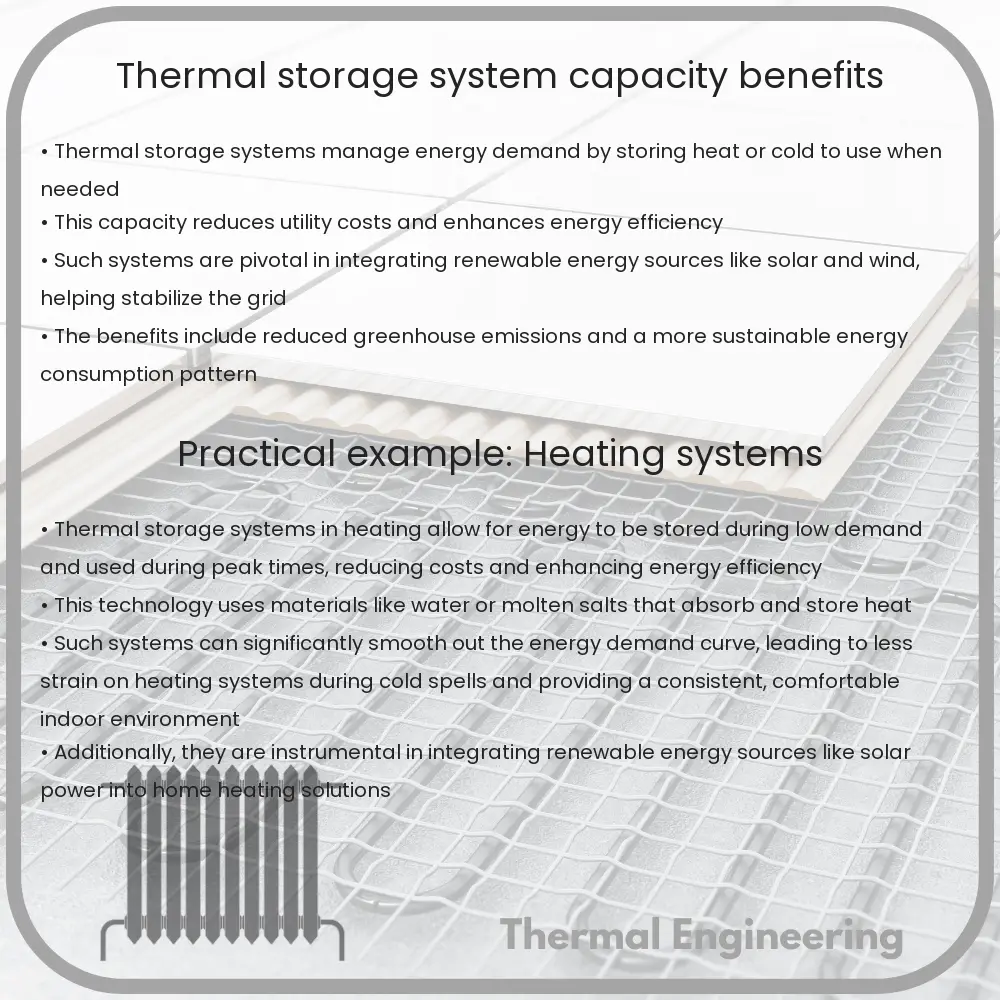
- Energy Efficiency: They can help reduce energy consumption and peak demand charges by allowing industrial and residential users to store excess energy produced during off-peak times and use it during peak hours.
- Rrenewable Energy Integration: These systems are ideal for smoothing out the supply of renewable energy sources, such as solar or wind, which are not consistent throughout the day.
- Cost-Effectiveness: By balancing supply and demand, thermal storage systems can significantly lower heating and cooling costs over time.
- Environmental Impact: They can reduce greenhouse gas emissions by optimizing the energy production from renewable sources and decreasing reliance on fossil-fueled power plants.
- Versatility: Thermal storage can be used in a variety of applications, from large-scale industrial processes to residential heating and cooling systems.
In conclusion, thermal storage systems, with their efficient and versatile energy storage capabilities, present an essential solution in the modern landscape of energy management and sustainability. Whether through sensible, latent, or thermochemical means, these systems harness the potential to revolutionize how we use and conserve energy across sectors.