Learn how thermodynamics guides the design of effective thermal insulators to manage heat transfer and enhance energy efficiency.
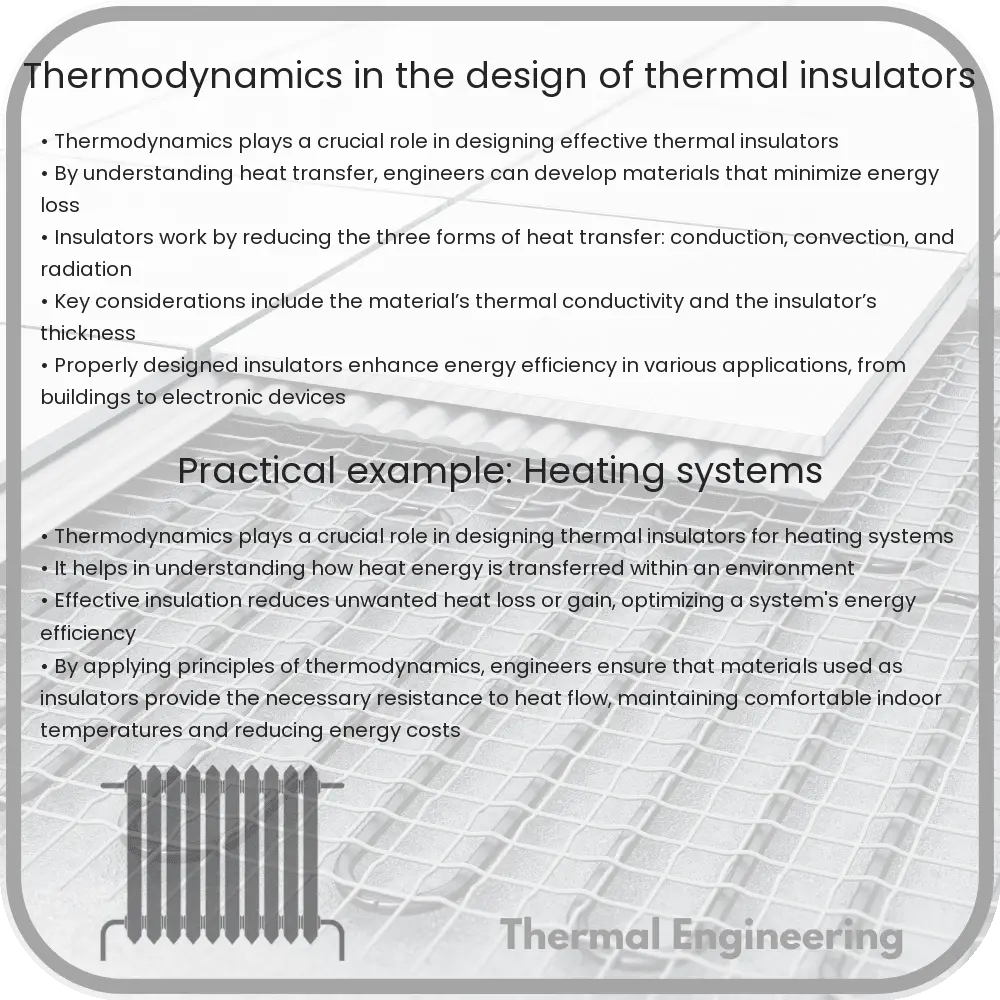
Understanding Thermodynamics in the Design of Thermal Insulators
Thermal insulation is a critical component in engineering, aimed at reducing the transfer of heat between objects in thermal contact or in the range of radiative influence. The design of thermal insulators relies heavily on the principles of thermodynamics, the branch of physics that deals with heat and temperature and their relation to energy and work. By understanding these principles, engineers can design materials and systems that effectively manage heat flow, enhancing energy efficiency and comfort in various applications from buildings to aerospace.
The Role of Thermodynamics in Insulation
Thermodynamics provides the foundational knowledge needed to understand how heat transfers through materials. This can be represented through the three methods of heat transfer: conduction, convection, and radiation. Effective thermal insulators must address and minimize these heat transfer modes.
- Conduction: This is the transfer of heat through materials without the movement of the substance itself. It occurs at the molecular level when a higher temperature object comes into contact with a lower temperature object. Engineers use materials with low thermal conductivity to reduce this type of heat transfer.
- Convection: Convection is the heat transfer that occurs with the physical movement of fluid (which may include air). In insulating systems, limiting air movement with compact designs or using materials that trap air can minimize convection.
- Radiation: Radiative heat transfer involves heat moving in the form of electromagnetic waves through a space. Materials that reflect radiative heat or have lower emissivity surfaces are key in reducing heat transfer by radiation.
Important Concepts of Thermodynamics Applied in Insulation Design
To effectively design insulators, several thermodynamic principles are particularly relevant:
- The First Law of Thermodynamics: This law, also known as the Law of Energy Conservation, states that energy cannot be created or destroyed in an isolated system. In insulation design, this principle underscores the need for materials that do not add or remove energy but only resist the flow of heat.
- The Second Law of Thermodynamics: This law states that the entropy (degree of disorder or randomness) of the universe tends to increase over time. In practical terms, this means heat will naturally flow from a warmer body to a cooler one. Effective insulators slow this process and manage the directionality of heat flow.
Materials and Technologies in Thermal Insulation
The choice of materials is critical in the design of effective thermal insulators. Materials used in insulation come in various forms and possess unique properties suitable for specific conditions and environments. Some common materials used include:
- Fiberglass: Composed mainly of fine strands of glass, fiberglass is widely used due to its low thermal conductivity and its ability to trap air.
- Polystyrene and Polyurethane Foam: These lighter, plastic-based materials are effective due to their structure that contains numerous small air pockets.
- Aerogel: Known as “frozen smoke,” aerogel has extremely low density and very low thermal conductivity, making it an exceptional insulator although it is more expensive compared to traditional materials.
Future Prospects and Innovations
As the demand for more efficient energy use continues to rise, so does the innovation in insulation materials and design. Emerging technologies focus on increasing insulator effectiveness while also reducing environmental impact. For instance, developments in nanoporous materials and vacuum insulated panels signify substantial advancements in this field. Engineers continue to leverage the evolving understandings of thermodynamics to create materials and systems that achieve superior insulation characteristics.
The field of thermal insulation demonstrates how thermodynamic principles are essential not just in understanding but also in actively designing solutions that address real-world challenges in energy efficiency and protection against extreme temperature environments.