Learn how thermodynamics applies to biological systems, emphasizing energy transformations and metabolic processes governed by its laws.
Understanding the Thermodynamics of Biological Systems
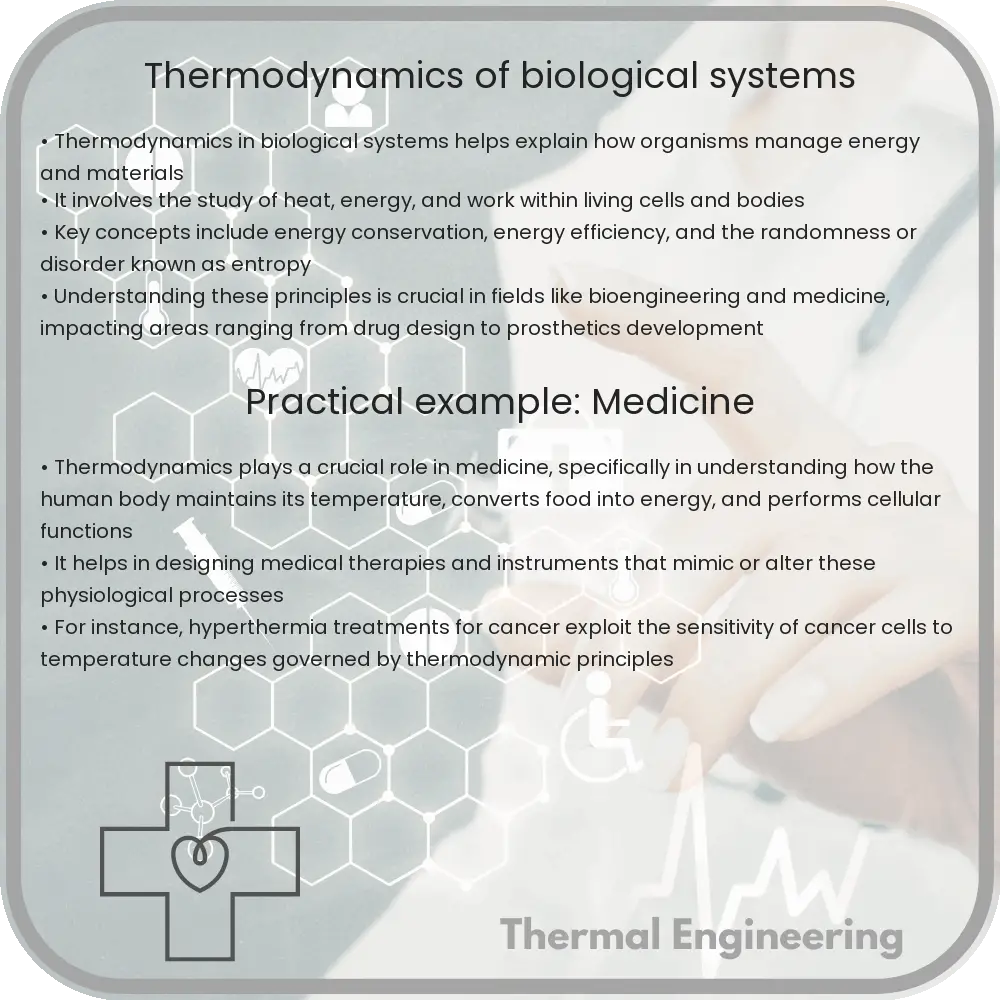
Thermodynamics, traditionally associated with physics and engineering, plays a crucial role in understanding how biological systems operate. This branch of science helps us discover how organisms manage energy transformations and maintain order amidst the chaos of the surrounding environment.
Basic Principles of Thermodynamics in Biology
In biological systems, thermodynamics is primarily concerned with two main processes: energy transfer and the transformation of energy within living organisms. The laws of thermodynamics govern these processes just as they do in physical systems. Here are the core concepts:
- The First Law of Thermodynamics – Also known as the Law of Energy Conservation, states that energy cannot be created or destroyed in an isolated system. In biological terms, this means that the total amount of energy in an organism remains constant, though it can change forms, such as from chemical energy in food to kinetic energy in movement.
- The Second Law of Thermodynamics – This law states that the entropy of an isolated system always increases over time. Entropy can be thought of as the measure of disorder or randomness. Biological systems, however, maintain low entropy (high order) by constant energy input, which is typically harnessed from the environment or from consumed nutrients.
Energy and Metabolism
At the heart of thermodynamics in biology is metabolism, the set of life-sustaining chemical reactions in organisms. These reactions primarily involve the conversion of energy from nutrients into usable chemical energy (ATP), along with the elimination of waste products.
Metabolism can be split into two categories:
- Catabolism – The breakdown of molecules to generate energy.
- Anabolism – The synthesis of all compounds needed by the cells using energy.
Both processes are driven by the energy transformations governed by the laws of thermodynamics. The efficiency of these transformations is critical for the survival of the organism.
Role of Enzymes in Thermodynamics
Enzymes play a pivotal role in the thermodynamics of biological systems by lowering the activation energy required to initiate a chemical reaction, thus making it easier for a reaction to occur and enhancing the rate at which it happens. This catalytic action helps manage the balance between energy release and energy storage necessary for cell function and overall organism health.
Thermodynamic Systems in Organisms
Biological systems can be thought of as open systems since they exchange both energy and matter with their environment. This differs from closed systems that exchange only energy with their surroundings, or isolated systems, which do not exchange energy or matter.
Examples of open systems in biology include:
- The human respiratory system, which takes in oxygen and expels carbon dioxide.
- Plant photosynthesis, where light energy is converted into chemical energy while exchanging gases with the environment.
Conclusion
The principles of thermodynamics are fundamental to understanding how biological systems function. They provide insights into how organisms efficiently use energy, maintain order, and interact with their environments. Whether in humans, animals, or plants, the laws of thermodynamics impact all aspects of life, showcasing the elegant complexity of nature’s engineering.