Learn about osmotic power generation, an innovative energy source that utilizes salinity gradients between seawater and river water to produce electricity through thermodynamic principles.
Understanding the Thermodynamics of Osmotic Power Generation
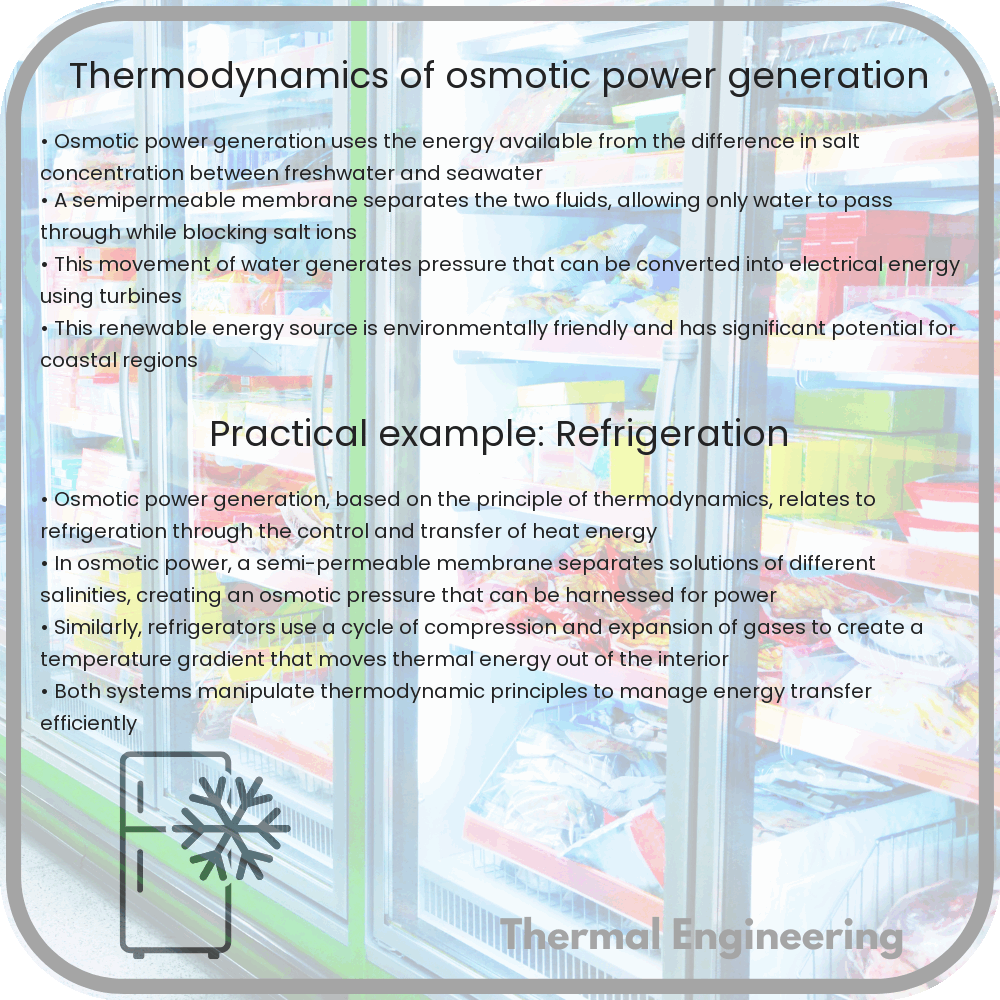
Osmotic power generation, also known as salinity gradient power or blue energy, harnesses the energy available from the difference in the salt concentration between seawater and river water. Let’s delve into the thermodynamic principles that make this innovative energy source possible.
Basic Principle of Osmotic Power
At its core, osmotic power generation revolves around the natural process where water moves from a lower concentration solution through a semipermeable membrane to a higher concentration solution, a process termed ‘osmosis.’ This movement of water generates pressure that can be converted into electrical energy.
Key Thermodynamic Concepts
- Gibbs Free Energy: In thermodynamics, the potential to generate power from the salinity gradient is explained through Gibbs free energy. This is the energy associated with a chemical reaction that can be used to perform work. The formula for Gibbs free energy (\(\Delta G\)) in the context of mixing river water and seawater can be represented as:
\[
\Delta G = -RT \ln(\frac{K_f}{K_i})
\]
where R is the gas constant, T is the absolute temperature, \(K_f\) is the final equilibrium constant, and \(K_i\) is the initial equilibrium constant.
- Osmotic Pressure: Osmotic pressure (\(\Pi\)) is crucial in osmotic power systems. It quantifies the pressure needed to stop the osmotic flow and can be calculated using the van’t Hoff equation, which for dilute solutions is:
\[
\Pi = iCRT
\]
where i is the van’t Hoff factor, C is the molar concentration of solute, and T is the absolute temperature.
Thermodynamic Cycle of Osmotic Power Generation
The practical application of osmotic power generation involves the use of PRO (Pressure Retarded Osmosis) or RED (Reverse Electrodialysis) systems to convert osmotic pressure into usable power.
- Pressure Retarded Osmosis (PRO): In PRO, sea water and fresh water are put on either side of a selective membrane. Water flows from the fresh to the saltwater side, increasing the pressure on the saltwater side. This pressurized saltwater then drives a turbine, generating electricity.
- Reverse Electrodialysis (RED): RED employs a series of ion-selective membranes alternating between permeability to positive ions and negative ions. As ions pass through these membranes from seawater to river water, it creates a voltage through electrochemical potential, which can drive an electric current.
Challenges and Efficiency
While osmotic power is promising, its efficiency and viability are affected by several factors:
- Membrane Performance: The efficiency of the semipermeable membrane and its ability to withstand high pressures and prevent fouling is crucial.
- Salt Concentration Gradient: The greater the difference in salinity between the bodies of water, the higher the potential power output.
- Thermal Considerations: Temperature affects osmotic pressure; warmer temperatures generally increase the rate of osmosis, potentially enhancing efficiency.
In conclusion, the thermodynamics of osmotic power exploits natural salinity gradients to produce a renewable energy source. Although challenges remain in terms of efficiency and technology, ongoing improvements in membrane technology and process optimization continue to enhance its potential as a sustainable power source.