Learn about the fundamental principles of phase equilibria in thermodynamics, which is crucial for various engineering and environmental applications.
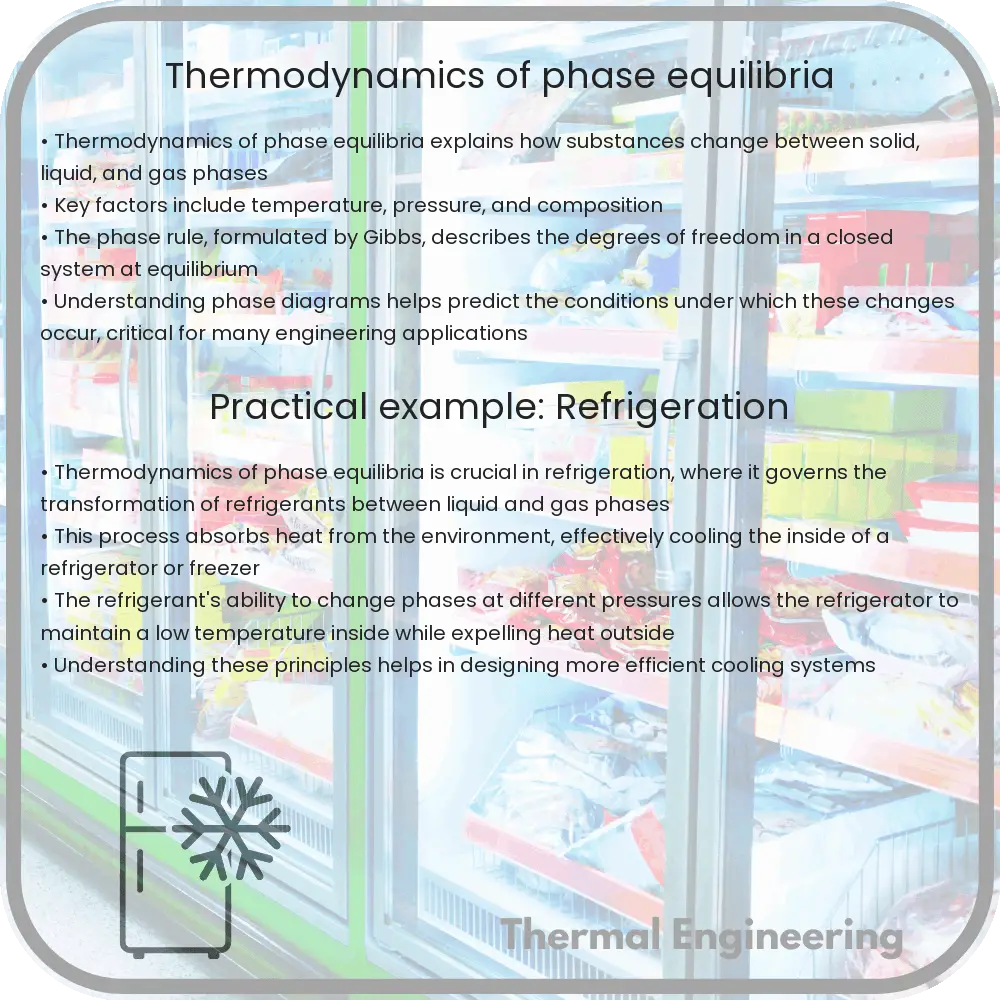
Understanding the Thermodynamics of Phase Equilibria
Thermodynamics is a fundamental branch of physics and engineering that deals with the relationships between heat, work, temperature, and energy in systems. Phase equilibria, a critical concept within thermodynamics, refers to the balance between different states (phases) of matter, such as solids, liquids, and gases, in a system at equilibrium. Understanding phase equilibria is essential for the design and operation of chemical processes, materials development, and environmental engineering.
Basics of Phase Equilibrium
In any system, the phases present can reach an equilibrium state where the mass and energy transfer between phases balance. The conditions under which these phases coexist can be described by the Gibbs phase rule, which provides a mathematical framework for predicting the number of degrees of freedom in a system:
\[\text{F = C – P + 2}\]
where F is the number of degrees of freedom, C is the number of components in the system, and P is the number of phases present. This rule helps us understand how variables like temperature and pressure affect the number of phases.
Phase Diagrams
Phase diagrams are graphical representations that show the conditions under which different physical states of a substance coexist at equilibrium. By examining a phase diagram, one can determine the boundaries between different phases and understand how changes in external conditions, such as pressure or temperature, impact the stability and transition of phases.
Key Concepts in Phase Equilibria
- Chemical Potential: The chemical potential is a critical concept in phase equilibria. It is the change in the system’s energy when an infinitesimal amount of substance is added, keeping the temperature and pressure constant. At equilibrium, the chemical potential of any component must be the same in all phases.
- Equilibrium Constant: The equilibrium constant is a measure of the extent to which a compound dissociates into its elements in a reversible reaction. For a reaction aA + bB ↔ cC + dD, the equilibrium constant (K) at a given temperature T is given by:
- Clausius-Clapeyron Equation: This equation describes how the pressure at which two phases coexist in a system changes with temperature. It is particularly useful for understanding the phase transition between vapor and liquid states:
\[ K = \left(\frac{{[C]^c \cdot [D]^d}}{{[A]^a \cdot [B]^b}}\right) \]
\[ \frac{{dP}}{{dT}} = \frac{{\Delta H_{\text{trans}}}}{{T \cdot \Delta V}} \]
where dP/dT is the rate of change of pressure with temperature, ΔHtrans is the enthalpy of transition, and ΔV is the change in volume during the phase change.
Practical Applications
Phase equilibria concepts are utilized across various engineering fields. For instance, in chemical engineering, they are essential for designing distillation processes that separate components based on differences in volatility. In mechanical engineering, phase diagrams aid in metal alloy design by delineating temperature and composition ranges for different microstructures. Environmental engineering uses these principles to understand pollutant behaviors and their condensation or evaporation under different conditions.
Conclusion
Phase equilibria provide a robust framework for understanding material behaviors across different phases and conditions. By leveraging thermodynamic principles, engineers can predict how changes in temperature, pressure, and composition influence material phases, leading to innovations in industrial processes, materials science, and environmental management. Emphasizing these concepts in engineering curricula equips future engineers with the foundational knowledge needed to tackle complex, real-world problems effectively.