Learn about thermoelectric cooling, a technology utilizing the Peltier effect for efficient heat transfer in various applications without moving parts.
Understanding Thermoelectric Cooling
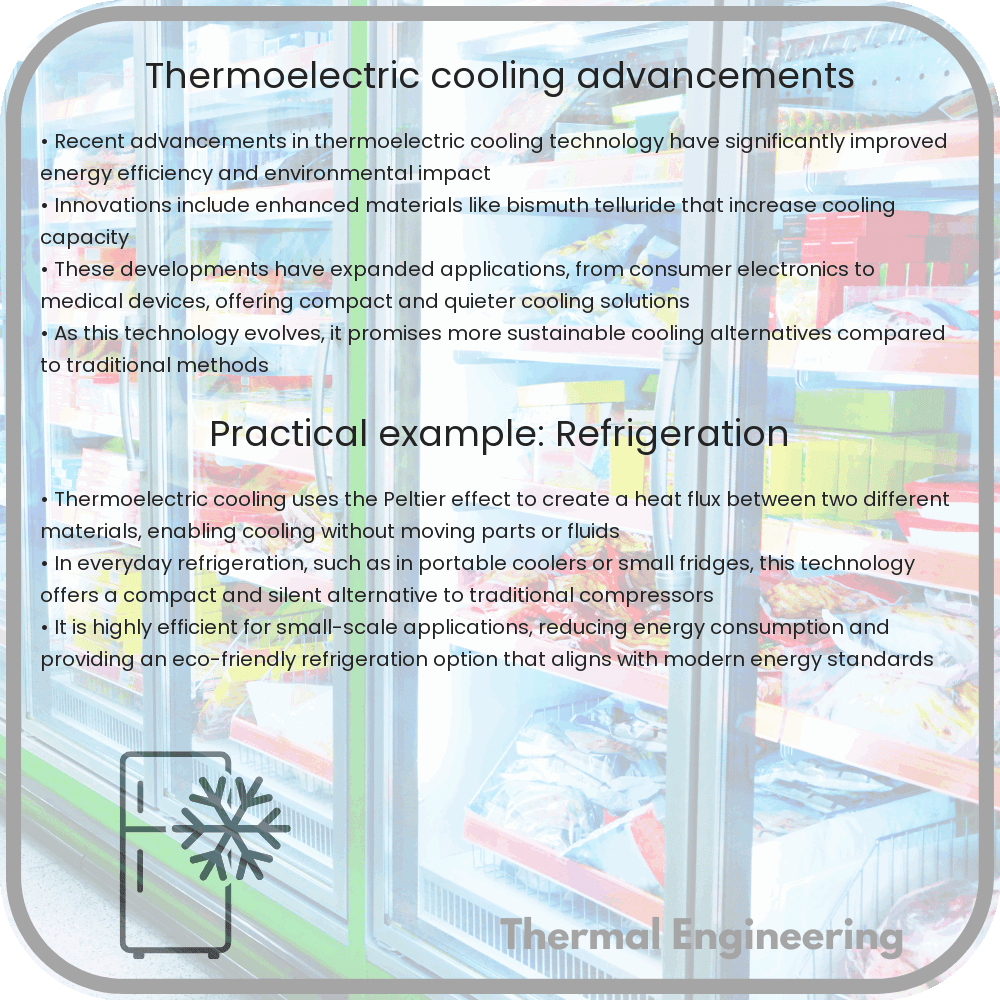
Thermoelectric cooling is a technology that harnesses the Peltier effect to create a heat flux between the junctions of two different types of materials. This method is highly valued for its ability to operate without moving parts or fluids, relying instead on semiconductor materials to manage heat. Its use spans from small cooling systems in electronics to more robust applications in refrigeration.
The Peltier Effect
The fundamental working principle of thermoelectric cooling is the Peltier effect. It occurs when an electric current passes through two different conductors or semiconductors; heat is absorbed at one junction (the cold side) and released at the other junction (the hot side). The operation can be reversed as well, providing both heating and cooling capabilities from the same device.
Materials and Efficiency
The efficiency of thermoelectric coolers (TECs) depends on the materials used. Traditionally, bismuth telluride has been the primary material used in most applications at room temperature. The dimensionless figure of merit (ZT) is used to measure the efficiency of these materials, where a higher ZT value indicates better performance. Recent advancements often focus on improving ZT through material science innovations.
Recent Advancements in Thermoelectric Cooling
- Nanostructured Materials: Recent developments in nanostructuring materials have shown significant potential in enhancing the efficiency of thermoelectric devices. Smaller particle sizes and interface engineering can decrease phonon transport while maintaining or increasing electron transport.
- Complex Thermoelectric Materials: Researchers are exploring beyond bismuth telluride to materials like skutterudites, clathrates, and quantum dots. These materials can potentially offer higher ZT values and better efficiency at different temperature ranges.
- Hybrid Approaches: Some advancements involve combining thermoelectric technology with other types of cooling technology, like compression cooling, to create hybrid systems. These systems aim to harness the benefits of both technologies, providing improved overall energy efficiency and cooling capacity.
Applications of Thermoelectric Cooling
Thermoelectric coolers are used in a variety of applications:
- Consumer Electronics: Portable coolers, refrigerated medicine cabinets, and precision temperature control devices in electronics, such as in computer CPUs or lasers.
- Automotive: Increasingly used in cars for seat cooling/heating and in wine coolers.
- Aerospace and Military: Used to maintain temperature-sensitive components in satellites and other high-performance platforms.
Challenges and Future Prospects
Despite its numerous applications, thermoelectric cooling faces challenges such as relatively low energy efficiency compared to traditional cooling methods like vapor compression. The potential for improvement exists, particularly through material innovations and system design optimizations. With ongoing research and development, the future of thermoelectric cooling looks promising, particularly for applications requiring compact and noiseless solutions with precise temperature control.
As thermoelectric technology continues to evolve, it promises to open new possibilities in cooling systems across commercial, industrial, and consumer applications, ensuring a significant role in the future of advanced thermal management solutions.