Learn about thermosyphon coolers, passive cooling systems utilizing natural convection for efficient heat transfer without external power.
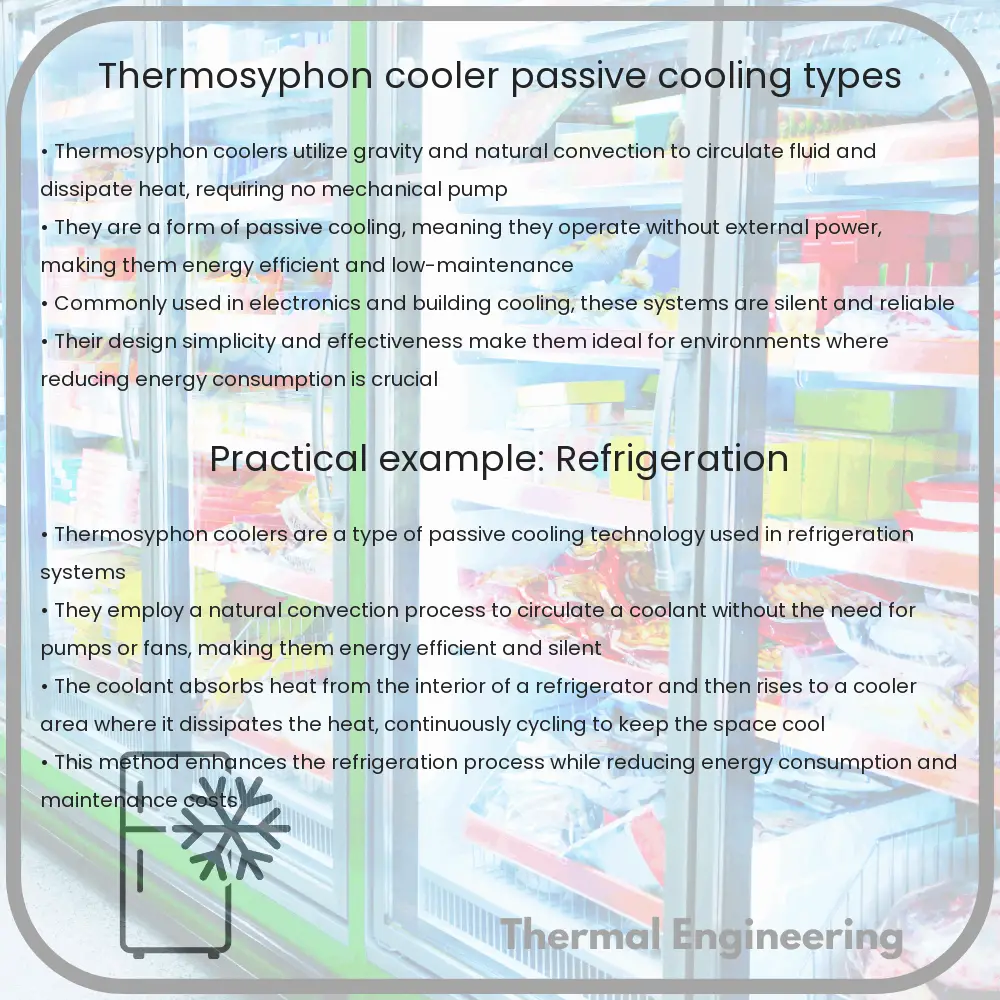
Understanding Thermosyphon Coolers: A Guide to Passive Cooling Systems
Thermosyphon coolers represent a fascinating application of thermal physics in engineering, providing efficient cooling mechanisms without the need for mechanical pumps. This method, which leverages the principles of natural convection and phase change, falls within a broader category of technologies known as passive cooling systems.
What is a Thermosyphon Cooler?
A thermosyphon cooler is a device that facilitates the transfer of heat through a fluid medium, typically without external power input. It uses a closed-loop system, relying on the natural convection currents generated by temperature differences within the fluid. The basic components of a thermosyphon include an evaporator section, a condenser section, and a connecting pipe that allows the fluid medium to circulate.
How Does a Thermosyphon Work?
The operation of a thermosyphon is grounded in the principles of heat transfer and fluid dynamics. The process consists of the following steps:
- Evaporation: The process begins at the evaporator, which is typically located at a lower position. Heat from an external source (such as an electronic component that needs cooling) is absorbed by the fluid inside the evaporator. As the fluid heats up, it changes phase from liquid to vapor, becoming less dense.
- Rising Vapor: Due to its lower density, the heated vapor rises naturally through the connecting pipe towards the condenser at the top.
- Condensation: At the condenser, the vapor releases its heat to the surroundings and transforms back into liquid form. This phase change releases a significant amount of latent heat, effectively removing heat from the fluid.
- Returning Liquid: The condensed liquid then travels back down to the evaporator due to gravity, aided by the cooler and denser liquid’s natural tendency to sink. This cycle repeats, continually transporting heat from the hot region to the cooler region.
The efficiency of a thermosyphon cooler is influenced by factors such as the properties of the working fluid (like thermal conductivity and heat of vaporization), the dimensions of the system components, and the temperature differential between the heat source and the ambient environment.
Applications of Thermosyphon Coolers
Thermosyphon systems are widely utilized in various applications where reliable and maintenance-free cooling is necessary:
- Electronic Equipment: They are used to cool high-performance computing systems and other electronic components.
- Solar Water Heaters: Thermosyphons are crucial in passive solar water heating systems, helping to transport heat from solar collectors to storage tanks.
- Refrigeration: In some refrigeration applications, these coolers help maintain optimal temperatures with greater energy efficiency compared to active cooling methods.
Advantages of Thermosyphon Coolers
Thermosyphon coolers offer several advantages over traditional mechanical cooling systems:
- No Moving Parts: The absence of mechanical pumps or fans minimizes maintenance requirements and enhances reliability.
- Energy Efficiency: They require no additional energy input for the coolant’s circulation, relying solely on natural convection.
- Cost-Effective: Lower operating and maintenance costs make thermosyphons an economical choice for many cooling applications.
- Scalability: The design can be scaled for different applications, from small electronic devices to large industrial systems.
In conclusion, thermosyphon coolers are a prime example of how fundamental physical principles can be applied ingeniously in engineering to solve practical problems, particularly in the realm of thermal management. Their simple yet effective operation, coupled with cost and energy efficiency, makes them an attractive option for passive cooling needs across various sectors.