Tritium gas, a radioactive hydrogen isotope, is used in self-luminous applications, thermal energy sources, and nuclear fusion.
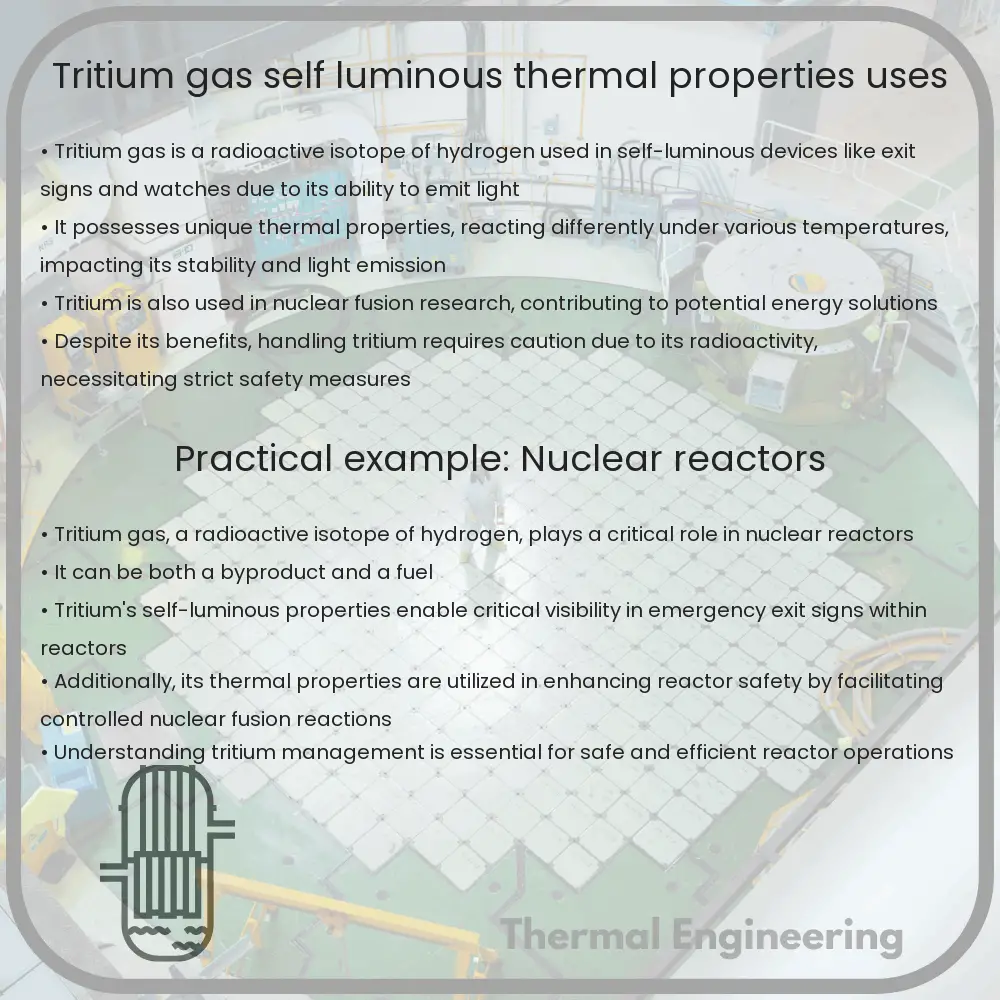
Understanding Tritium Gas: Self-Luminous Characteristics, Thermal Properties, and Uses
Tritium gas, denoted as 3H or T2, is a radioactive isotope of hydrogen. Comprising one proton and two neutrons, tritium is unique among the hydrogen isotopes for its radioactivity and has several distinctive physical and chemical properties that are exploited in various technological applications.
Self-Luminous Characteristics
Tritium is renowned for its ability to emit light through a process called radioluminescence. When tritium gas is sealed in phosphor-coated tubes, the beta particles (electrons) it emits interact with the phosphor material, causing the phosphor to glow. This luminescence does not require external energy sources, making tritium an ideal candidate for self-luminous applications:
- Exit signs: Tritium is used in self-illuminated exit signs in buildings, which are reliable because they do not depend on external power sources.
- Watches and instruments: The dials and displays of certain watches and aircraft instruments are coated with tritium to enable visibility in the dark.
- Emergency lighting: Tritium provides low-level lighting for pathway marking in military and commercial aircraft, submarines, and in other areas where reliability is critical under all conditions.
Thermal Properties
The thermal characteristics of tritium are intriguing due to its radioactive nature. It undergoes beta decay to helium-3 with a half-life of approximately 12.32 years, releasing 18.6 keV of energy per decay. This decay process leads to a release of heat, a property that can be utilized in various ways:
- Radioisotope Thermoelectric Generators (RTGs): Some proposed designs for RTGs suggest using tritium as a heat source to generate electricity in space missions, leveraging its decay heat.
- Research: Understanding tritium’s decay and associated thermal output is crucial for nuclear fusion research, especially in experiments involving heavy water reactors where tritium is a byproduct.
Uses of Tritium
Beyond its self-luminosity and thermal properties, tritium has several other applications across diverse industries:
- Nuclear Fusion: Tritium is a key fuel in nuclear fusion research due to its ability to release a significant amount of energy when fused with deuterium. Projects like the International Thermonuclear Experimental Reactor (ITER) focus heavily on utilizing the D-T (deuterium-tritium) fusion reaction.
- Hydrology: As a tracer, tritium can help determine the age of recent groundwater, providing valuable information about water resources and hydrological cycles.
- Scientific Research: Its radioactive properties make tritium useful in biological and chemical research, for tracing and labeling studies.
Tritium, despite its radioactive nature, poses minimal health risks in contained applications due to its weak penetration ability and low radiation energy. However, safety protocols and regulatory guidelines are strictly adhered to when handling and disposing of tritium to avoid environmental contamination and ensure public safety.
In conclusion, tritium’s unique properties make it invaluable across several fields, from emergency lighting to advancing our understanding and application of nuclear fusion technology. As research continues, the contributions of this small but mighty hydrogen isotope are expected to expand, illuminating both practical applications and fundamental scientific inquiries.