Learn about vortex-induced vibrations (VIV), the challenges they pose to structures like bridges and pipelines, and the solutions used to mitigate their effects.
Understanding Vortex-Induced Vibrations
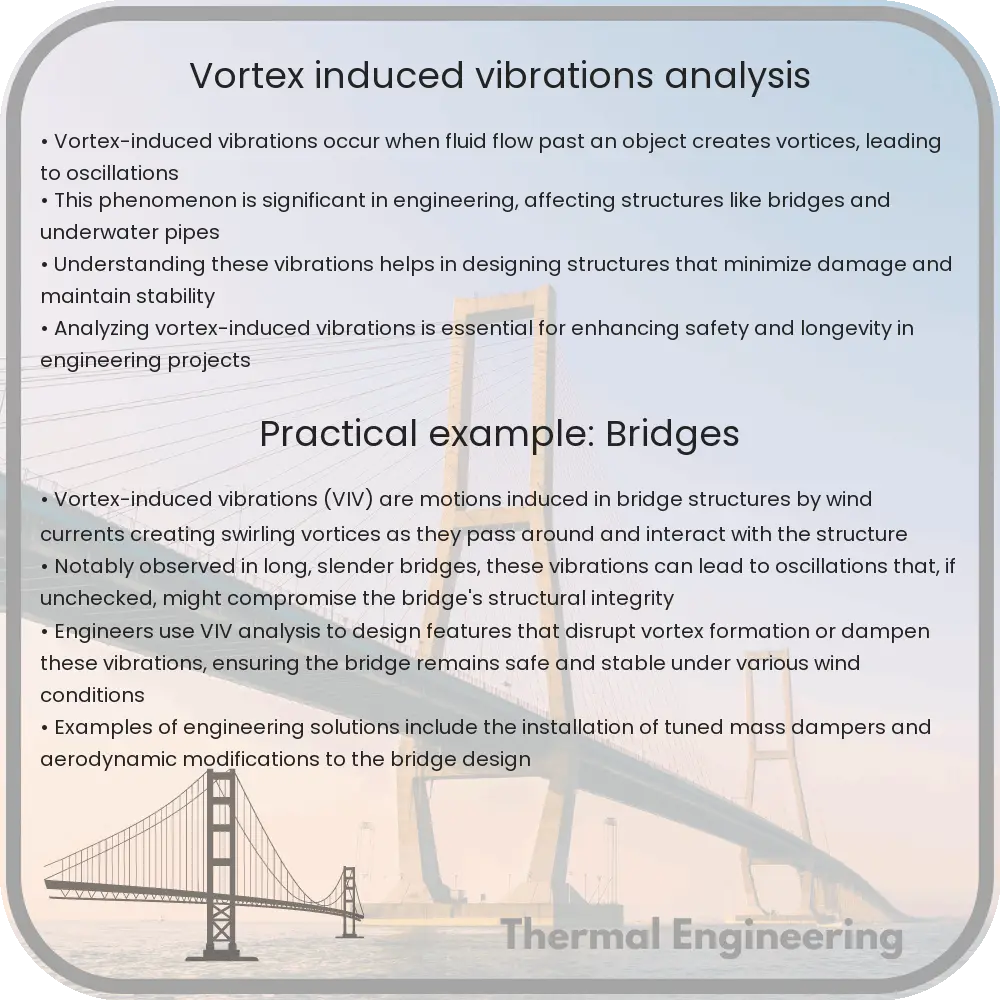
Vortex-induced vibrations (VIV) are motions induced in body structures subjected to fluid flow. The phenomenon is commonly observed in engineering and can affect structures such as skyscrapers, bridges, underwater pipelines, and cables. Understanding VIV is crucial for the design of these structures to prevent potential damage or failure over time.
What Causes Vortex-Induced Vibrations?
When a fluid, such as air or water, flows past a bluff (non-streamlined) body, vortices or swirling flows are shed from the body’s downstream side. This process is known as vortex shedding and is characterized by alternating low-pressure vortices formed on both sides of the body. The pressure differences across the body caused by these vortices lead to fluctuating forces that can induce vibrations in the body.
The frequency at which these vortices shed is known as the shedding frequency, which often depends on the velocity of the fluid flow, the density and viscosity of the fluid, and the dimensions and shape of the body. The shedding frequency can be estimated by the dimensionless Strouhal number (St), given by:
\[
\text{St} = \frac{f \times D}{V}
\]
where:
- f is the shedding frequency,
- D is the characteristic diameter, and
- V is the flow velocity.
Effects of VIV on Structures
VIV can lead to a range of problems for engineering structures, including fatigue damage, reduced structural integrity, and even catastrophic failures. For example, in offshore engineering, VIV is a significant concern for the design and operation of risers and subsea pipelines. The continuous vibrations caused by VIV can fatigue the material, leading to cracks and the eventual failure of the infrastructure.
Preventative Measures and Solutions
Several strategies can be employed to mitigate the effects of VIV in engineering structures:
- Vortex Suppressors: These are devices attached to the structure that alter the flow around the body to reduce vortex shedding. Common examples include fairings and strakes.
- Tuned Mass Dampers: These are devices installed in structures to absorb the vibrational energy caused by VIV. By tuning these dampers to the dominant frequency of the vibrations, the impact of VIV can be significantly reduced.
- Shape Optimization: Modifying the shape of the structure to streamline the flow can drastically reduce VIV. This approach is often used at the design stage of new structures.
Advances in computational fluid dynamics (CFD) and real-time monitoring technologies also allow for improved prediction and management of VIV effects on structures.
Conclusion
Vortex-induced vibrations represent a critical concern in the field of structural engineering, particularly for structures exposed to fluid flows. Through a combination of design innovation and technological solutions, engineers can effectively manage and mitigate the risks associated with VIV, ensuring the longevity and safety of vital infrastructure.