Learn about Thermal Interface Materials (TIMs), essential for managing heat in electronic devices to enhance performance and longevity.
What Is a Thermal Interface Material?
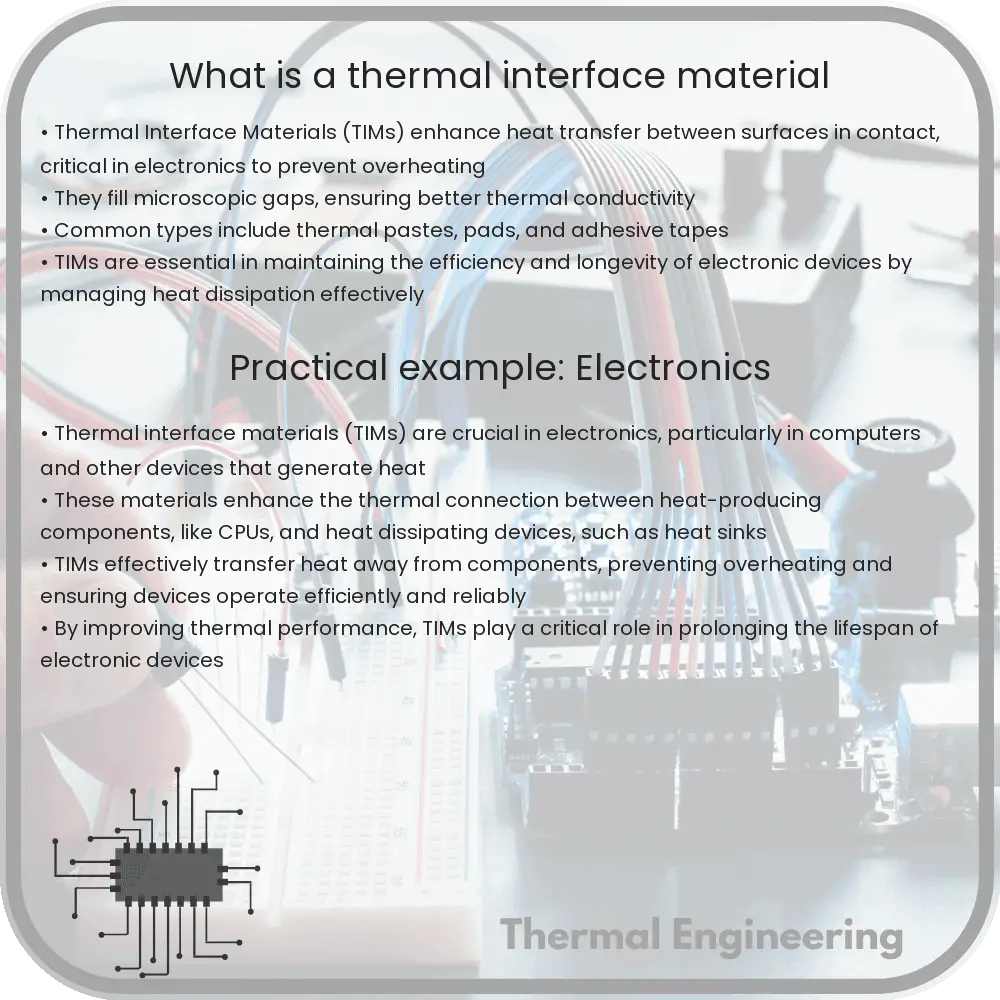
Thermal Interface Material (TIM) is a critical component in the engineering and electronics fields, playing a pivotal role in the management of heat in electronic devices. As electronic devices operate, they generate heat, which can degrade their performance and lifespan if not properly dissipated. TIMs are used to enhance thermal transfer between heat-generating components and heat dissipation parts, such as heatsinks.
Types of Thermal Interface Materials
There are several types of TIMs, each with unique properties and applications:
- Thermal Greases: Also known as thermal paste, these are viscous fluid substances that fill air gaps and microscopic irregularities between the surfaces.
- Thermal Pads: These are pre-cut pieces of soft material that act as a filler between two surfaces. They are easier to use but generally offer lower thermal conductivity compared to greases.
- Phase Change Materials: These materials change state from solid to liquid at certain temperatures to enhance thermal conductivity through the interface.
- Thermal Tapes and Adhesives: These are stickier and can be used not only to improve thermal conductivity but also to mechanically bond components together.
- Metal-based TIMs: Composed of metals like silver or aluminum, these TIMs provide a very high level of thermal conductivity, suitable for high-performance applications.
Key Properties of TIMs
The effectiveness of a TIM is determined by several key properties:
- Thermal Conductivity: This is a measure of a material’s ability to conduct heat, expressed in watts per meter-Kelvin (W/m*K). A higher number indicates better conductivity.
- Thermal Impedance: This is a measure of resistance to heat flow, typically given in degrees Celsius-inch2/watt (°C-in2/W). Lower values indicate better performance.
- Viscosity: Relevant for greases and gels, this refers to the thickness of the TIM and its ability to flow and fill gaps.
- Adhesion: The ability of tape or adhesive TIMs to stick components together and maintain contact throughout temperature variations.
Application and Importance
TIMs are essential in numerous electronic applications such as in processors (CPUs, GPUs), LED lighting, and power electronics. The correct application of TIM affects not only the efficiency of heat dissipation but also the overall performance and lifespan of the electronic device. Poor thermal management can lead to overheating, reduced performance, device failure, and even hazards in extreme cases.
Conclusion
Understanding and selecting the right Thermal Interface Material is vital for ensuring effective thermal management in electronic devices. It ensures that devices operate within optimal thermal conditions, thereby enhancing performance, reliability, and longevity. As devices continue to shrink in size while increasing in power, the role of TIMs becomes even more crucial in the design and maintenance of modern electronic systems.