Learn essential thermal analysis techniques used in materials science to study thermal properties and behaviors as materials react to temperature changes.
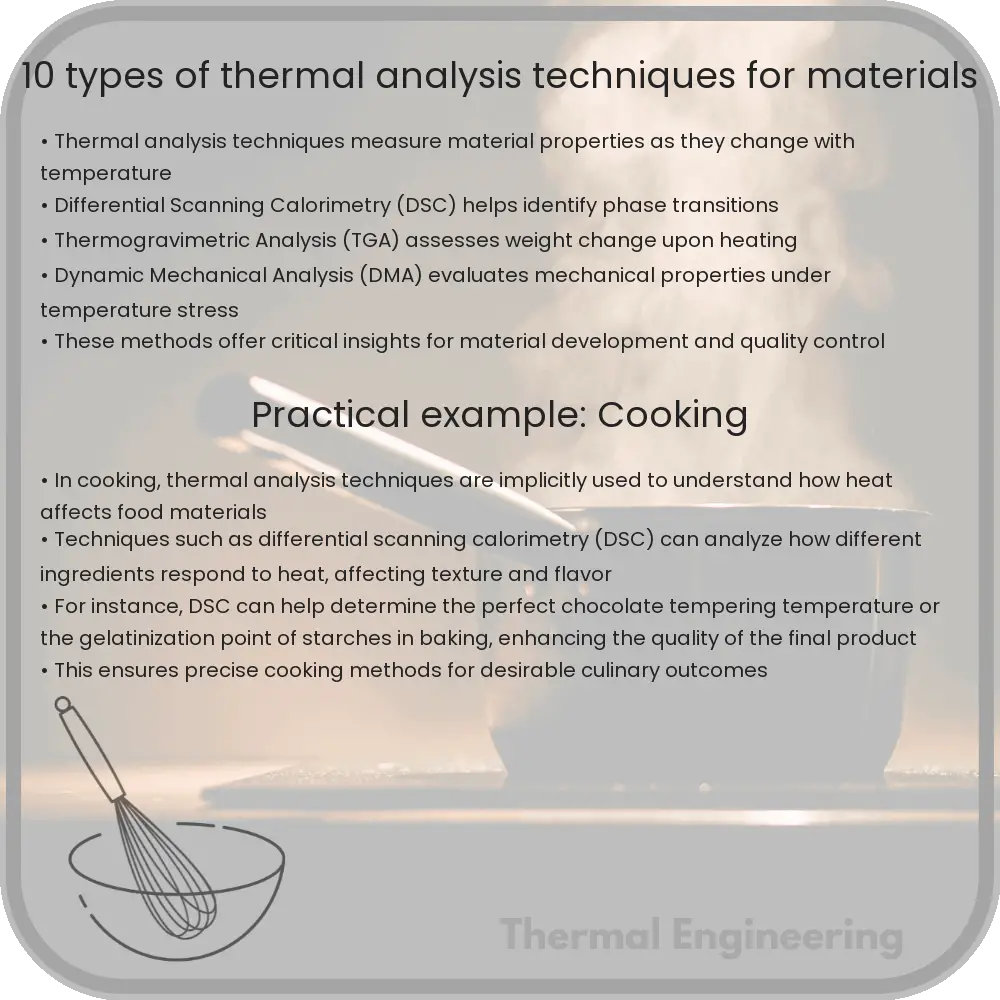
Introduction to Thermal Analysis Techniques for Materials
Thermal analysis is a branch of materials science where the properties of materials are studied as they change with temperature. Techniques in thermal analysis can provide valuable insights into thermal stability, composition, decomposition, and physical properties, like phase transitions of various materials. These techniques are essential in the research and development of new materials, product improvement, and quality control. Here, we will explore ten of the most common thermal analysis techniques used today.
1. Differential Scanning Calorimetry (DSC)
Differential Scanning Calorimetry (DSC) measures how much heat a sample absorbs or releases as it is heated, cooled, or held at a constant temperature. DSC is widely used to analyze polymeric materials to determine their glass transition temperature, crystallization, and melting points.
2. Thermogravimetric Analysis (TGA)
Thermogravimetric Analysis (TGA) involves measuring the mass of a sample as it is heated or cooled in a controlled atmosphere. This technique is useful for determining decomposition temperatures, moisture content, and the amount of fillers in materials.
3. Dynamic Mechanical Analysis (DMA)
Dynamic Mechanical Analysis (DMA) measures the mechanical properties of materials as a function of temperature, time, and frequency. It is primarily used to examine the viscoelastic behavior of polymers, providing insights into modulus (stiffness) and damping characteristics.
4. Thermomechanical Analysis (TMA)
Thermomechanical Analysis (TMA) tracks dimensional changes in a material as a function of temperature. TMA can be used to determine coefficient of thermal expansion, glass transition temperatures, and softening points.
5. Differential Thermal Analysis (DTA)
Differential Thermal Analysis (DTA) measures the temperature difference between a sample and an inert reference as both are subjected to controlled temperature programming. DTA can detect phase changes, crystallization events, and other thermal properties.
6. Dielectric Thermal Analysis (DETA)
Dielectric Thermal Analysis (DETA) measures the dielectric properties (such as permittivity and dissipation factor) of a material as a function of temperature and frequency. It is sensitive to minute changes in the molecular structure of materials.
7. Thermally Stimulated Current (TSC)
Thermally Stimulated Current (TSC) analysis involves heating a previously electrically polarized material to induce a flow of charge as the temperature increases, revealing information about trap states in electronic materials.
8. Micro-Thermal Analysis (μTA)
Micro-Thermal Analysis combines microscopic examination with localized thermal analysis capabilities. This technique allows for thermal properties to be mapped with high spatial resolution.
9. Laser Flash Analysis (LFA)
Laser Flash Analysis (LFA) is used to measure the thermal diffusivity of materials. The technique involves using a laser pulse to heat the surface of a small disk sample and then measuring the temperature change on the opposite face to calculate thermal properties.
10. Thermoreflectance
Thermoreflectance is a non-contact method used to study thermal properties by measuring the change in the reflectivity of a material as a function of temperature. It is especially useful for investigating thin films and semiconductor materials.
Conclusion
These thermal analysis techniques are fundamental tools in materials science and engineering, providing essential data for the characterization, development, and quality control of materials. Understanding the principles and applications of these methods can significantly contribute to advancements in technology and industrial applications.