Learn about heat exchangers, essential devices for transferring heat in systems like ACs and power plants, enhancing energy efficiency and performance.
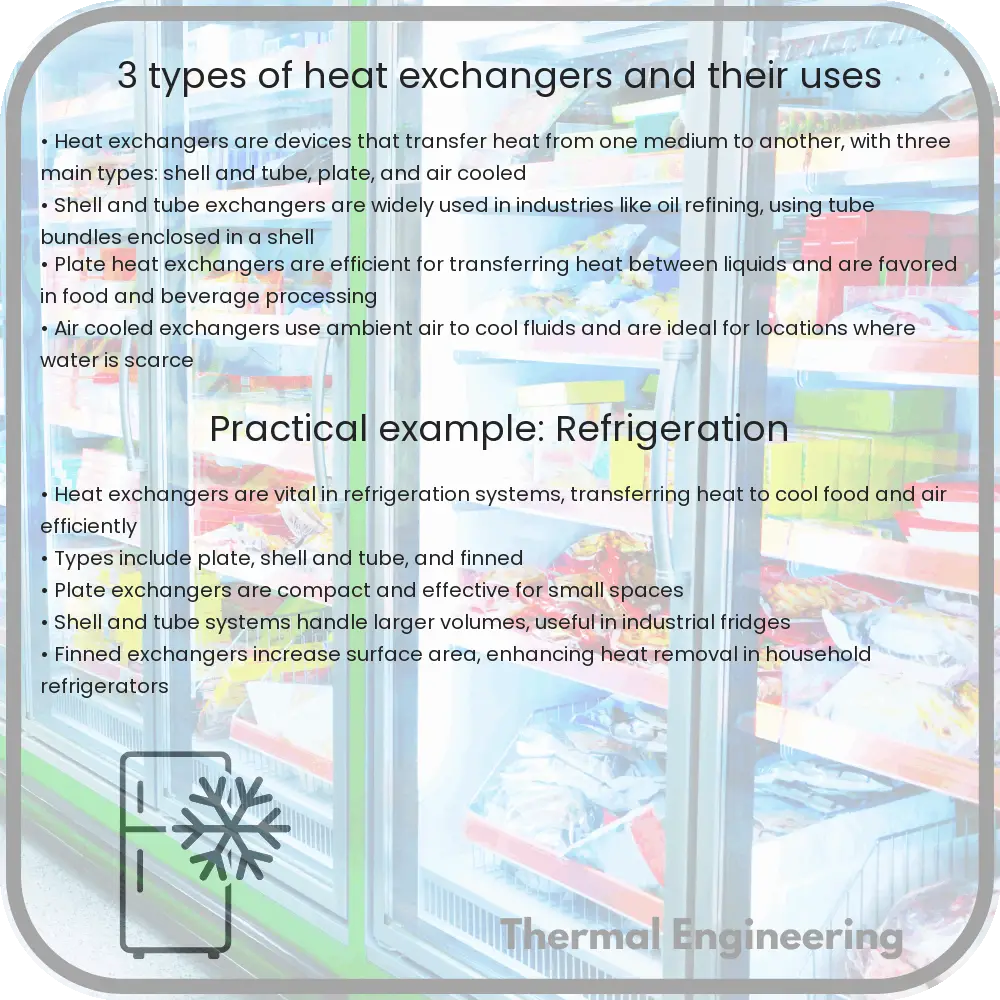
Introduction to Heat Exchangers
Heat exchangers are devices designed to transfer heat between two or more fluids—be it liquids, gases, or vapors—either by direct contact or through a separating wall. Commonly used in refrigeration, air conditioning systems, power stations, and chemical plants, these devices play a crucial role in energy efficiency and system effectiveness.
Different Types of Heat Exchangers and Their Uses
There are various types of heat exchangers designed for specific applications, efficiencies, and flow arrangements. Here, we’ll explore three fundamental types:
1. Shell and Tube Heat Exchanger
The shell and tube heat exchanger consists of a series of tubes, each of which is surrounded by a larger cylindrical shell. One fluid flows through the tubes while the second fluid flows over the tubes within the shell. This design offers high efficiency and is particularly adept at handling high-pressure applications.
- Applications: Shell and tube heat exchangers are commonly used in oil refineries and large chemical processes where robustness and high-temperature tolerance are required.
2. Plate Heat Exchanger
Plate heat exchangers utilize thin, slightly separated plates that have very large surface areas and fluid flow passages for heat transfer. This stacked-plate arrangement can be more efficient in transferring heat than the shell and tube heat exchanger, primarily due to the larger surface area in contact with the fluid.
- Applications: Due to their efficiency and compact size, plate heat exchangers are often used in domestic heating, solar heating applications, and in the cooling of milk and other dairy products in food processing plants.
3. Air Cooled Heat Exchanger
Also known as finned tube heat exchangers, air-cooled heat exchangers are commonly used where there is no immediate access to cooling water. They use ambient air to cool the fluid by passing it through a coil with extended outer surface area (fins).
- Applications: These exchangers are typically used in vehicle radiators, air conditioning systems, power plants, and in process cooling under harsh environmental conditions such as in oil refineries in desert areas.
Conclusion
The choice of heat exchanger depends on a variety of factors including temperature levels, pressure, fluid states, and environmental conditions. By understanding the different types of heat exchangers and their uses, engineering solutions can be optimized for efficiency and performance in various industrial applications. While the technologies behind these devices are complex, their contribution to industrial efficiency and environmental management is invaluable, making them a critical component of modern engineering systems.