Learn about microchannel heat exchangers, their design, advantages, and applications in enhancing heat transfer efficiency in various industries.
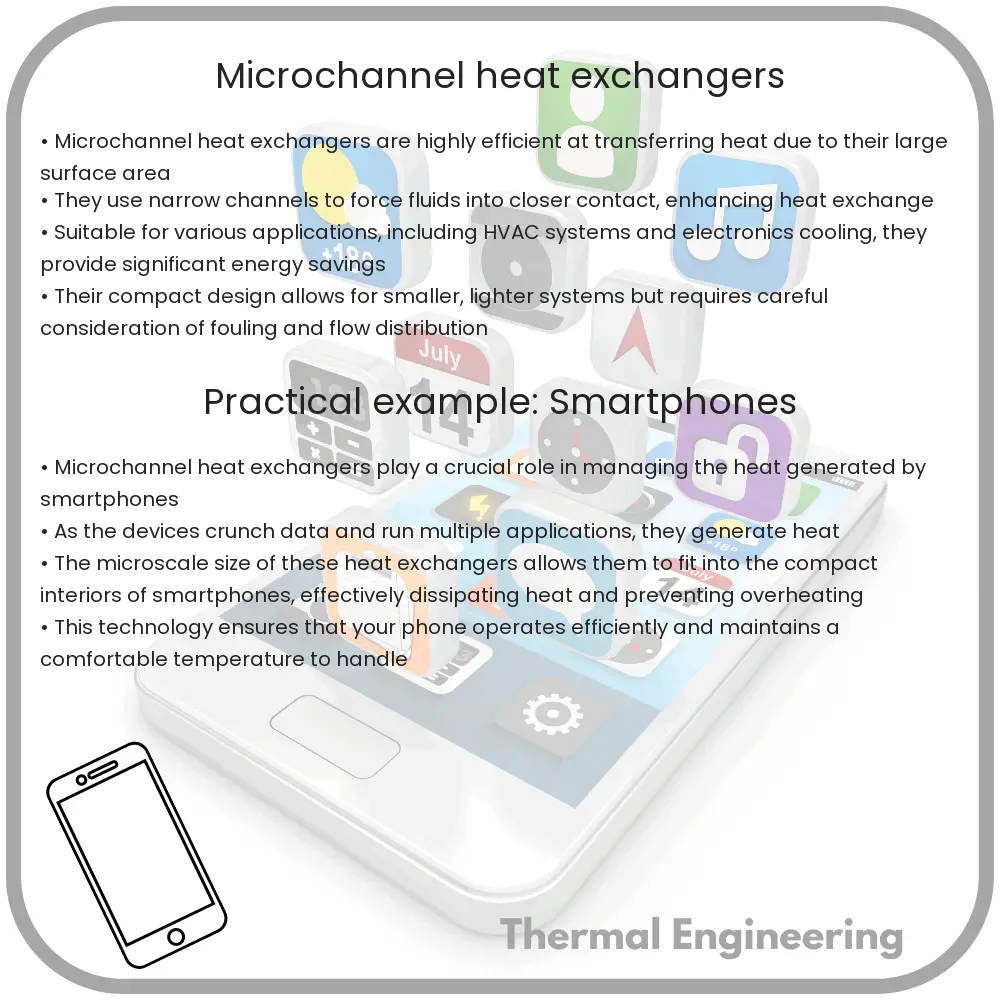
Understanding Microchannel Heat Exchangers
Microchannel heat exchangers are at the forefront of heat exchange technology, offering efficiency and size advantages that make them suitable for a range of applications, from air conditioning systems to automotive radiators. Understanding how these systems work and why they are beneficial can reveal much about their growing presence in various industries.
What are Microchannel Heat Exchangers?
Microchannel heat exchangers consist of many small channels that fluids flow through, with the heat transfer occurring across the thin walls of these channels. Typically, these channels have hydraulic diameters in the range of less than 1 mm. Microchannel heat exchangers are usually made from materials with high thermal conductivity, such as aluminum or copper, allowing them to facilitate efficient heat exchange.
Key Advantages
- High Surface Area to Volume Ratio: The small channels in microchannel heat exchangers provide a large surface area in a compact volume, enhancing the heat transfer effectiveness.
- Reduced Air-Side Resistance: They lower air-side resistance compared to conventional fin-and-tube designs, which helps in improving the overall efficiency of systems.
- Less Refrigerant Usage: These exchangers operate effectively with less refrigerant than traditional exchangers, which is particularly important given the environmental impact of some refrigerants.
Design and Operation
Microchannel heat exchangers are designed using principles of thermodynamics and fluid mechanics to maximize heat transfer. They employ channels through which the working fluids flow; one carrying the hot fluid and the other carrying the cold fluid. The design typically entails a multi-pass arrangement, allowing for the optimal flow and temperature crossover which results in a better heat transfer coefficient.
Applications
- Automotive Industry: Used extensively in the radiators, oil coolers, and air conditioning systems of vehicles, reducing weight and improving fuel efficiency.
- HVAC Systems: Their compact size and efficiency advantages make them ideal for use in heating, ventilation, and air conditioning systems in residential and commercial buildings.
- Power Plants: Employed in cooling processes for equipment and processes within power generation facilities, contributing to better thermal management.
Efficiency Calculation
The efficiency of a heat exchanger is typically measured by its effectiveness, which can be calculated with the formula:
\[ \text{Effectiveness} = \frac{Q}{Q_{\text{max}}} \]
where \( Q \) is the actual heat transfer rate and \( Q_{\text{max}} \) is the maximum possible heat transfer rate, calculated by:
\[ Q_{\text{max}} = \text{min}(C_{\text{hot}}, C_{\text{cold}}) \times (T_{\text{hot,in}} – T_{\text{cold,in}}) \]
Here, \( C_{\text{hot}} \) and \( C_{\text{cold}} \) are the heat capacities of the hot and cold fluids respectively, and \( T_{\text{hot,in}} \) and \( T_{\text{cold,in}} \) are the inlet temperatures of the hot and cold fluids.
Challenges and Future Prospects
Despite their advantages, microchannel heat exchangers face challenges such as potential for clogging and higher initial costs. Advances in manufacturing technology and materials science continue to address these issues, aiming to make these systems more robust and cost-effective. As industries continue to demand higher energy efficiency and smaller equipment sizes, the role of microchannel heat exchangers is expected to expand, heralding a new era in heat exchange technology.
Understanding the basic operations and advancements of microchannel heat exchangers provides insights into their critical role in modern thermal management solutions. With ongoing research and development, these systems promise to become even more indispensable in future engineering applications.