Learn about heat flux sensors, essential tools for measuring the rate of heat transfer across surfaces in various applications.
Introduction to Heat Flux Sensors
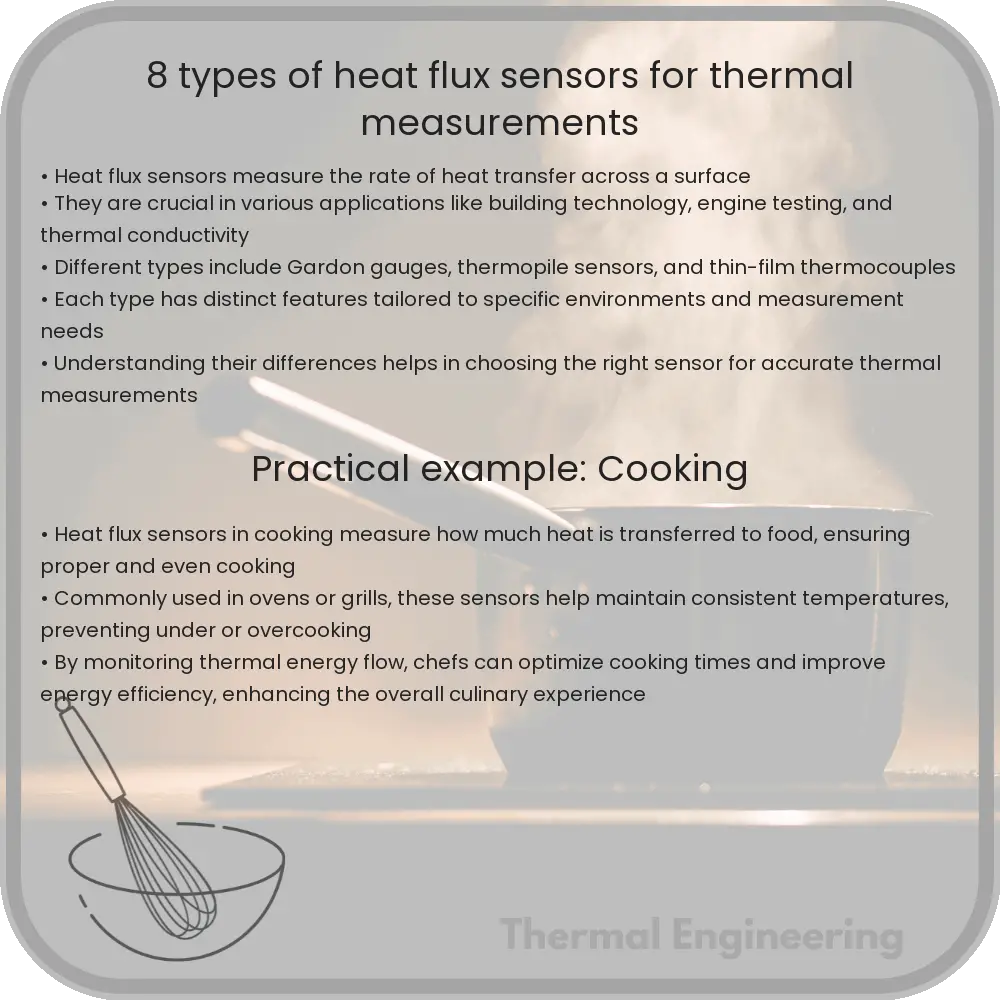
Heat flux sensors are essential tools used to measure the rate of heat transfer through a surface per unit area. These instruments are crucial in various engineering and scientific applications, from studying thermal properties of materials to monitoring industrial processes. Understanding the different types of heat flux sensors helps in selecting the right sensor for specific applications.
Types of Heat Flux Sensors
There are several types of heat flux sensors, each suited for different applications based on their working principle, construction, and sensitivity. Here, we will explore eight common types of these sensors.
- Gardner Sensors: These sensors use a thin layer of thermally conductive material placed between two temperature-measuring devices. They are typically used in environments where the heat flux is relatively low.
- Schmidt-Boelter Sensors: Widely used in fire testing and heat transfer studies, these sensors consist of a water-cooled calorimeter that measures high heat flux levels. They provide accurate measurements even under rapid changing conditions.
- Capacitance Type Sensors: These sensors measure heat flux through changes in capacitance caused by temperature differences across a dielectric material. They are useful in applications where minimal sensor thickness is crucial.
- Thin-Film Thermopile Sensors: These consist of thermocouples arranged in a series or parallel configuration to detect temperature difference across a thin film. Their design allows for high sensitivity and fast response time, making them suitable for both laboratory and industrial applications.
- Gradient Heat Flux Sensors: Using the principle of thermal gradients, these sensors calculate heat flux by measuring temperature variation across a known distance. They are often used in studies involving soil or building materials.
- Calorimetric Sensors: These sensors operate by measuring the heat absorbed or released by a material. Calorimetric sensors are particularly effective in applications requiring the measurement of total heat transfer over time.
- Optical Sensors: Using infrared or other radiation methods, optical sensors can measure heat flux without direct contact with the heat source. This non-invasive approach is ideal for sensitive or inaccessible surfaces.
- Acoustic Sensors: These innovative sensors use the speed of sound within a medium to infer changes in thermal conductivity and, thus, heat flux. Though less common, they offer unique advantages in specific applications like gaseous environments.
Applications of Heat Flux Sensors
Heat flux sensors find applications across various fields. In building physics, they help assess insulation effectiveness and identify heat losses. In the aerospace industry, they monitor thermal protection systems to ensure they maintain their protective qualities under extreme conditions. Environmental studies use these sensors for monitoring soil heat flux, which is important for understanding and predicting changes in climate and soil composition.
Conclusion
Selecting the appropriate type of heat flux sensor is crucial for obtaining reliable and accurate measurements in any thermal analysis. Each type offers distinct advantages and limitations, making them suited for specific environments and applications. By understanding the different types of heat flux sensors, engineers and researchers can effectively apply this technology to improve safety, efficiency, and innovation in various domains.