Explore how air quality modeling assesses and manages urban air pollution, using data and simulations to predict pollutant dispersion.
Understanding Air Quality Modeling in Urban Areas
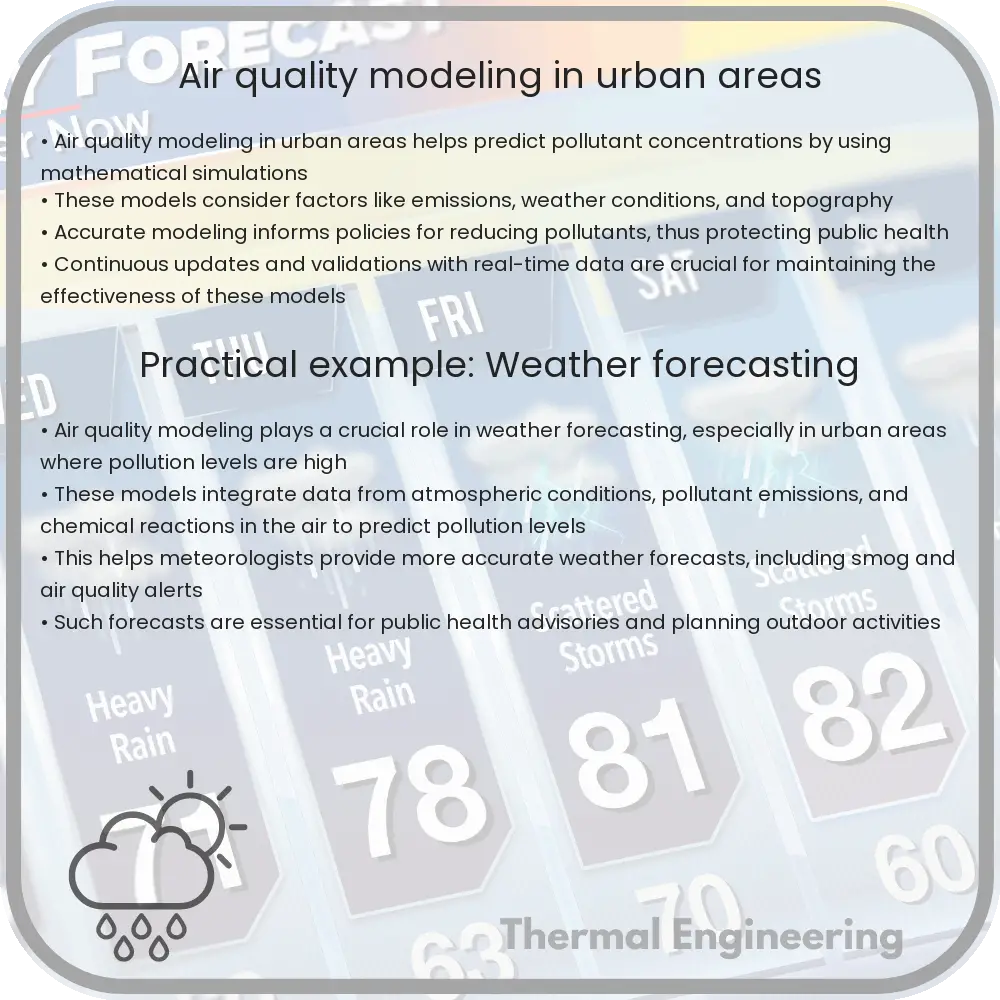
Air quality modeling serves as a crucial tool in assessing the health of the urban environment and managing public health risks related to air pollution. Urban areas, with their high density of vehicles, industrial activities, and energy production, are particularly susceptible to air pollution. Air quality models help predict the dispersion of pollutants and their concentration in the air over time, enabling city planners and public health officials to make informed decisions.
How Air Quality Modeling Works
Air quality modeling involves using mathematical and computational techniques to simulate the physical and chemical processes that pollutants undergo as they diffuse through the atmosphere. These models typically intake data such as emissions from various sources, meteorological conditions, and topography to predict pollutant levels.
Types of Air Quality Models
- Gaussian models: These models are based on the Gaussian plume equation, which assumes that the pollutants disperse in the air in a bell-shaped curve. They are widely used for estimating the dispersion of pollutants from single sources, such as factory chimneys.
- Grid models (Eulerian models): These models divide the air space into a three-dimensional grid and solve the pollutant dispersion equations for each cell. The approach is useful for more complex scenarios involving multiple interacting pollution sources and varying meteorological conditions.
- Lagrangian models: These models track the movement of air parcels as they move through the environment, accounting for changes in pollutant concentrations due to chemical reactions and interactions with the earth’s surface. This type is particularly useful for studying long-range transport of pollutants.
Key Equations in Air Quality Modeling
The general dispersion equation critical to most air quality models can be given by:
∆C / ∆t = -U * (∆C / ∆x) – V * (∆C / ∆y) – W * (∆C / ∆z) + S + E
- ∆C / ∆t is the rate of change of pollutant concentration.
- U, V, W are the wind speeds in the x, y, and z directions, respectively.
- ∆x, ∆y, ∆z represent changes in space along the x, y, and z axes.
- S represents the sources of pollution.
- E represents the environmental loss terms, including deposition and chemical reaction.
The Role of Data in Air Quality Modeling
Accurate data is the backbone of effective air quality modeling. Inputs commonly used include:
- Emissions data: Information on the types and quantities of pollutants released by various sources.
- Meteorological data: Details about wind speed and direction, temperature, humidity, and solar radiation, which influence pollutant dispersion and chemical reactions.
- Topographic data: Landscape features that affect air flow and pollutant distribution, such as hills, buildings, and bodies of water.
Implications and Applications
Air quality models are not just academic tools; they have practical applications in urban planning and public health. They are used to:
- Forecast air pollution levels, helping to alert populations to unhealthy conditions in advance.
- Develop air pollution control strategies, assessing the potential impact of proposed industrial developments or traffic management schemes.
- Identify hotspots of high pollution for targeted action.
- Contribute to environmental impact assessments required for new projects.
Overall, air quality modeling is an indispensable method in the toolkit of modern urban planning and environmental management, helping mitigate one of the most pressing issues faced by cities around the world—air pollution.