Guide to enhancing boiling heat transfer efficiency in various engineering applications for improved thermal management systems.
Understanding Boiling Heat Transfer Enhancement
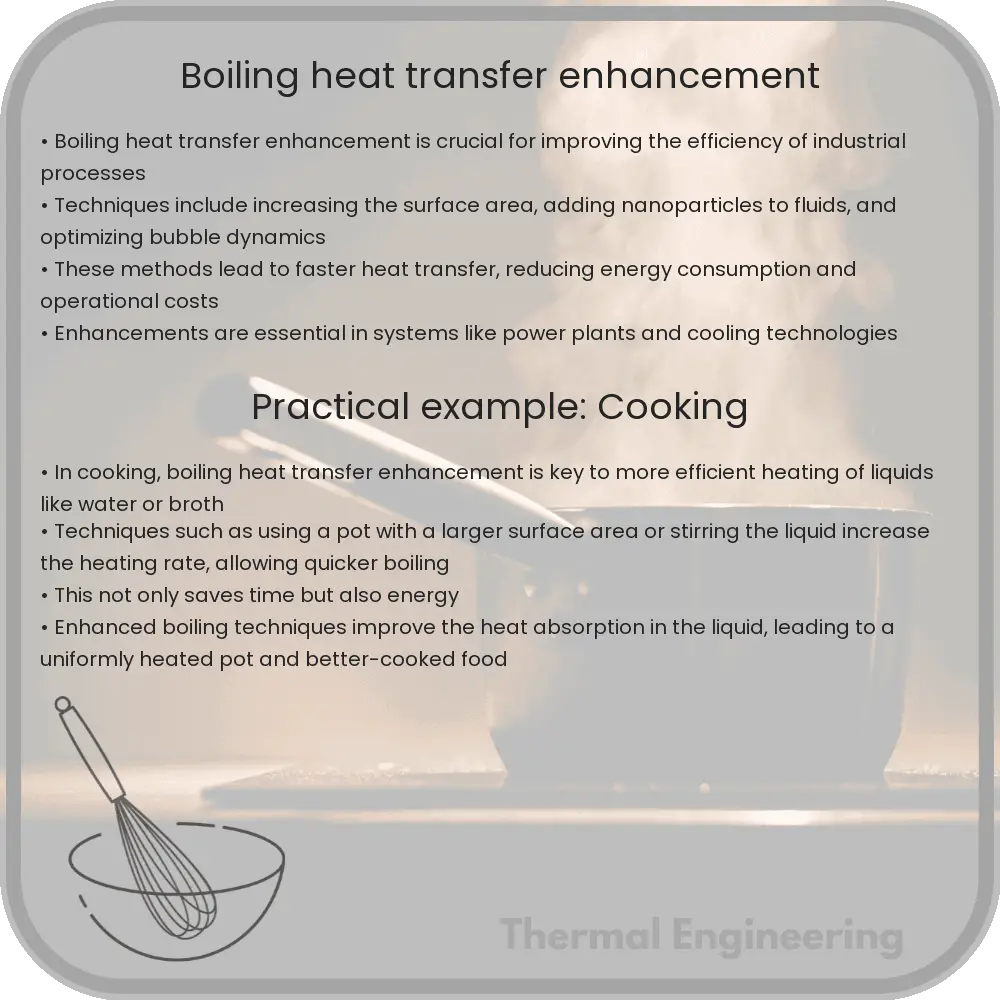
Boiling heat transfer is a process where heat is efficiently transferred from a solid surface to a liquid causing the liquid to boil. In engineering applications, enhancing this process is vital, as it can lead to significant improvements in the efficiency of energy systems, including power generation and cooling technologies. This article explores the methods and technologies used to enhance boiling heat transfer and their applications in various engineering fields.
Basic Mechanisms of Boiling Heat Transfer
Boiling heat transfer involves the transfer of heat from a hotter surface to a boiling liquid, leading to the formation and release of vapor bubbles. This process can be categorized into two main types:
- Nucleate Boiling: This occurs at moderate surface temperatures and is characterized by the vigorous formation of vapor bubbles at discrete points on the heated surface.
- Film Boiling: At higher surface temperatures, a continuous film of vapor forms between the surface and the liquid, which tends to decrease the rate of heat transfer.
Enhancing boiling heat transfer typically focuses on increasing the efficiency of nucleate boiling since this mode offers higher heat transfer coefficients.
Techniques for Enhancing Boiling Heat Transfer
Several techniques can be employed to enhance the boiling heat transfer, which include:
- Surface Modification: Altering the surface characteristics (such as roughness or wettability) can significantly impact bubble dynamics. Techniques such as sandblasting, coating, or etching are used to increase the number of active nucleation sites, thereby enhancing heat transfer.
- Additives in Boiling Fluid: Adding particles like nanoparticles (nano-fluids) or surfactants to the boiling fluid can alter the boiling dynamics. These additives can change the thermal conductivity of the fluid and the surface tension, which in turn affects the bubble generation and detachment.
- Vibration: Applying mechanical vibrations to the system can enhance heat transfer by promoting the detachment and formation of bubbles.
- Electric or Magnetic Fields: Using electric or magnetic fields has been shown to affect the boiling process. Electric fields can influence bubble formation and detachment, whereas magnetic fields can be used with ferrofluids to control heat transfer properties.
Each of these techniques can be tailored to specific applications, depending on the requirements of the system and the properties of the boiling fluid.
Applications of Enhanced Boiling Heat Transfer
Enhanced boiling heat transfer is crucial in several key industries:
- Electronics Cooling: In high-performance computing and electronics, efficient heat removal is necessary to maintain operational stability and prevent overheating. Enhanced boiling techniques can improve the effectiveness of cooling systems used in these technologies.
- Power Generation: In power plants, especially in nuclear reactors, efficient heat transfer is crucial for safety and operational efficiency. Enhancing the boiling process helps in achieving higher thermal efficiencies and better cooling processes.
- Refrigeration: Enhanced boiling processes are also used in refrigeration to increase the efficiency of heat exchangers and cooling units, reducing energy consumption and improving performance.
- Desalination: In thermal desalination processes, enhanced heat transfer can improve the efficiency and output of freshwater production, which is vital in arid regions.
In conclusion, boiling heat transfer enhancement plays a pivotal role in the advancement of various engineering domains through increased efficiency and performance in thermal management systems. Continuous research and technological improvements are driving this field towards more sustainable and effective solutions, contributing to advancements in energy systems, electronic applications, and environmental management.