The keyword “Carbon Nanotubes” refers to cylindrical nanostructures of carbon atoms with exceptional thermal conductance and strength, used in advanced materials applications.
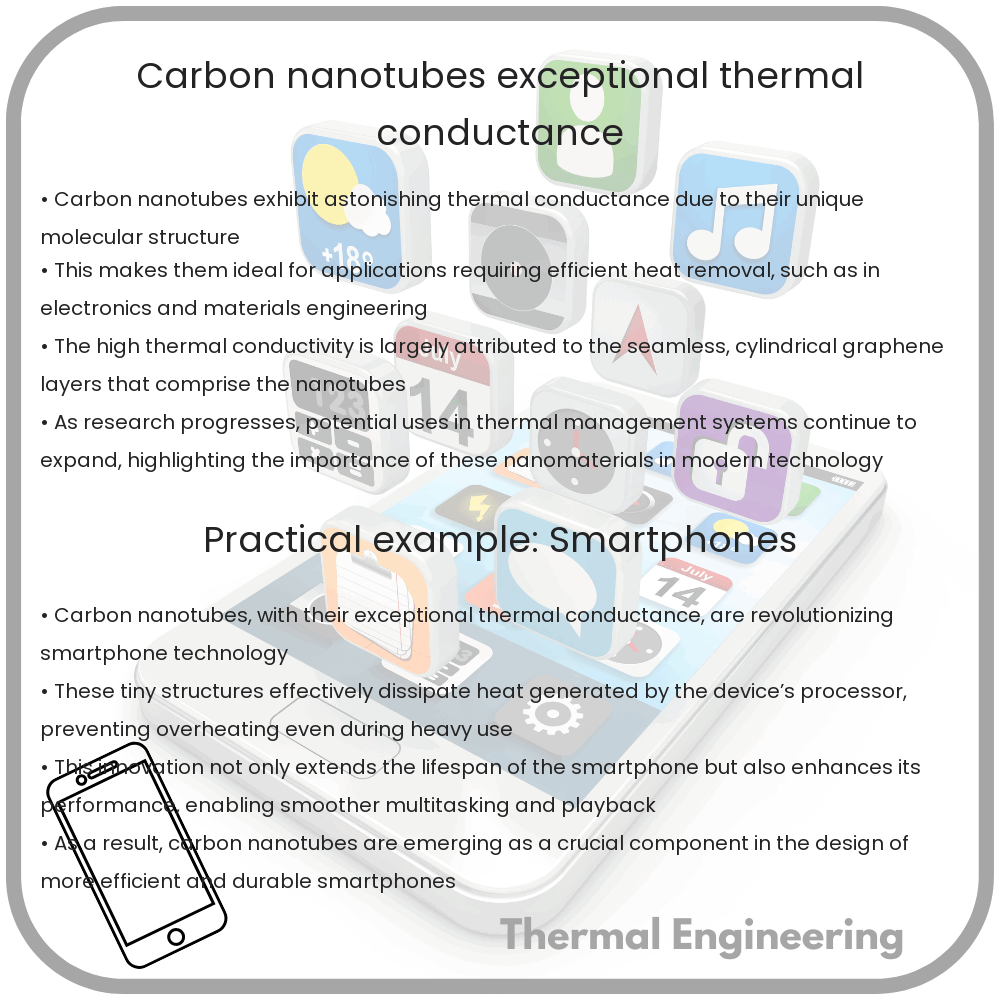
Carbon Nanotubes: Pioneers in Thermal Conductance
Carbon nanotubes (CNTs) have garnered significant attention in the realm of materials science due to their exceptional properties, particularly in terms of thermal conductance. This remarkable ability makes them potential candidates for a variety of applications, including the enhancement of thermal management systems in electronics and other high-performance materials. In this article, we explore why CNTs exhibit such high levels of thermal conductance and how this feature sets them apart in the engineering world.
Structure of Carbon Nanotubes
Before delving into the thermal properties of CNTs, it is essential to understand their unique structure. Carbon nanotubes are allotropes of carbon, similar to graphite and diamonds, but their molecular arrangement is distinct. They are composed of carbon atoms arranged in a cylindrical nanostructure, categorized mainly into two types: single-walled nanotubes (SWNTs) and multi-walled nanotubes (MWNTs). This cylindrical makeup provides the foundation for their unusual strength and thermal properties.
Thermal Conductance in Carbon Nanotubes
The superior thermal conductance of carbon nanotubes can be attributed primarily to the strong covalent bonds between carbon atoms and the nanotubes’ phonon transport capabilities. Phonons refer to the quanta of sound or a vibrational wave, which play a crucial role in heat transfer in CNTs and other crystalline materials.
Mechanisms of Heat Transfer
Heat transfer in carbon nanotubes occurs primarily through a lattice vibration mechanism known as phonon transport. Unlike metals, where electrons carry heat, in CNTs, phonons are responsible for this transfer. The effectiveness of phonon-based heat transfer is significantly enhanced in CNTs due to their seamless, defect-free structure which allows for ballistic transport of phonons.
- Ballistic Transport: The phenomenon where phonons propagate without scattering, maintaining a high thermal conductance over larger distances than typical in other materials.
- Scattering Impacts: In some cases, impurities, defects, or tube-tube junctions in multi-walled nanotubes can cause phonon scattering, which impedes thermal conductance. However, in high-quality single-walled CNTs, this scattering is minimal.
Comparative Analysis with Other Materials
When compared to other materials like copper, which is commonly used for thermal management due to its good conductive properties, carbon nanotubes can exhibit over 10 times the thermal conductance. Specifically, measurements have shown that the thermal conductivity of single-walled carbon nanotubes can exceed 3000 W/(m*K), a stark contrast to copper’s 400 W/(m*K).
Applications of Carbon Nanotubes in Thermal Management
The exceptional thermal conductance of carbon nanotubes opens up new avenues in engineering applications, particularly in the fields of electronics cooling, composite materials, and thermal interface materials. In electronics, CNTs can be used to dissipate heat efficiently, thereby improving the reliability and performance of electronic devices. Additionally, their integration into composite materials can enhance the thermal management properties of the host material without significantly increasing its weight.
Conclusion
The unmatched thermal conductance of carbon nanotubes makes them a revolutionary material in thermal management systems. As research continues to optimize the production and application of CNTs, their full potential can further transform technology, paving the way for more efficient thermal management solutions across various industries.