Explore the vital role of condensers in HVAC systems and steam power plants, focusing on their types, operation, and impact on system efficiency.
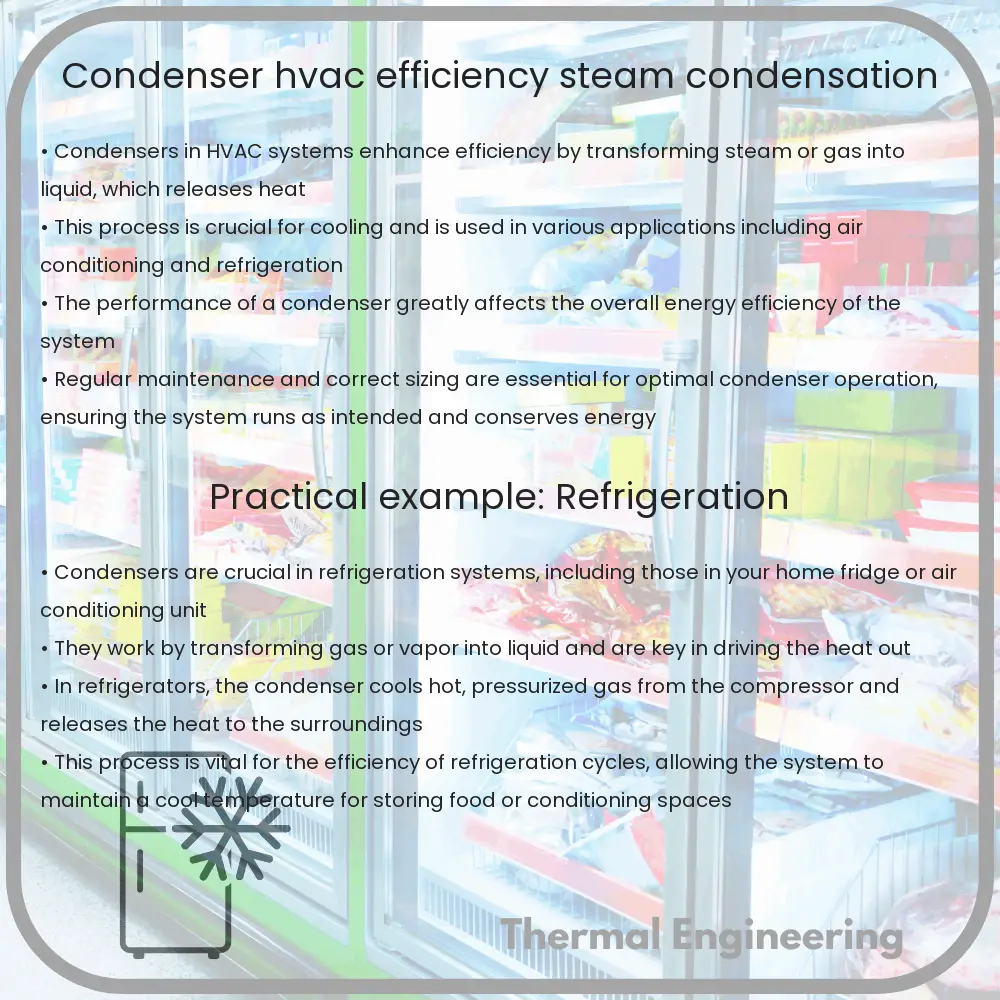
Understanding the Role of Condensers in HVAC Efficiency and Steam Condensation
A condenser is a critical component in various engineering systems, notably in heating, ventilation, and air conditioning (HVAC) systems as well as in steam power plants. Despite their widespread use, the principles behind condensers and their impact on system efficiency often go unnoticed. This article delves into the operation of condensers, their types, and their pivotal role in enhancing the efficiency of systems.
What is a Condenser?
In the most general sense, a condenser is a device or unit used to condense a substance from its gaseous to its liquid state, typically by cooling it. In doing so, the latent heat is released by the substance and transferred to the surrounding environment.
Types of Condensers
- Air-Cooled Condensers: These condensers expel heat into the atmosphere directly using fans or natural convection.
- Water-Cooled Condensers: These systems use water to remove the latent heat from the condenser coils and are typically more efficient than air-cooled versions.
- Evaporative Condensers: These combine wet and dry cooling by allowing some of the fluid to evaporate into the atmosphere, aiding in the heat removal process.
Condensers in HVAC Systems
In HVAC systems, condensers are used in the heat rejection process. For air conditioners, the condenser is part of the outdoor unit where refrigerant gas is compressed and forced through condenser coils, where it is cooled and turned back into a liquid. The efficiency of an air conditioner or heat pump is significantly dependent on the performance of the condenser. Factors influencing the efficiency include the type and size of the condenser, ambient temperature, and maintenance level.
Condensers in Steam Power Plants
Steam power plants use condensers to condense exhaust steam from steam turbines. The process is crucial for improving the efficiency of turbines by maintaining a low backpressure on the exhaust side. Commonly, water-cooled condensers are used in this setting to handle large volumes of steam.
The thermal efficiency of steam power plants is significantly impacted by the performance of these condensers. The general formula for calculating the efficiency (\(\eta\)) is given by:
\(\eta = 1 – \frac{T_c}{T_h}\)
Here, \(T_c\) represents the cool reservoir temperature (condenser temperature), and \(T_h\) is the hot reservoir temperature (boiler temperature).
Improving HVAC and Plant Efficiency Through Effective Condensation
Maintaining an effective condenser is key to optimizing the efficiency in both HVAC systems and steam power plants. This is achieved through:
- Regular cleaning of condenser coils to ensure unimpeded heat transfer.
- Ensuring adequate air flow around the condenser unit to avoid recirculation of hot air.
- Using water treatment in water-cooled condensers to prevent scaling and corrosion, which impair heat transfer efficiency.
Ultimately, condensers play a fundamental role in the process of heat exchange necessary for efficient system operations across different applications. By understanding their function and maintaining them properly, significant improvements in system efficiency can be achieved, leading to cost savings and reduced environmental impact.