Explore the properties and applications of diborane, a high-energy fuel with significant aerospace potential and handling challenges.
Understanding Diborane: A High Energy Fuel with Unique Thermal Properties
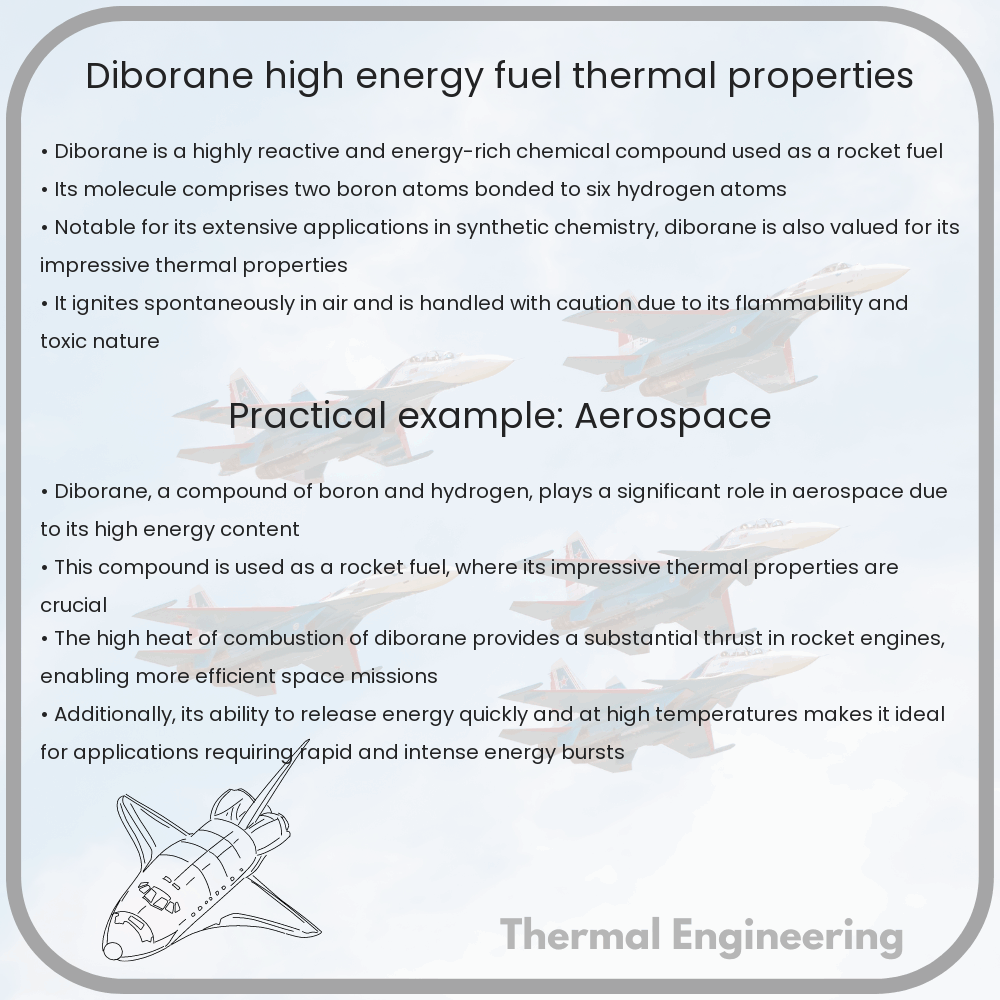
Diborane, with the chemical formula B2H6, is a highly reactive and volatile compound of boron and hydrogen. Known for its potential as a high-energy fuel, diborane offers considerable interest in fields such as rocket propulsion and other aerospace applications. However, its use comes with challenges, primarily due to its physical and chemical properties.
Chemical Composition and Structure
Diborane belongs to the class of boron hydrides. It is composed of two boron atoms bonded together with six hydrogen atoms. What makes diborane stand out is its structure; it features four terminal hydrogen atoms and two bridging hydrogen atoms, creating a three-center two-electron bond which is an interesting phenomenon both structurally and chemically.
Thermal Properties
The thermal properties of diborane contribute significantly to its potential and limitations as a fuel. It has a boiling point of approximately 180 K (-93°C or -136°F) and a melting point around 216 K (-57°C or -70°F), which indicates that diborane is a gas at room temperature and requires careful handling and storage under pressurized or cryogenic conditions.
Energy Content and Reactivity
Diborane is known for its high energy content. It releases a significant amount of energy upon combustion, making it an attractive candidate for applications requiring high-power outputs, such as rockets. The combustion reaction of diborane with oxygen is highly exothermic:
- 2 B2H6 + 3 O2 → 2 B2O3 + 6 H2O
This reaction not only releases water but also boron trioxide. The heat release from this reaction has been a point of interest for its potential to provide thrust in jet and rocket engines.
Hazards and Handling
Diborane is also notorious for its toxicity and flammability, requiring specialized handling and storage techniques. It ignites spontaneously in air, necessitating an inert or reduced-oxygen environment for safe handling. Additionally, diborane’s exposure risks include potential respiratory tract irritation and neurological effects, making personal protective equipment essential when working with this compound.
Applications and Current Research
The high-energy characteristics of diborane have led to its examination for various military and space-related propulsion systems. Moreover, current research focuses on harnessing its energy more safely and efficiently. This includes developing stable diborane-based fuel blends and advanced storage materials that mitigate its inherent risks.
To conclude, diborane’s remarkable energy release capability makes it a substance of interest for cutting-edge engineering applications, particularly in aerospace. However, the challenges associated with its volatility, reactivity, and toxicity require ongoing research into safer handling and more efficient utilization techniques.