Learn about electric heaters, their types, and uses in residential and commercial settings, and explore their advantages and disadvantages.
Introduction to Electric Heaters
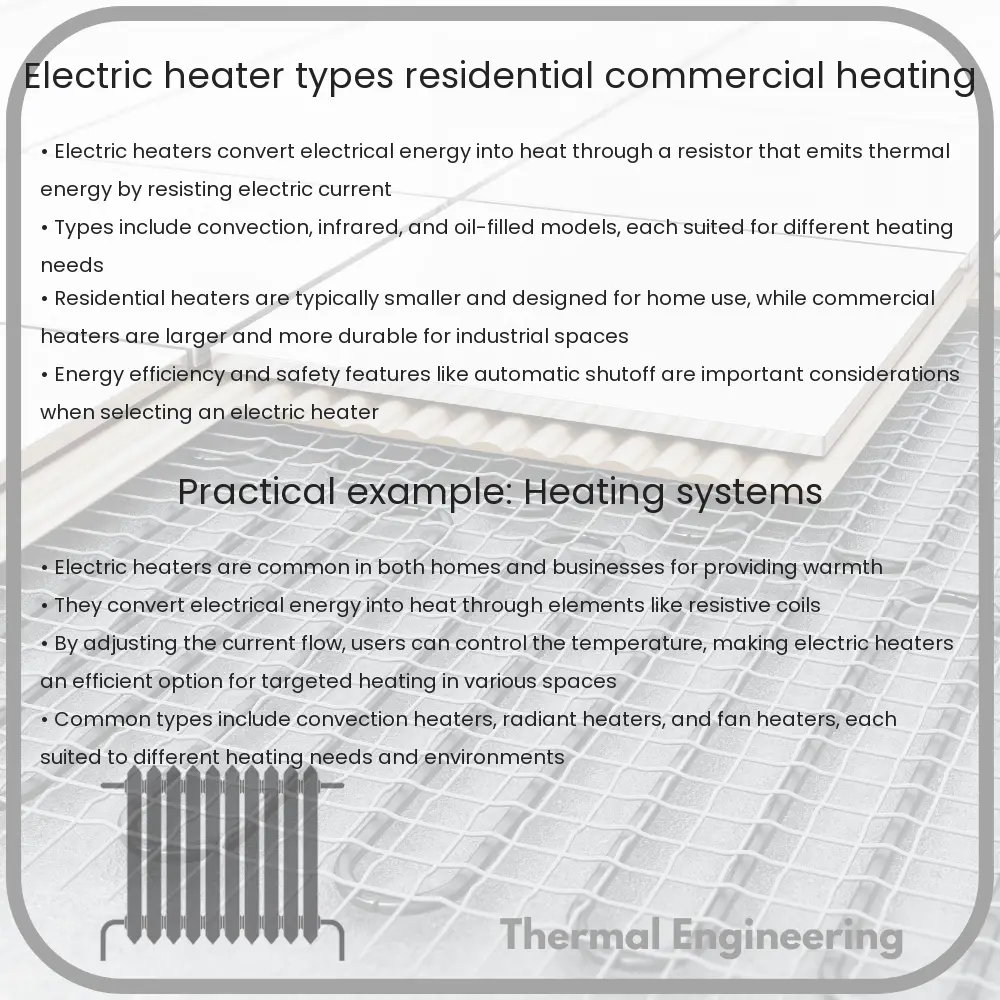
Electric heaters are devices used to convert electrical energy into thermal energy. They provide an essential source of warmth in both residential and commercial settings, especially in regions with colder climates. Particularly favored for their cleanliness, convenience, and efficiency, electric heaters offer a diverse range of models and types tailored to meet various heating requirements.
Types of Electric Heaters
There are several types of electric heaters, each operating on different principles and suited to specific applications:
- Convection Heaters: These heaters warm the air that circulates through the room by natural convection or by using a fan to accelerate air movement. They are suitable for heating entire rooms.
- Radiant Heaters: Radiant heaters emit infrared radiation that directly heats objects and people in front of them without necessarily warming the air. They are ideal for spot heating and poorly insulated spaces.
- Fan Heaters: Also known as forced convection heaters, these use a fan to pass air over a heat element speeding up the heat transfer. This type is effective for quickly heating small to medium-sized areas.
- Oil-Filled Heaters: These operate by heating oil within a sealed reservoir, indirectly heating the air around the heater. The heat continues to be released even after the heater is turned off.
- Ceramic Heaters: These are typically compact and utilize a ceramic heating element which heats up quickly and is efficient at retaining heat, making it suitable for use in home offices or bedrooms.
- Baseboard Heaters: Installed at the base of walls, these electric heaters use convection to draw in cool air from the floor, heat it, and let it rise into the room as warm air.
Heating in Residential Settings
In residential settings, electric heaters are commonly used for their ease of installation and maintenance, as well as the ability to control them room by room. Portable heaters, such as ceramic and fan heaters, are popular in homes for their affordability and convenience. However, for whole-home heating, baseboard heaters and permanent convection heaters are often installed because they provide a more balanced distribution of heat across larger areas.
Heating in Commercial Settings
Commercial buildings often require large, distributed heating solutions, which can be effectively managed by electric heating systems. Fan heaters and convection heaters are commonly used due to their ability to operate efficiently over large areas. Additionally, radiant heaters are favored in warehouses and shop floors where targeted heating is required as they can efficiently provide heat directly to people and workstations without heating unnecessary space.
Advantages and Disadvantages of Electric Heaters
- Advantages:
- Energy Efficiency: Electric heaters convert nearly all the electrical energy they consume into heat.
- Low Installation Costs: They generally do not require extensive installation processes or ductwork like central heating systems.
- Clean and Quiet Operation: Electric heaters operate without combustion, making them cleaner (no emissions) and usually quieter.
- Disadvantages:
- Higher Operating Costs: Electricity costs more per unit of heat output when compared to natural gas in many regions.
- Limited Heating Capacity: Electric heaters might not be effective in extremely cold environments or in very large spaces without a substantial number of units.
- Dependence on Electricity: During power outages, electric heating systems will not operate, potentially leaving spaces without heat.
Conclusion
Electric heaters are a versatile and widely-used solution for both residential and commercial heating needs, offering models and types to suit nearly any space. Despite the higher cost of electricity, their benefits of cleanliness, ease of use, and controlled heating continue to make them a popular choice in many scenarios.