Explore the concept of entropy in environmental systems, analyzing its role in sustainability, energy efficiency, and resource management.
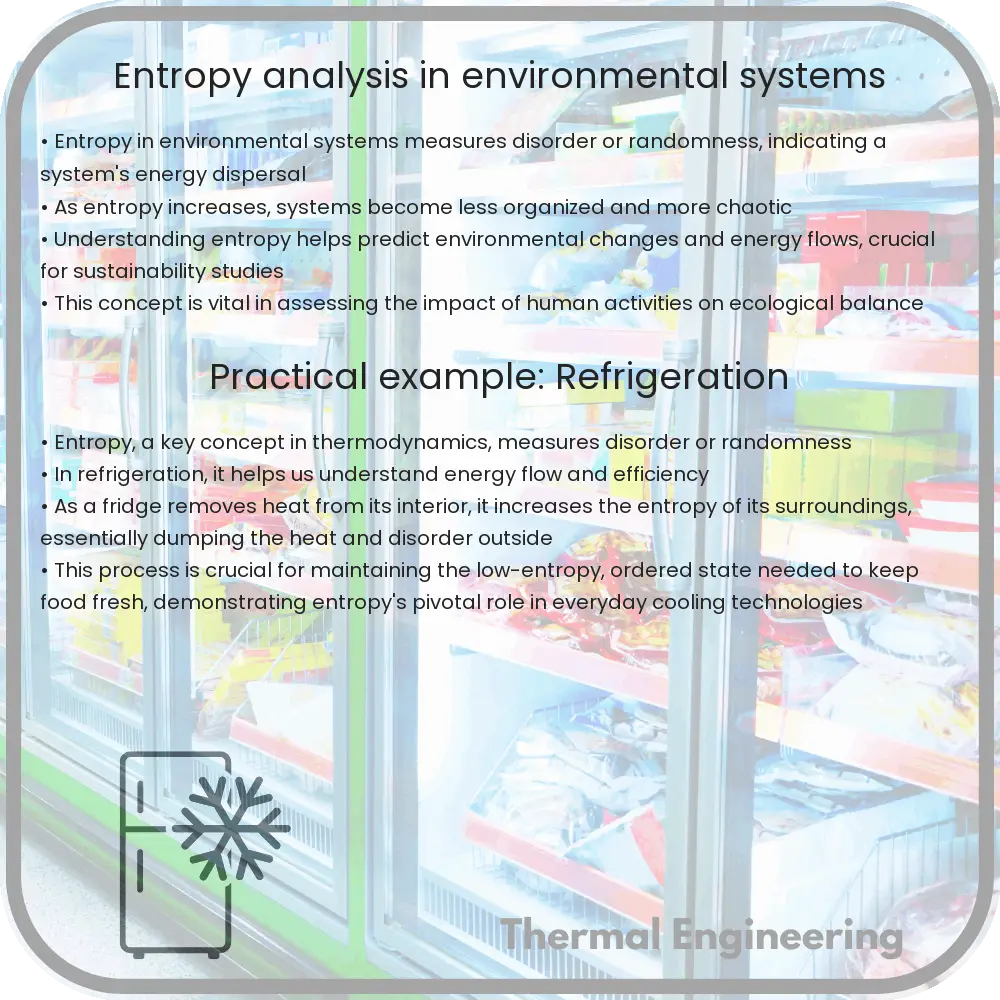
Understanding Entropy Analysis in Environmental Systems
Entropy, a fundamental concept in thermodynamics, is often associated with the measure of disorder, randomness, or uncertainty in a system. The application of entropy analysis to environmental systems provides a powerful lens to understand complex ecological interactions and the impact of human activities on natural order and resource distribution. This article dives into how entropy analysis helps assess the sustainability and efficiency of environmental systems.
What is Entropy?
Entropy is a thermodynamic quantity originally used to conceptualize the inefficiencies within a heat engine. The second law of thermodynamics states that in any closed system, the entropy of the system will either remain constant or increase over time; it never decreases. In simple terms, this law suggests that energy systems tend to move toward a more disordered state if no energy is input to organize the system.
Entropy in Environmental Systems
In environmental science, entropy can be applied to analyze ecological balance, energy flow, and resource depletion. Systems with lower entropy are more ordered and generally more sustainable. Conversely, high entropy in an environmental context often signals overconsumption of resources and a move towards disorder and instability.
- Energy Analysis: Entropy helps quantify the quality and usability of different forms of energy in an ecosystem. For example, high-quality energy like electricity has low entropy, while heat, often a byproduct of industrial processes, has high entropy and lower utility.
- Pollution and Waste Management: Entropy analysis helps measure the impact of pollutants and waste on the environment, illustrating how these factors contribute to increasing the overall entropy of the system—indicating degradation and inefficiency.
Entropy and Sustainability
Understanding the entropy changes caused by various economic and industrial activities allows us to gauge their sustainability. Processes that increase entropy (i.e., cause more disorder or waste) are less sustainable over the long term. Conversely, practices that manage to keep entropy low are typically more sustainable, preserving order and energy quality in the environment.
Quantitative Measures of Entropy
Entropy can be quantified using different metrics depending on the specifics of the system. One common approach is through the entropy production in a system, which is indicative of irreversible processes leading to dissipative losses. The equation for entropy change (∆S) is given by:
∆S = Sfinal – Sinitial
where Sfinal is the entropy at the final state, and Sinitial is the entropy at the initial state. More specifically, the entropy of a system increases as the following occurs:
- The transfer of heat in an irreversible manner,
- Chemical reactions leading to increased randomness,
- Physical dispersal of materials, like pollutants or dissolved substances in a water body.
Real-World Applications of Entropy Analysis
From designing more efficient engines that minimize entropy production to creating waste management systems that better organize disposal and recycling, entropy analysis serves a practical purpose in engineering and environmental planning. Additionally, it plays a critical role in the assessment of renewable energy systems where minimizing entropy production is synonymous with maximizing efficiency and sustainability.
Conclusion
Entropy analysis provides a critical framework for understanding and enhancing the efficiency and sustainability of environmental systems. By assessing how activities and technologies influence entropy, we can make informed decisions to preserve natural order and decrease environmental impact. Thus, embracing entropy analysis in environmental strategies is not only about embracing a scientific concept but also about fostering a sustainable future.