Learn about heat transfer in thermal systems, covering conduction, convection, and radiation, and their applications in engineering.
Understanding Heat Transfer in Thermal Systems
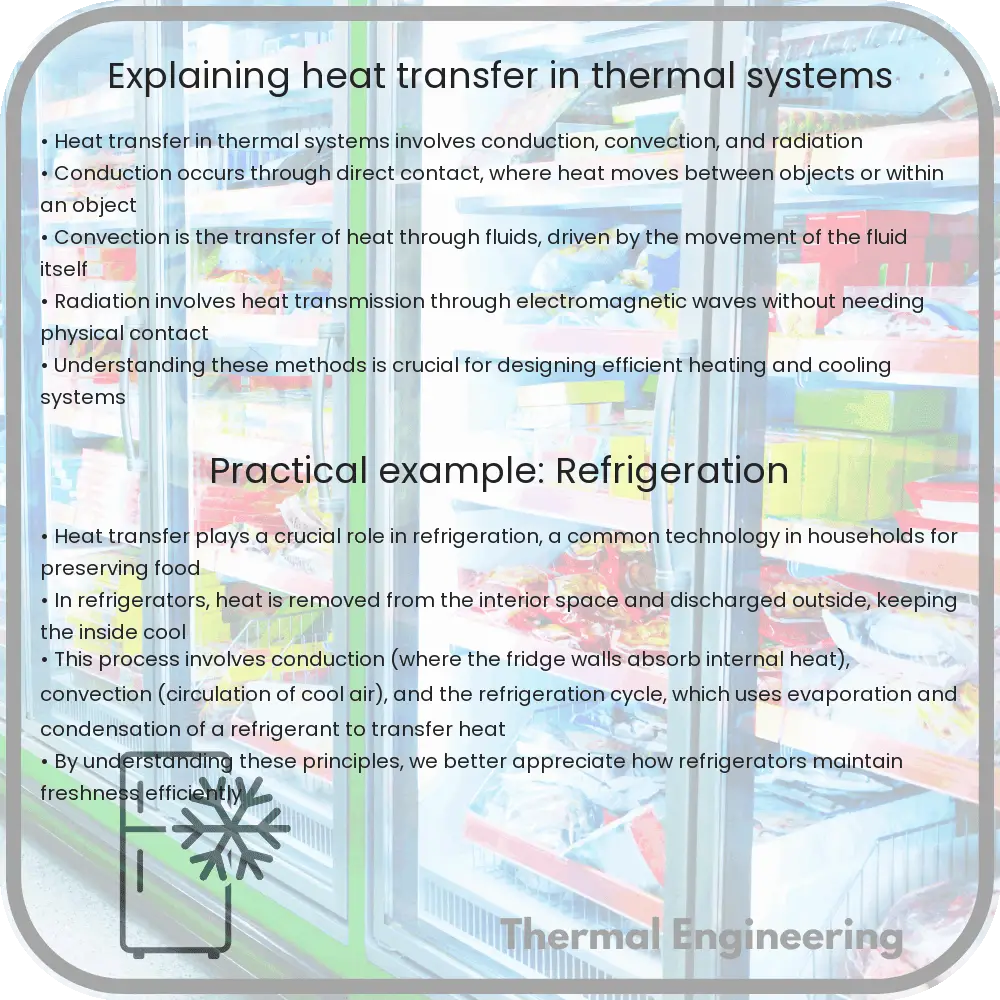
Heat transfer is a fundamental concept in the field of thermal engineering, which involves the movement of thermal energy from one place to another due to temperature differences. In the design and operation of various mechanical systems and devices, from simple household appliances to complex industrial processes, understanding heat transfer is essential. It can be categorized into three main mechanisms: conduction, convection, and radiation.
Conduction
Conduction is the process of heat transfer through a solid material from a region of higher temperature to a region of lower temperature, without any actual movement of the material itself. This type of heat transfer occurs due to the collision and scattering of molecules and electrons within the material. The rate at which heat is conducted depends on the properties of the material, such as its thermal conductivity, which can be described by Fourier’s law of heat conduction:
q = -k * A * (dT/dx)
- q is the heat transfer rate in watts (W).
- k is the thermal conductivity of the material in watts per meter-Kelvin (W/m*K).
- A is the cross-sectional area through which heat is conducted in square meters (m2).
- dT/dx represents the temperature gradient along the direction of heat transfer in Kelvins per meter (K/m).
Convection
Convection is the heat transfer that occurs between a surface and a fluid (liquid or gas) that is in motion, and it involves both the diffusion and advection (bulk movement) of molecules. Convective heat transfer can be natural (due to density gradients caused by temperature variations in the fluid), or forced (by external sources like fans or pumps). The transfer of heat by convection can be quantified using Newton’s law of cooling:
q = h * A * (Ts – T∞)
- q is the heat transfer rate in watts (W).
- h is the heat transfer coefficient in watts per square meter-Kelvin (W/m2*K).
- A is the contact area between the fluid and the surface in square meters (m2).
- Ts is the surface temperature in Kelvins (K).
- T∞ is the fluid temperature far from the surface in Kelvins (K).
Radiation
Radiation is the transfer of heat in the form of electromagnetic waves, without the involvement of a physical medium. This mode of heat transfer can occur between two bodies separated by a medium colder than both bodies. A key principle of thermal radiation is the Stefan-Boltzmann law, which is mathematically expressed as:
E = σ * A * T4
- E is the rate of radiant energy emitted in watts (W).
- σ is the Stefan-Boltzmann constant (5.67 x 10⁻⁸ W/m2*K4).
- A is the emitting surface’s area in square meters (m2).
- T is the absolute temperature of the surface in Kelvins (K).
Understanding these fundamental principles of heat transfer allows engineers to design more efficient heating, cooling, and ventilation systems, enhance the thermal efficiency of engines, and manage thermal loads in electronic devices, among various other applications.