Learn how fluid couplings facilitate power transmission in machinery by using hydraulic principles for smoother and safer operations.
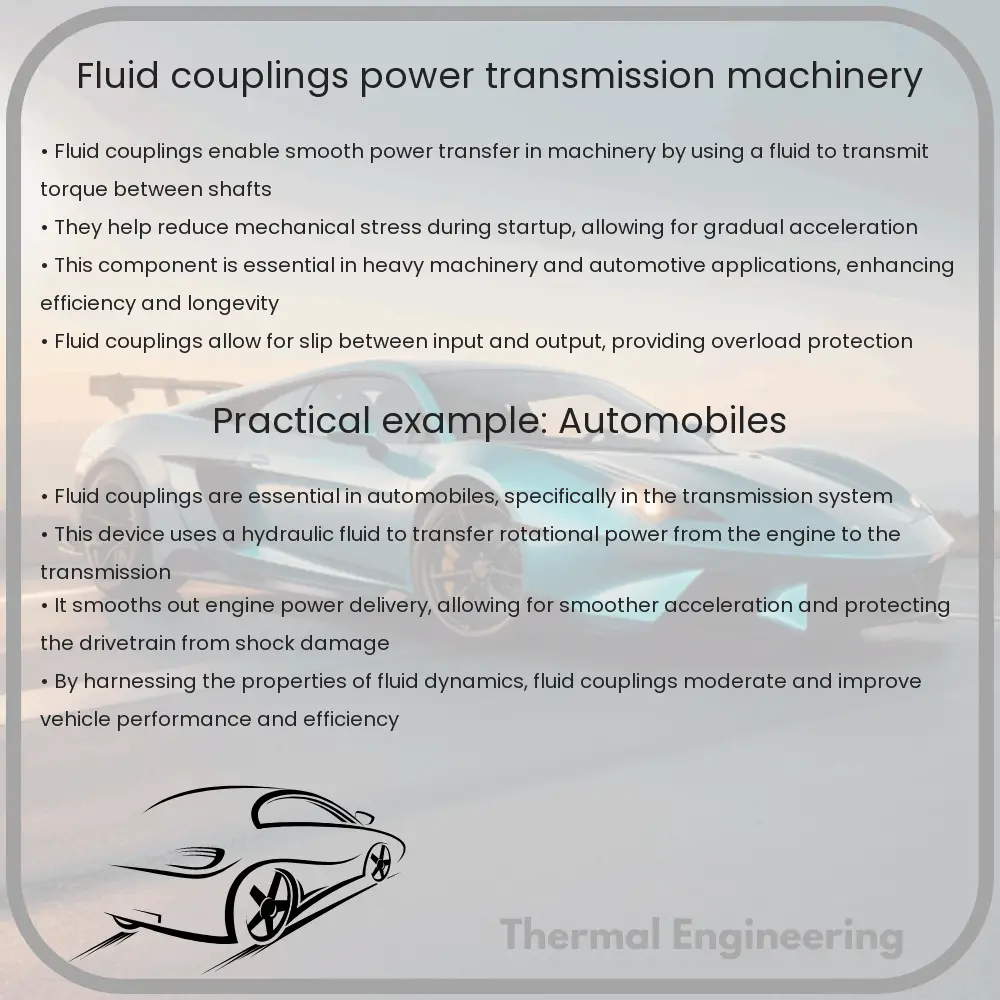
Understanding Fluid Couplings: Essential for Power Transmission in Machinery
Fluid couplings play a pivotal role in the realm of power transmission, particularly in heavy machinery and automotive applications. This device, leveraging the principles of hydraulic power, enables the transfer of rotational power from one shaft to another, using fluid as a medium. Its fundamental operation provides numerous benefits, including smooth start-ups and protection against mechanical overloads.
The Basic Structure and Functioning of Fluid Couplings
The structure of a fluid coupling typically includes three primary components: an input shaft connected to the driving power source, an output shaft connected to the driven machine, and an enclosed chamber that houses the fluid. Inside the chamber, two main elements exist— the impeller (or pump) fixed to the input shaft and the turbine fixed to the output shaft.
Operation begins when the driving shaft (engine or motor shaft) turns the impeller. This motion imparts kinetic energy to the hydraulic fluid, spirally projecting it outward toward the turbine blades. The fluid’s movement imparts a force on the turbine blades, causing the turbine and the output shaft to rotate, thereby transferring power from the input to the output through the fluid medium.
Advantages of Using Fluid Couplings
- Torque Conversion: Fluid couplings can modify the torque transmitted between the input and the output, which is beneficial for applications requiring variable torque settings.
- Controlled Startup: They allow for a gradual increase of load, which provides a smooth and controlled startup, thus reducing stress on the machinery during initial power take-up.
- Overload Protection: By acting as a mechanical fuse, fluid couplings protect against mechanical overloads by slipping when the load exceeds safe operating limits.
- Vibration Dampening: They help to damp vibrations and reduce shock loads to the drive system, thus extending the life-span of machinery components.
Applications of Fluid Couplings
Fluid couplings are used extensively across various industries. They are particularly prevalent in automotive applications, like in automatic transmissions where they serve as a replacement for mechanical clutches, providing a smoother ride. In industrial settings, they are employed in conveyors, crushers, fans, pumps, and compressors, where variable speed operation and controlled start-up conditions are required.
Conclusion
The integration of fluid couplings in power transmission systems offers enhanced operational efficiency, protection, and control. As industries continue to demand more flexible and reliable machinery operations, the importance of understanding and implementing fluid couplings will undoubtedly increase. Whether in heavy machinery or automotive applications, the role of fluid couplings is integral to modern mechanical engineering.