Explore how fluid dynamics is applied in understanding volcanic eruptions, focusing on magma movement, eruption types, and volcano monitoring.
Understanding Fluid Dynamics in Volcanic Eruptions
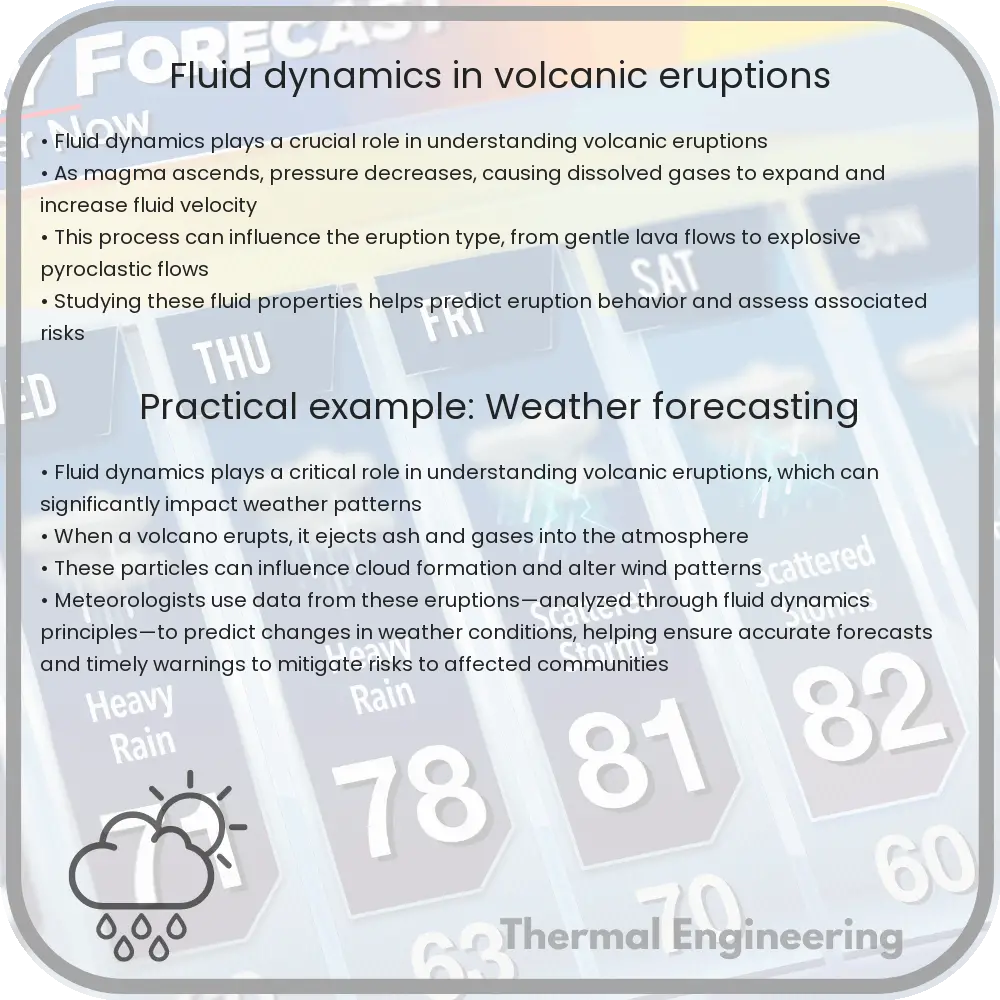
Fluid dynamics plays a crucial role in understanding the mechanisms behind volcanic eruptions. The movement and behaviors of magmatic fluids, mainly comprised of molten rock or magma, are central to the predictions and observations of volcanic activity. In this article, we will explore how the principles of fluid dynamics are applied to study and interpret volcanic eruptions.
Basics of Fluid Dynamics in Volcanology
Fluid dynamics, a sub-discipline of physics, involves the study of fluids (liquids, gases, and plasmas) in motion. Magma, the primary agent in volcanic eruptions, behaves as a complex fluid whose dynamics are influenced by its viscosity, temperature, and chemical composition.
- Viscosity: This property defines a fluid’s resistance to gradual deformation by shear stress or tensile stress. In volcanology, the viscosity of magma determines how it flows and influences the type of eruption that can occur.
- Temperature: The temperature of magma affects its viscosity, with hotter magma being less viscous, thereby affecting its flow characteristics.
- Composition: Magma composition affects its physical properties, including viscosity and density, which in turn alter the flow dynamics.
Mathematical Modeling of Magma Flow
To analyse magma movement, scientists employ various mathematical models that incorporate equations from fluid dynamics. The most common are the Navier-Stokes equations, which describe the motion of fluid substances. For magma flow, these equations can be represented as follows, where u represents the fluid velocity, p the pressure, ρ the density, and μ the dynamic viscosity:
\[ \rho \left( \frac{\partial u}{\partial t} + u \cdot \nabla u \right) = -\nabla p + \mu \nabla^2 u + \rho g \]
This equation helps predict how magma moves through conduits and fractures within the Earth’s crust, contributing to predictions about eruption styles and intensities.
Types of Eruptions and Fluid Dynamics
The fluid dynamics of magma not only dictate its movement but also the nature of the volcanic eruption:
- Effusive Eruptions: These occur when low-viscosity magma flows smoothly from a vent, forming lava flows. The fluid dynamics involved are generally dominated by gravity and pressure gradients.
- Explosive Eruptions: High-viscosity magma leads to explosive eruptions. Here, the dynamics are influenced heavily by high gas pressures and the resistance provided by the magma’s viscosity, leading to violent ejections of ash and pyroclastic material.
Applications of Fluid Dynamics in Volcano Monitoring
Understanding the fluid dynamics of magma allows scientists to predict and monitor volcanic activity more effectively. Technologies and methods such as tiltmeters, strainmeters, and ground deformation analysis rely on principles of fluid dynamics to detect changes in magma movement that could indicate an impending eruption.
In conclusion, fluid dynamics is integral to the field of volcanology, providing vital insights that help mitigate risks associated with volcanic eruptions. By studying how magma behaves under different conditions, scientists can better predict and respond to these potent natural phenomena.
Further Reading and Resources
For those interested in delving deeper into the technical aspects of fluid dynamics in volcanology, resources and academic journals on geophysics and earth science can provide more detailed studies and findings. Additionally, educational websites dedicated to earth science education often provide animations and simulations that help visualize complex fluid movements in volcanic contexts.