Learn how heat pipe efficiency improvements enhance thermal management systems, utilizing advanced materials and innovative design strategies.
Understanding Heat Pipe Efficiency Improvements
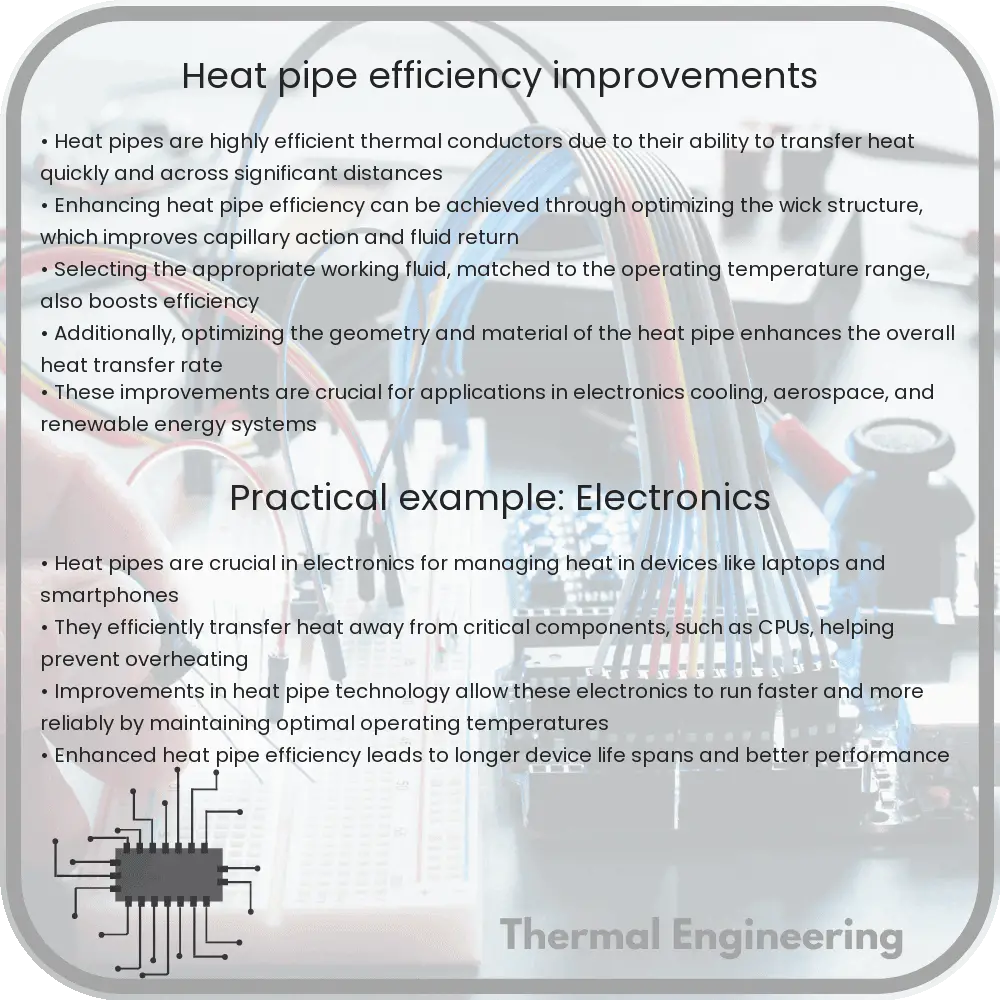
Heat pipes are devices that exploit the principles of heat transfer and thermodynamics to efficiently manage the transfer of heat between two interfaces. They are widely used in applications ranging from electronics cooling to renewable energy systems. Improving the efficiency of heat pipes is crucial for enhancing the performance and sustainability of such systems. This article explores the various strategies and technologies that have been developed to improve the efficiency of heat pipes.
Key Factors Influencing Heat Pipe Efficiency
Several parameters influence the operational efficiency of heat pipes, including:
- Working Fluid: The choice of fluid significantly affects heat transfer rates. Common fluids include water, ammonia, and acetone, each suitable for different temperature ranges and heat flux conditions.
- Material of Construction: The thermal conductivity of the material from which the heat pipe is made also plays an essential role. Copper, for instance, is frequently used due to its high thermal conductivity.
- Surface Tension: The wicking material and its structure inside the pipe affect the capillary pressure, which helps in driving the fluid back from the condenser to the evaporator.
- Operational Temperature: The efficiency of a heat pipe is also dependent on the operational temperature, which should ideally be within the range where the working fluid has the best phase change characteristics.
Technological Advances in Heat Pipe Efficiency
Recent advancements in materials science and engineering have led to several innovative approaches to increase heat pipe efficiency:
- Nano-fluids: Utilizing fluids with suspended nanoparticles (nano-fluids) has been shown to enhance thermal conductivity and heat transfer capability, improving the overall effectiveness of heat pipes.
- Composite Wick Structures: Developing complex wick structures with layers of different fibrous materials can optimize the capillary pumping effect, thereby enhancing the internal cycle efficiency of heat pipes.
- Vapor Chamber Technology: Integrating the traditional heat pipe design into a broader vapor chamber allows a more uniform distribution of heat over larger surfaces, ideal for cooling in high-performance computing and electronics.
- Flexible Heat Pipes: The use of bendable materials permits the deployment of heat pipes in scenarios where space and form factor are constraints, allowing better integration into compact systems.
Quantitative Measures of Improvement
Improvements in heat pipe efficiency can be quantitatively assessed by parameters such as:
- Thermal Resistance: A lower thermal resistance indicates higher efficiency, given by the equation R = L / (k * A), where L is the length of the heat pipe, k is the thermal conductivity of the material, and A is the cross-sectional area.
- Heat Transfer Coefficient: An increased heat transfer coefficient suggests improved performance in heat exchange capabilities.
- Heat Flux: The capability to operate at higher heat flux while maintaining temperature stability is a critical factor for the performance improvement in heat pipes.
In conclusion, by leveraging advanced materials, innovative designs, and enhanced fluid dynamics, the efficiency of heat pipes can be substantially improved, leading to more effective heat management solutions in various applications. These improvements not only contribute to more sustainable technologies but also pave the way for new applications and developments in thermal management systems.
Future Outlook and Research Directions
Continued research and development in heat pipe technology focus on exploiting new materials such as graphene and further advancements in nano-fluids. Moreover, the integration of artificial intelligence to optimize the design and operational parameters of heat pipes presents a promising avenue for future exploration. Such innovations could lead to even more significant leaps in heat pipe efficiency, expanding their applications in energy-sensitive and high-tech environments.