Learn about heat transfer in gas turbines, including conduction, convection, radiation, cooling methods, and their impact on turbine efficiency.
Understanding Heat Transfer in Gas Turbines
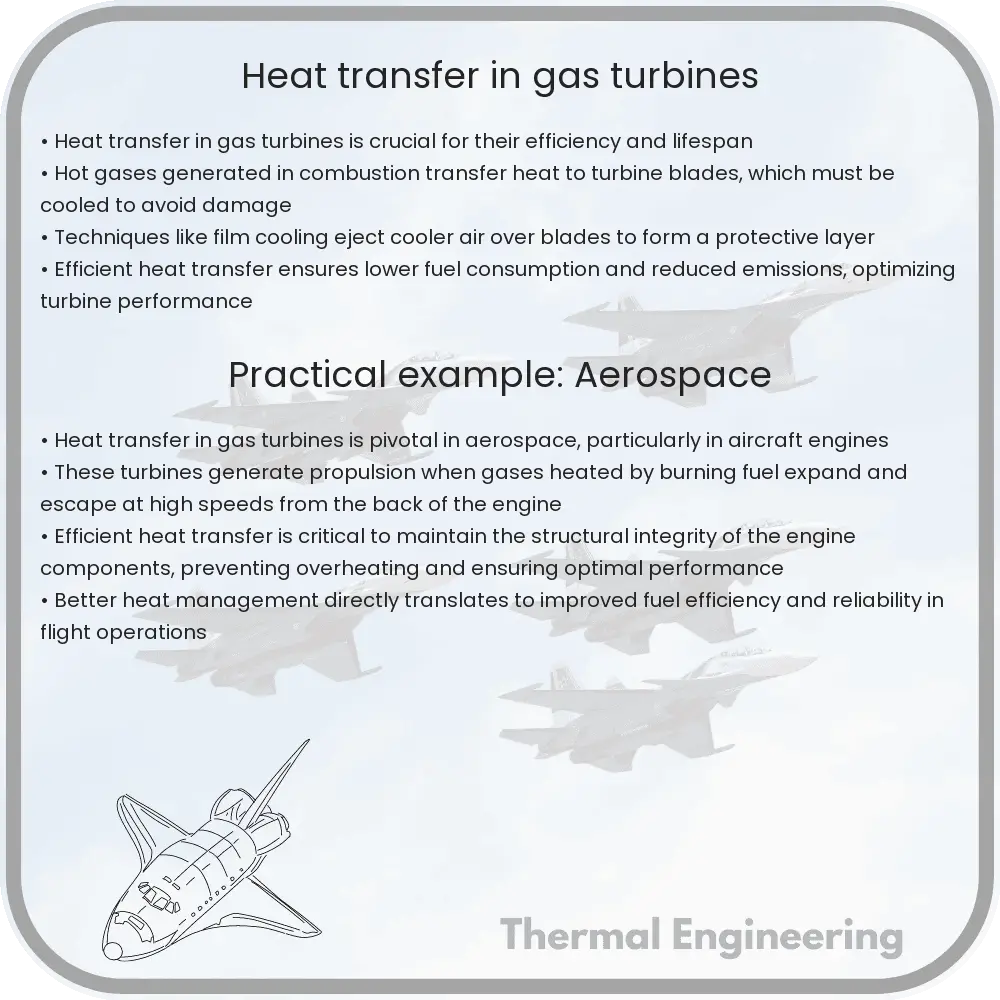
Gas turbines are fundamental components used in a variety of applications including power generation, aircraft propulsion, and large ships. A key factor affecting the efficiency and functionality of a gas turbine is the management of heat transfer within the system. This article explores the basics of heat transfer in gas turbines and its significance in turbine performance.
Basics of Gas Turbines
Gas turbines operate on the basic principles of thermodynamics and fluid dynamics. They convert the energy stored in a fuel (typically natural gas or aviation fuel) into mechanical energy. This conversion occurs through several stages:
1. Air intake and compression
2. Fuel combustion, producing high-temperature, high-pressure gas
3. Expansion of gas through a turbine, generating mechanical power
4. Exhaust.
Heat transfer in each of these steps is a critical factor influencing efficiency and operational limits of the turbine.
Types of Heat Transfer in Gas Turbines
In gas turbines, heat transfer occurs primarily through three modes: conduction, convection, and radiation.
- Conduction is the transfer of heat through materials without the movement of the material itself. In turbines, this is most relevant in components like the turbine blades and shaft.
- Convection involves the transfer of heat by the movement of fluids (in this case, the hot gas passing through the turbine). It is the dominant form of heat transfer in the combustion chamber and across the turbine blades.
- Radiation is the heat transfer through electromagnetic waves. It plays a role in high-temperature sections of the turbine such as the combustor.
Importance of Cooling in Gas Turbines
Overheating is a major limitation in gas turbine operation. The high temperatures generated in the combustion process can deteriorate turbine blades and other components, reducing their lifespan and efficiency. Therefore, efficient cooling methods are integral to turbine design. The primary cooling techniques used include:
- Air Cooling: Cooler air from the compressor is often redirected to pass over or within turbine components to absorb heat.
- Steam Cooling: For higher efficiency, steam can be used for cooling parts of the turbine exposed to the highest temperatures.
- Cooling Coatings: Ceramic or metallic coatings on turbine blades help to reflect heat and reduce thermal strain.
Mathematical Description of Heat Transfer
Heat transfer in engineering can often be described using Newton’s Law of Cooling, which is expressed as:
Q = h*A*ΔT
Where:
- Q is the rate of heat transfer
- h is the heat transfer coefficient
- A is the surface area through which heat is being transferred
- ΔT is the temperature difference across the surface
This equation highlights the relationship between heat transfer rate and the gradient in temperature, area of exposure, and the efficacy of the heat transfer medium (denoted by h). Understanding and optimizing these parameters is crucial for enhancing turbine efficiency and durability.
Conclusion
Heat transfer in gas turbines is a complex but fascinating subject impacting turbine efficiency, longevity, and performance. Advances in cooling technology and thermal barrier coatings continue to drive the evolution of more robust and efficient gas turbine designs. Understanding these heat transfer processes and technologies is essential for anyone involved in the design, operation, or maintenance of gas turbines.