Explore the importance of thermal management in enhancing the efficiency and lifespan of photovoltaic panels.
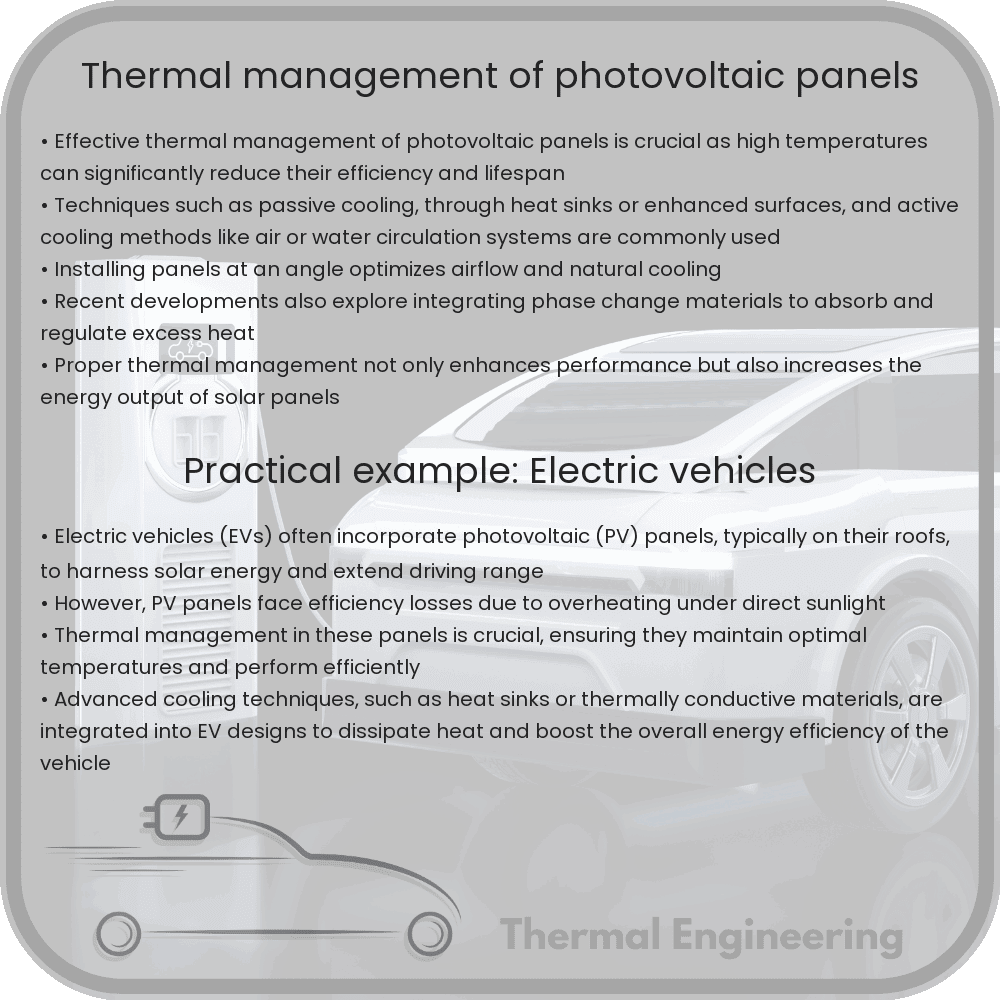
Understanding Thermal Management in Photovoltaic Panels
Photovoltaic (PV) panels are a cornerstone of renewable energy, converting sunlight directly into electricity. However, a critical challenge affects their efficiency: temperature. As the panels absorb solar radiation, they also heat up. Higher temperatures can significantly reduce the output and lifespan of PV panels. This article explores the significance of thermal management in photovoltaic systems and various methods used to maintain optimal panel temperatures.
The Impact of Temperature on PV Efficiency
The performance of photovoltaic panels decreases with temperature increase. This reduction in efficiency is primarily due to the physical properties of the semiconductor materials used in PV cells. As the temperature rises, the semiconductor’s band gap decreases, resulting in lower voltage output. Moreover, an increase in temperature also increases the rate at which electrons and holes recombine, further reducing the electrical output.
Empirically, the efficiency of a typical silicon PV cell declines by about 0.4% for every 1 degree Celsius increase in temperature. This sensitivity is quantified by the temperature coefficient, typically found in the specifications of PV modules.
Methods for Thermal Management
- Cooling Systems: Active and passive cooling systems are essential for managing the temperature of PV panels. Active cooling may involve using water or air to directly cool the panels. For instance, water can be circulated at the back of the panels to absorb heat, while air cooling could involve forced ventilation systems.
- Radiative Cooling: This passive cooling technique involves designing the panel surfaces to emit infrared radiation, helping to radiate heat back to the atmosphere during cooler periods of the day or night.
- Heat Sinks: Adding a heat sink to the back of photovoltaic panels can enhance heat dissipation. Materials with high thermal conductivity like aluminum are typically used for this purpose.
- Improved Materials: Research continues into developing materials with lower temperature coefficients. Using materials that inherently manage heat better can directly enhance the overall efficiency of the PV system.
- Mounting Techniques: Certain mounting techniques may mitigate heat build-up. Elevated or rack-mounted panels allow for air circulation around the panels, which can aid in cooling.
Advances in Technology and Materials
Technological innovations continue to improve the thermal management of PV panels. For instance, phase change materials (PCMs) that melt and solidify at certain temperatures can effectively manage excess heat by absorbing and releasing latent heat. Additionally, nano-fluids and advanced geometrics for heat sinks are being explored to enhance the surface area and improve heat dissipation rates.
Conclusion
Efficient thermal management in photovoltaic panels is vital for maximizing their output and durability. By effectively managing the temperature, we can ensure that solar panels operate at optimal conditions, thereby increasing both their efficiency and lifespan. As research continues, it is likely that new materials and technologies will further enhance the capabilities of photovoltaic systems to manage thermal energy, making solar power an even more attractive option for sustainable energy production.